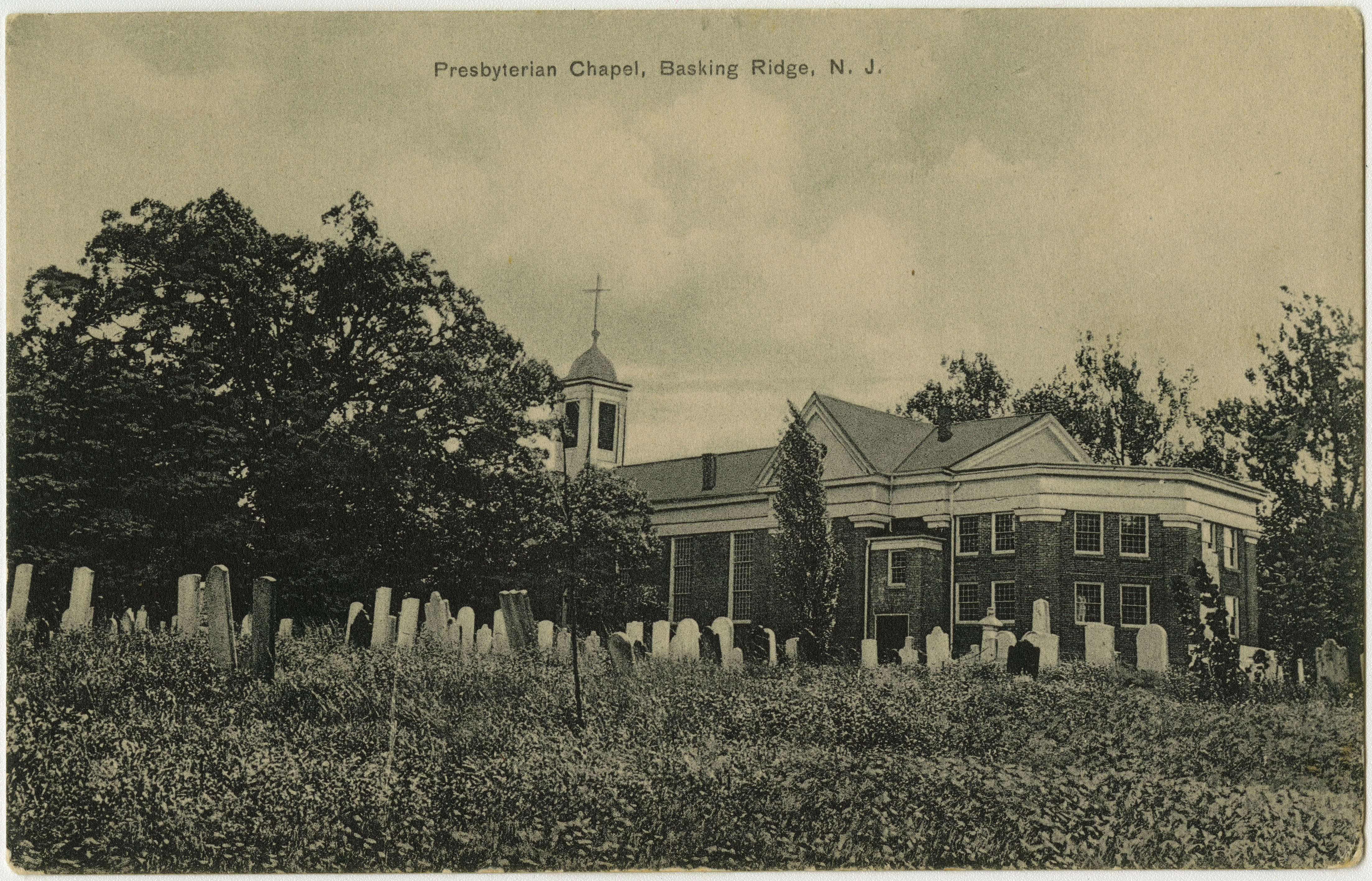
Presbyterian Church in Basking Ridge
For roughly six centuries, a white oak tree grew in the churchyard at 1 East Oak Street in Basking Ridge, New Jersey. It was already ancient when the Presbyterian congregation was founded here in 1717. It was enormous -- nearly 100 feet tall with a crown spread of more than 130 feet -- when 5,500 French soldiers under the comte de Rochambeau marched past it in 1781, heading south to the battle at Yorktown that would end the Revolutionary War. And it was dying, slowly and publicly, when arborists took it down over three days in April 2017. A young white oak grown from one of the old tree's acorns now stands in its place, a sapling in the shadow of a story.
Before the Republic
The congregation dates to 1717, which makes it older than the nation it would watch come into being. Basking Ridge sits in the Somerset Hills of north-central New Jersey, and in the early 18th century it was a settlement at the edge of the colonial frontier. The Presbyterians who gathered here were Scots-Irish and English, part of the wave of Protestant migration that filled the New Jersey interior in the decades before independence. They built their first meetinghouse on this site, and the oak tree -- already estimated at several hundred years old -- became the landmark that defined the churchyard. By the time of the Revolution, the tree and the church were already inseparable.
Rochambeau's March
In the summer of 1781, the French general Jean-Baptiste Donatien de Vimeur, comte de Rochambeau, led 5,500 troops south from Newport, Rhode Island, to join George Washington's Continental Army for the campaign that would end the war. Their route passed through Basking Ridge, and the great oak stood witness. The march to Yorktown is one of the decisive movements in American military history -- without French reinforcement, the siege that forced British General Cornwallis to surrender might never have happened. Today, the church is listed among the historic sites preserved along the Washington-Rochambeau Revolutionary Route, a reminder that the road to independence ran through quiet New Jersey towns as surely as it ran through battlefields.
Brick, Glass, and Greek Revival
The present church building was constructed in 1839, replacing the earlier structure. It is a handsome rectangle of red brick on a stone masonry foundation, 72 feet by 46 feet. Five tall windows -- 14 feet high and 5 feet wide -- line each long wall, their panes arranged in a distinctive 30-over-30-over-30 pattern across three sashes. As of a 1974 survey, much of this glass appeared to be original, giving the sanctuary a quality of light that modern windows cannot replicate. The style is Greek Revival, restrained and symmetrical, reflecting the mid-19th century taste that reshaped New England and mid-Atlantic churches. The Historic American Buildings Survey inventoried the church in 1939, and it was added to the National Register of Historic Places in 1974.
The Death of the Old Oak
By the early 2010s, the white oak was in decline. Estimated at 600 years old, it had outlived most trees of its species by centuries. News coverage in 2016 tracked its deterioration: CBS News called it the oldest white oak in North America, and the community rallied to preserve it. Arborists tried to extend its life, but by September 2016 the tree was declared dead. The removal took three days, finishing on April 26, 2017. The Associated Press covered the felling, and the story was picked up nationally -- a 600-year-old witness to history, finally gone. But the churchyard is not empty. A young white oak, grown from an acorn of the old tree, has been planted where its ancestor stood. If it thrives, it will shade this ground for centuries more, growing into a world its parent could not have imagined.
From the Air
Located at 40.707°N, 74.549°W in the Basking Ridge section of Bernards Township, Somerset County, New Jersey. The church is at 1 E. Oak Street, identifiable from low altitude by the churchyard and surrounding mature trees in the village center. Nearest airports: Somerset Airport (SMQ) approximately 7 nm west, Morristown Municipal (MMU) approximately 10 nm north. The church sits in the historic core of Basking Ridge, a compact village within the broader suburban landscape of the Somerset Hills.