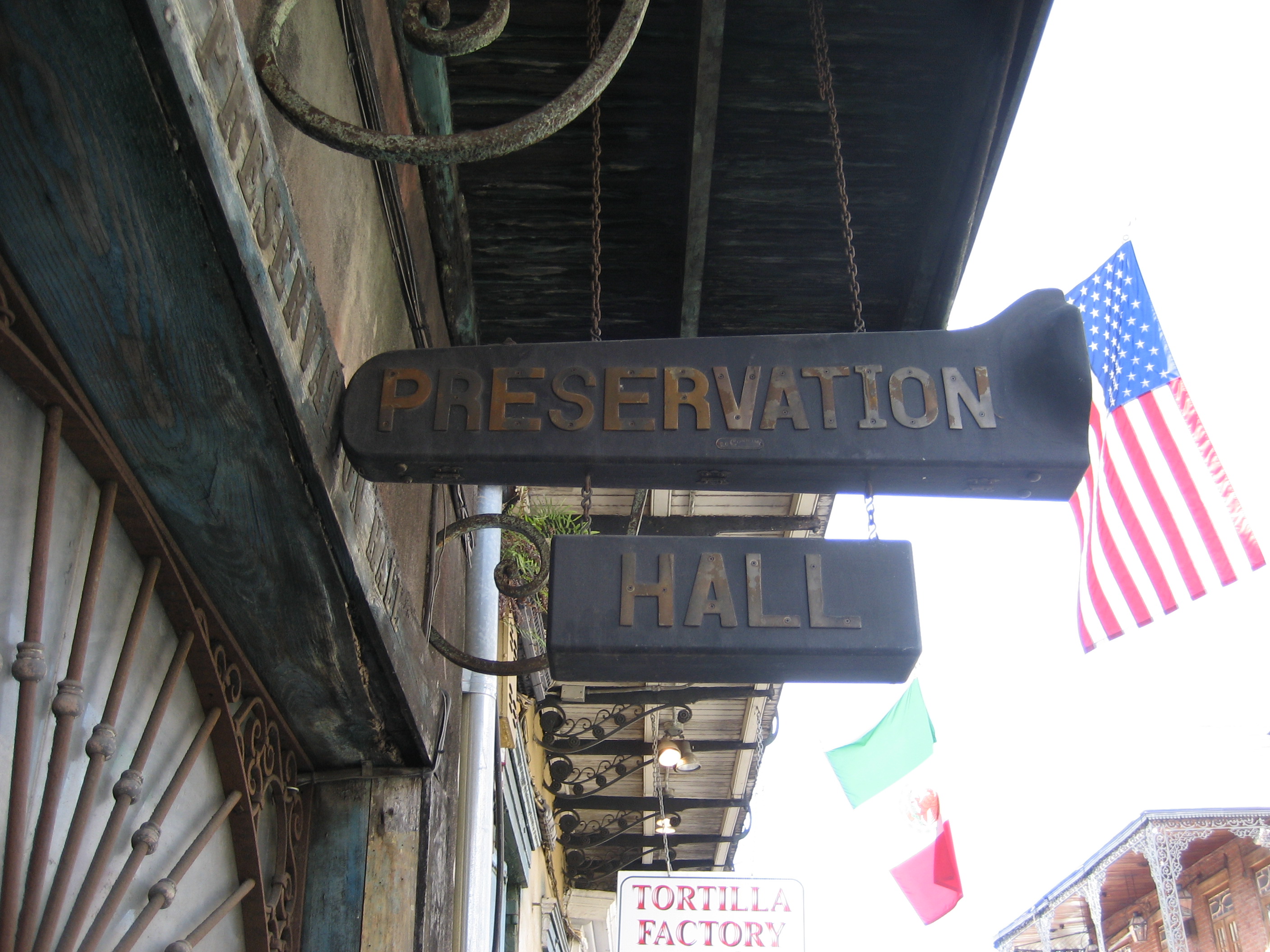
Preservation Hall
There is no bar, no air conditioning, no amplification. The wooden benches are worn smooth, the plaster walls are cracked and dimly lit, and the musicians sit so close you can watch the spit valves drip. Preservation Hall at 726 St. Peter Street in the French Quarter does not sell an experience; it simply is one. Since 1961, this intimate room inside an early 19th-century Creole townhouse has served as the living sanctuary of traditional New Orleans jazz, the place where musicians in their sixties, seventies, and even nineties played the music that the modern world was forgetting.
The Art That Listened
In the 1950s, Larry Borenstein, an art dealer from Milwaukee, ran a small gallery called Associated Artists at 726 St. Peter Street. Business was slow, so Borenstein began inviting local jazz musicians to play informal rehearsal sessions in the gallery, hoping the music would attract foot traffic. It worked, but not the way he intended. People came for the jazz and ignored the paintings. By 1961, the music had fully eclipsed the art, and Borenstein turned management over to Ken Grayson Mills and Barbara Reid, who christened the venue Preservation Hall. That same year, a young couple from Pennsylvania wandered in on what was supposed to be a brief honeymoon stopover. Allan Jaffe, a tuba player with a freshly minted Wharton School of Business degree, and his wife Sandra, who had worked at a Philadelphia advertising agency, had planned to pass through New Orleans on their way home from Mexico City. They never quite left.
No Drinks, No Ads, No Compromise
When Borenstein offered the Jaffes management of the Hall in September 1961, Allan accepted with a vision that was radical in its simplicity: the music and nothing else. He served no alcohol, used no microphones, and refused to advertise. What he did was hire aging Black musicians who were struggling with poverty, racism, and illness, giving them a stage and a steady paycheck during the Jim Crow era. Preservation Hall became one of the rare spaces in the segregated South where racially integrated bands played to racially integrated audiences. The performers included pianist Sweet Emma Barrett, trumpeter Kid Thomas Valentine, brothers Percy and Willie Humphrey, and clarinetist George Lewis, whose international reputation drew fans from as far as Japan. In 1963, Allan organized the Preservation Hall Jazz Band for a string of Midwest performances. The tour's success launched decades of international touring that carried traditional New Orleans jazz to concert halls around the world.
A Threadbare Cathedral
The building itself is part of the experience. The early 19th-century structure carries Spanish colonial and Creole architectural influences typical of the French Quarter, with weathered shutters and iron detailing on its facade. Inside, the performance space is deliberately modest: a small room with wooden benches, floor cushions for those willing to sit low, and standing room along the walls. The absence of modern comforts is intentional. Without air conditioning, the humid New Orleans air hangs heavy; without amplification, the brass and reed instruments fill the room with unmediated sound. The acoustics, shaped by plaster walls and low ceilings, create an intimacy impossible to replicate in larger venues. Every crack in the wall, every scuff on the floor, testifies to the tens of thousands of performances that have taken place here. The weathered interior has become so iconic that a perfume company could bottle its atmosphere and people would buy it.
Surviving the Storm
When Hurricane Katrina struck in 2005, Preservation Hall sustained roof damage but escaped the catastrophic flooding that devastated much of New Orleans. The greater threat was to the community itself. Musicians scattered across the country, and it took nearly a year to reassemble enough of the musical community to resume nightly concerts. Ben Jaffe, Allan and Sandra's son who had taken over as creative director following his father's death in 1987, spearheaded the recovery. He created the New Orleans Musicians Hurricane Relief Fund, organizing benefit concerts that raised money to help displaced artists return and rebuild. The Hall reopened, and the Preservation Hall Jazz Band went on to even broader acclaim, collaborating with artists ranging from the Foo Fighters to My Morning Jacket. In 2025, the venue expanded into the adjacent historic building at 730 St. Peter Street, once New Orleans' first theater, adding space for artist residencies and jazz education while keeping the original performance room exactly as it has always been.
The Sound That Stays
Preservation Hall operates today much as it did in 1961. Shows run nightly, with three sets per evening. There is still no bar, still no air conditioning, and the cover charge remains modest. The Preservation Hall Jazz Band, now a globally touring act, returns regularly to its home stage. The Preservation Hall Foundation supports music education programs, including a brass band book initiative that introduces young musicians to the tradition. The Hall's influence extends far beyond its modest footprint. It demonstrated that traditional jazz was not a museum piece but a living art form, capable of drawing packed houses night after night for over six decades. For the musicians who have played here, from George Lewis in the early days to the current ensemble, the cramped room on St. Peter Street is not a relic. It is proof that some things do not need to be modernized to remain vital.
From the Air
Located at 29.958N, 90.065W in the heart of the French Quarter, on St. Peter Street between Bourbon and Royal. The small Creole townhouse is not individually visible from altitude, but the French Quarter grid is unmistakable from the air with the curve of the Mississippi River defining its southern edge. Nearest airports: Louis Armstrong New Orleans International (KMSY), approximately 11 nm west; Lakefront Airport (KNEW), about 5 nm north. Best appreciated in the context of the French Quarter's dense historic streetscape, visible at 1,500-2,500 ft AGL.