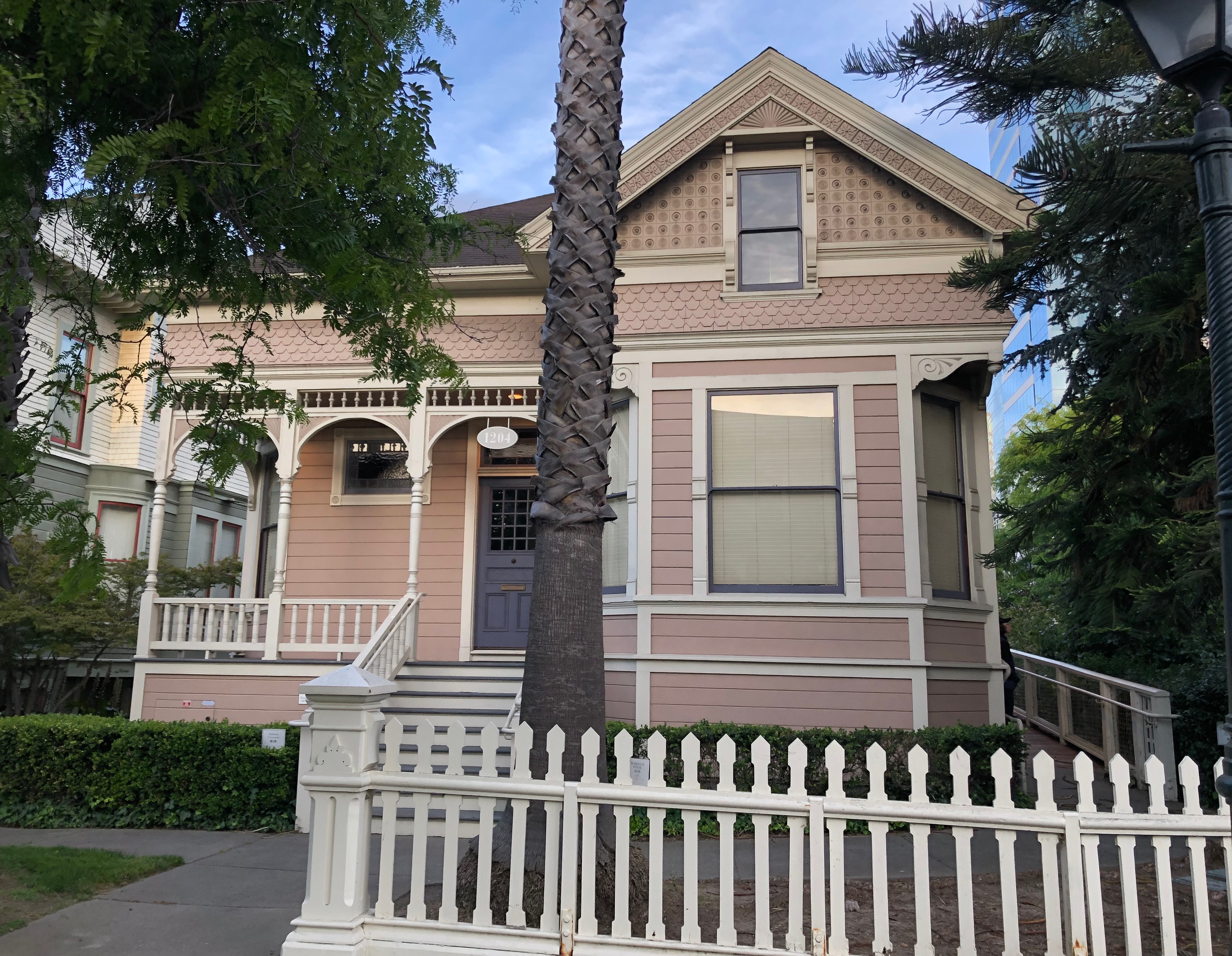
Preservation Park
Lilly Remillard tutored Jack London in a Queen Anne house that now stands two miles from where it was built. The house moved because the alternative was a wrecking ball, and in Oakland, where freeways and urban renewal consumed whole neighborhoods of Victorian architecture, moving a house was sometimes the only way to save it. Preservation Park gathers sixteen of these survivors — five on their original foundations, eleven transplanted from elsewhere in the city — and arranges them along landscaped paths to recreate something that no longer exists anywhere else in downtown Oakland: a block that looks the way the city looked in the 1890s.
Dentists, Tailors, and Train Painters
The houses that make up Preservation Park were built by people whose occupations read like a cross-section of 19th-century Bay Area commerce. Charles O. Park painted train cars for the Central Pacific Railroad; his Italianate villa originally stood at 7th and Grove and was moved twice before reaching its current location. Henry Knox was a San Francisco dentist whose house on what is now 28th Street, in the area called Pill Hill, was the last home relocated to the park. William Bartling partnered in a San Francisco bookbinding firm. Reinhold Bauske, another dentist, built a Queen Anne cottage for his wife, Hazel, near Glen Echo Creek. The Jacobs House belonged to a Prussian-trained tailor whose next-door neighbor on 16th Street was the pianist and painter Pauline Powell Burns. These were not the city's wealthiest residents. They were the professional middle class, and their houses reflect that stratum's aspirations — ornamental but not ostentatious, built to last but vulnerable to progress.
The Brickmaker's Legacy
Pierre Remillard made bricks. His company supplied the materials for the nearby First Unitarian Church of Oakland, and his Queen Anne house became one of the park's most storied buildings. It was here that Lilly Remillard tutored a young Jack London, years before he would write The Call of the Wild and become one of America's most famous authors. The connection is almost too literary — the brickmaker's wife shaping the mind of a writer who would chronicle the raw edge of human and animal survival. A few doors down stands the Thornton House, built during the era when Jane Sather's house and garden occupied the lot across the street. Sather would go on to donate both Sather Gate and Sather Tower to UC Berkeley. The Thornton House later passed to Orrin Gowell, who became an architect in the office that designed the 1923 Tribune Tower. Oakland's architectural past loops back on itself here.
Halls of the Elite
Not everything in Preservation Park is a private home. The Nile Club, a members-only organization of Oakland's male elite, built a Craftsman-style theater next to the Ginn House. Designed by Charles W. Dickey, who also worked on the Claremont Hotel, Nile Hall later served as a USO facility during World War II. The Ginn House itself was commissioned by Frederick Burrell Ginn and his wife Mary Crocker from architect A. Page Brown, who would go on to design the San Francisco Ferry Building. The Trowbridge House, in the Stick Style, was built by multimillionaire Frederick William Delger as a wedding gift for his daughter Lillie and her husband Henry. It originally stood behind the Fox Oakland Theatre. Even the park's non-residential structures carry weight: a cast-iron fountain forged in Paris, featuring the moon goddess Diana with acanthus leaf ornament, once stood at the Latham House and Gardens at what is now 17th and Jackson Streets.
Rescued from the Wrecking Ball
The eleven houses that were relocated to Preservation Park came from scattered sites across Oakland, each one displaced by the forces that reshaped American cities in the mid-20th century: freeway construction, commercial development, urban renewal. The Bartling House originally stood where the 14th Street freeway overpass now runs. The Robinson House was built in Fruit Vale — now Fruitvale — before being uprooted. Moving a Victorian house is neither cheap nor simple, requiring the severing of utility connections, the navigation of city streets on flatbed trucks, and the construction of a new foundation at the destination. That eleven houses survived this process and now stand together in a coherent ensemble is a testament to a preservation movement that gained momentum in Oakland during the 1980s and 1990s, when the city's redevelopment agency partnered with preservationists to create the park.
A Neighborhood Without Residents
Today, Preservation Park functions as a public space and office complex. Nonprofits occupy many of the buildings. The White House — built for Ellen Gould White and James White, who worked within the Seventh-day Adventist church and launched the paper Signs of the Times — now houses the park's administrative offices and the Rio California cafe. Weddings are held in the gardens. The Latham-Ducel Fountain anchors the end of 13th Street where it enters the park. The buildings themselves are not open to the public, but the grounds are, and walking the paths between the houses offers something rare in a modern downtown: a sense of architectural continuity, of a neighborhood that hangs together visually even though its components arrived from different corners of the city. Adjacent to the African American Museum and Library at Oakland, Preservation Park sits at the intersection of Oakland's preserved past and its ongoing story.
From the Air
Located at 37.805°N, 122.278°W in downtown Oakland, California, bordered by 12th Street, Castro Street, 14th Street, and Martin Luther King Jr. Way. The park's cluster of Victorian-era buildings is a distinctive visual contrast to the surrounding modern downtown. Look for the compact grouping of historic rooflines near the I-980 freeway corridor. Adjacent to the African American Museum and Library at Oakland. Nearest airports include Oakland International (KOAK, ~7 nm south) and San Francisco International (KSFO, ~15 nm southwest). Clear visibility typical except during marine layer intrusion.