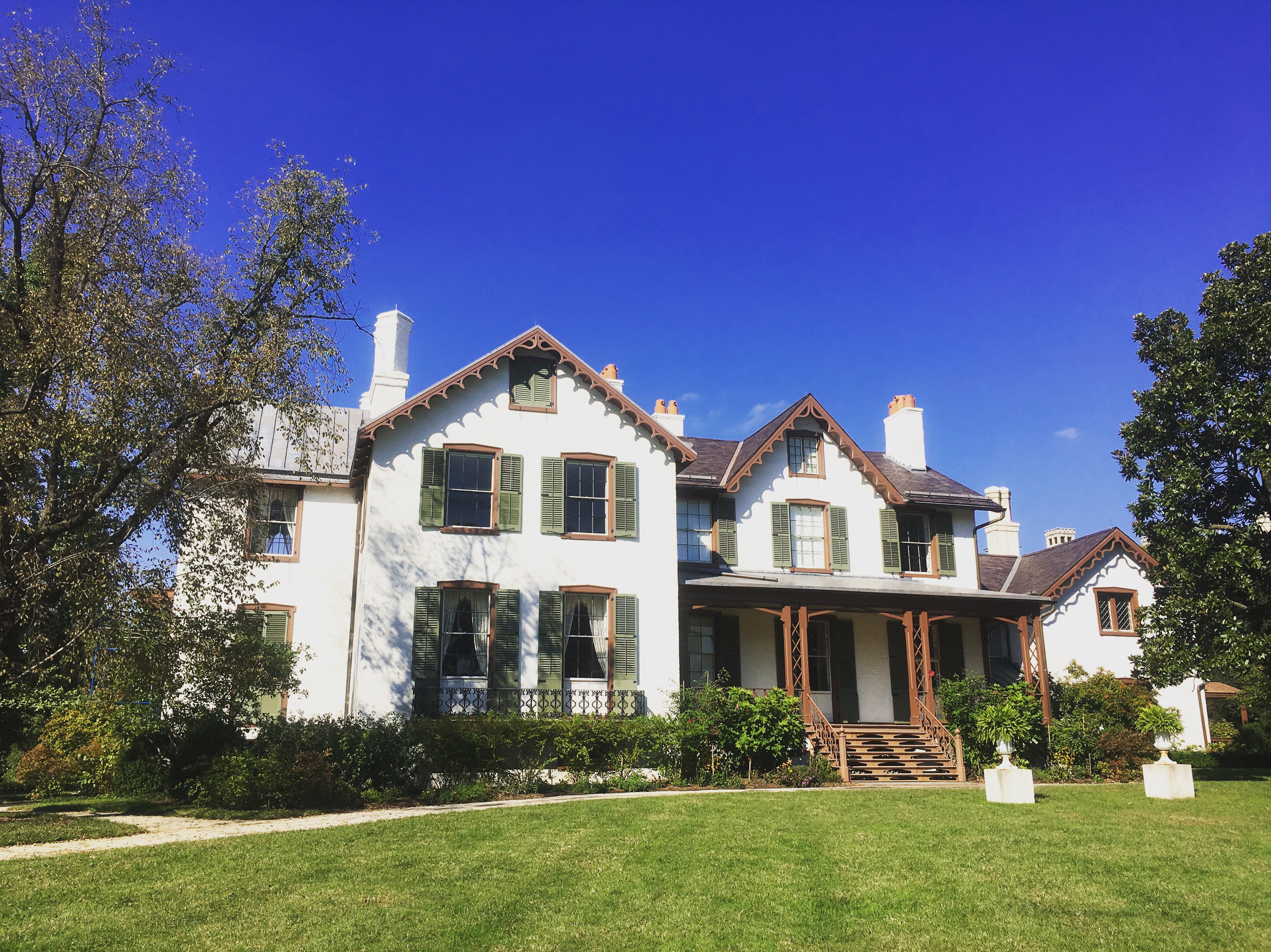
President Lincoln's Cottage at the Soldiers' Home
Walt Whitman saw him almost every day in the summer of 1863 -- a tall man in plain black clothes, "somewhat rusty and dusty," riding a gray horse between the White House and a hilltop three miles north. "I saw very plainly the President's dark brown face, with the deep cut lines, the eyes," Whitman wrote in the New York Times, "always to me with a deep latent sadness in the expression." The two men exchanged bows. Lincoln was riding to and from the place where he did some of his most consequential thinking: a Gothic Revival cottage on the grounds of the Soldiers' Home, sitting atop the third-highest point in Washington, D.C.
A Banker's Country House, a President's Refuge
The cottage was never built for a president. George Washington Riggs, the banker who would go on to establish Riggs National Bank, constructed it between 1842 and 1843 as a private residence in the fashionable Gothic Revival style. When the federal government acquired the surrounding property for the Soldiers' Home -- a retirement community for military veterans -- the cottage came with it. President James Buchanan was the first to use it as a summer retreat from 1857 to 1861, escaping the oppressive humidity and disease that plagued the low-lying capital. But it was Lincoln who would make the place historic. He and his family lived there seasonally from June through November, 1862 to 1864, commuting to the White House each day. After Lincoln, Presidents Rutherford B. Hayes and Chester A. Arthur continued the tradition, making it one of Washington's earliest Summer White Houses.
Where Freedom Was Written in Draft
During his first summer at the cottage in 1862, Lincoln drafted the preliminary version of the Emancipation Proclamation. The document that would declare freedom for millions of enslaved people took shape not in the formal rooms of the Executive Mansion but in this quiet hilltop retreat, surrounded by wounded soldiers recuperating at the Home and the graves of veterans buried on its grounds. The contrast was deliberate, or at least fitting -- Lincoln needed distance from the political machinery of downtown Washington to wrestle with the war's moral dimensions. The cottage gave him that distance, three miles of open road between the noise of governance and the clarity of purpose. He worked at a drop-lid walnut desk that still survives, the only known piece of furniture to have been used in both the White House and the cottage during Lincoln's era. The original desk now sits in the Lincoln Bedroom of the White House.
A Hilltop Between War and Peace
The Soldiers' Home campus was no idyll. The Civil War raged through Lincoln's time there, and the grounds were populated by veterans, some of them gravely wounded. The campus cemeteries hold approximately 450 Civil War veterans on the West Campus alone, with thousands more military and civilian burials on the East Campus. Lincoln's daily commute on horseback between the cottage and the White House was not without danger -- it passed through a city tense with wartime anxiety and Confederate sympathizers. Mary Todd Lincoln, despite the grief and turmoil that defined those years, remembered the place with tenderness. "How dearly I loved the Soldiers' Home," she wrote in 1865, the year her husband was assassinated. In 1889, the cottage was renamed Anderson Cottage after Brevet Major General Robert Anderson, one of the founders of the Soldiers' Home and the Union commander who defended Fort Sumter at the war's opening.
Rescued from Ruin
By the end of the 20th century, the cottage had fallen into neglect. In 2000, the National Trust for Historic Preservation placed it on its list of America's 11 Most Endangered Places. That same year, President Bill Clinton proclaimed approximately 2.3 acres of the Soldiers' Home grounds a National Monument. The National Trust undertook a careful restoration, completed in 2007, bringing the exterior back to its 1860s appearance under the standards of the National Park Service. The cottage opened to the public on February 18, 2008, accompanied by an adjacent visitor education center featuring exhibits on wartime Washington and Lincoln's role as commander-in-chief. A reproduction of Lincoln's writing desk was commissioned for display in the cottage. Today, the property is managed as an independent nonprofit, offering tours seven days a week -- a quiet counterpoint to the more famous Lincoln Memorial across the city.
From the Air
President Lincoln's Cottage sits at 38.94N, 77.01W on the grounds of the Armed Forces Retirement Home in the Petworth neighborhood of northwest Washington, D.C. It occupies one of the city's highest elevations, making the campus visible from the air against the surrounding urban landscape. Nearest airports: KDCA (Ronald Reagan Washington National, 5nm south), KADW (Joint Base Andrews, 10nm southeast). The cottage is approximately 3 miles due north of the White House, which can be traced along the route Lincoln rode daily. Best viewed at 2,000-4,000 feet AGL.