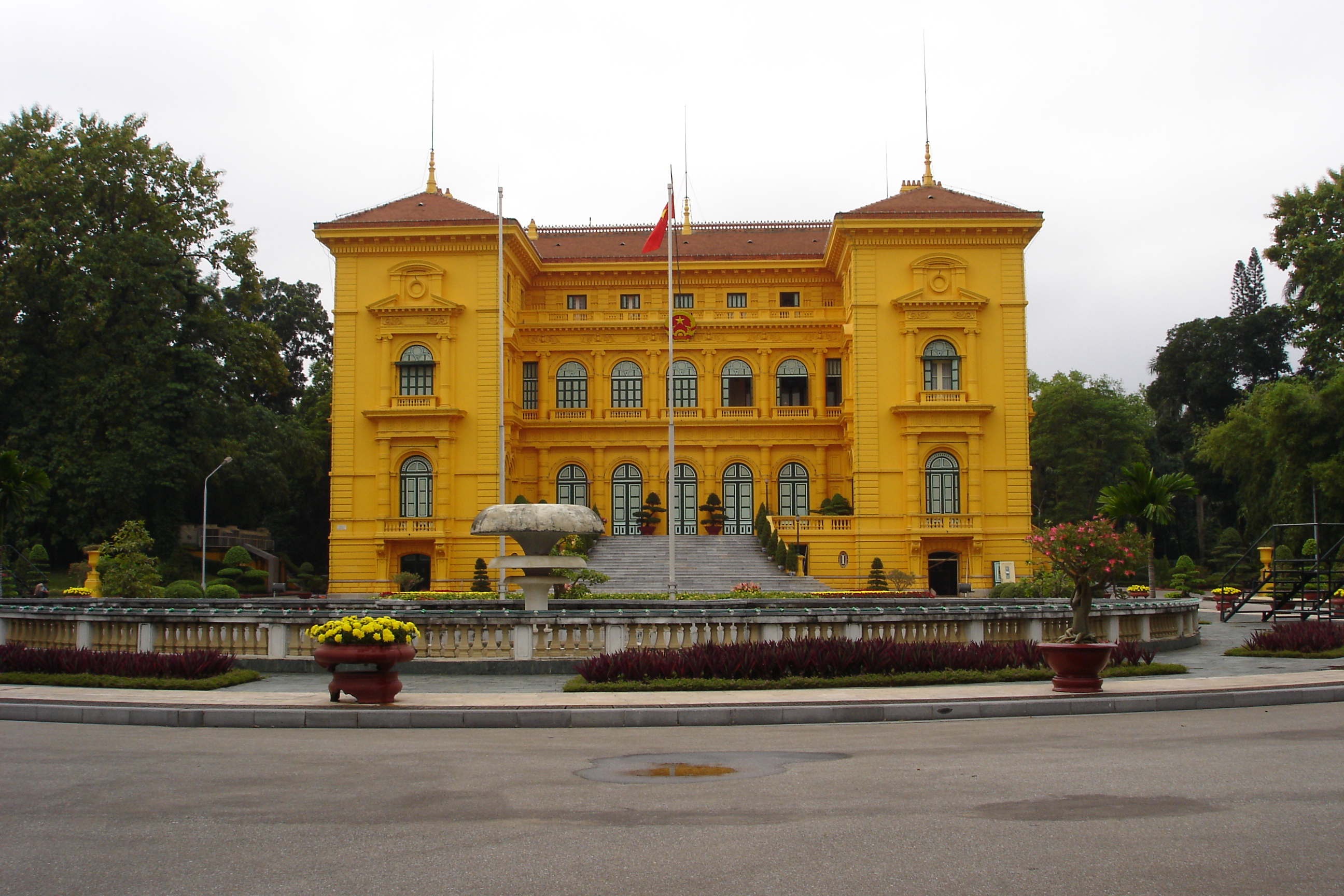
Presidential Palace, Hanoi
Ho Chi Minh could have had the grandest bedroom in Vietnam. When the country won independence in 1954, the Presidential Palace stood waiting for its new leader -- a soaring yellow confection of Italian Renaissance columns, wrought iron gates, and broken pediments, built to project French imperial power across Indochina. Ho declined. The palace was too lavish for a revolutionary who had spent decades in exile, too European for a country that had just fought to shed European rule. Instead, he had a traditional Vietnamese stilt house built on the palace grounds, with a carp pond beside it. The contrast between the two structures -- the colonial showpiece and the modest wooden house on stilts -- became one of the most potent symbols in modern Vietnamese history.
A Governor's Dream in Yellow
The palace was constructed between 1900 and 1906 by architect Charles Lichtenfelder to serve as the residence of the French governor-general of Indochina. The attribution is often incorrectly given to Auguste Henri Vildieu, who served as the official French architect for the colony, but Lichtenfelder designed the building. Its style is pointedly European -- aedicules, a formal piano nobile reached by a grand staircase, classical columns, and quoins -- all rendered in that distinctive mustard yellow that marks French colonial architecture across Southeast Asia. The only visual concession to its tropical location is the mango trees growing on the grounds. Behind its wrought iron gates flanked by sentry boxes, the palace announced a simple message: France intended to stay. The building served as the nerve center of colonial administration for half a century, hosting everything from state dinners to the bureaucratic machinery of empire.
The Stilt House and the Carp Pond
Ho Chi Minh's refusal to inhabit the palace was more than personal modesty -- it was political theater of the most effective kind. He continued to receive state guests in the grand building, understanding its diplomatic utility, but he lived and worked in a far simpler setting. The stilt house he built on the grounds followed traditional Vietnamese design: elevated on wooden pillars, open to breezes, surrounded by fruit trees and a pond stocked with carp. Ho lived in House No. 54 from 1954 to 1958 before moving to the stilt house. The juxtaposition was deliberate and legible to every Vietnamese citizen. Here was a leader who chose the architecture of the village over the architecture of the colonizer. In 1975, after reunification, the house and grounds were designated the Presidential Palace Historical Site, preserving both structures as a paired monument to the country's colonial past and revolutionary identity.
Power Still Walks These Halls
The palace remains a working seat of government. It hosts official meetings and state functions, and visiting heads of state still pass through its gates. In February 2019, the building drew global attention when Donald Trump met Kim Jong-un there for their second summit, the yellow facade flashing across television screens worldwide. Joe Biden visited for a state meeting in 2023. The palace itself is not open to the public, though visitors can walk the surrounding grounds for a fee, passing the stilt house, the carp pond, and the mango trees that have grown for more than a century. The Ho Chi Minh Mausoleum sits nearby, completing a cluster of sites that together narrate Vietnam's passage from colony to independent nation -- all within a few hundred meters in Hanoi's Ba Dinh district.
Two Architectures, One Story
Seen from above, the Presidential Palace complex reads as a diagram of twentieth-century Vietnamese history. The grand European structure, symmetrical and imposing, faces its ornamental gardens. Behind it, almost hidden among the trees, sits the small stilt house -- a domestic space scaled to one person rather than an empire. Visitors often describe the emotional shift of walking from one to the other: from the cool marble grandeur of colonial ambition to the warm wood and simple furnishings of a leader who chose austerity. The dining room and bedroom of Ho's house have been preserved as they were, modest spaces that feel more like a scholar's retreat than a head of state's residence. That contrast, maintained for decades now, continues to speak. The palace was built to impress. The stilt house was built to mean something else entirely.
From the Air
Located at 21.039N, 105.834E in Hanoi's Ba Dinh district. The yellow palace and surrounding grounds are visible near the Ho Chi Minh Mausoleum complex. Nearest airport is Noi Bai International Airport (VVNB), approximately 25 km to the north. The palace sits west of Hoan Kiem Lake and the Old Quarter. Best viewed at 2,000-3,000 feet for context of the governmental district.