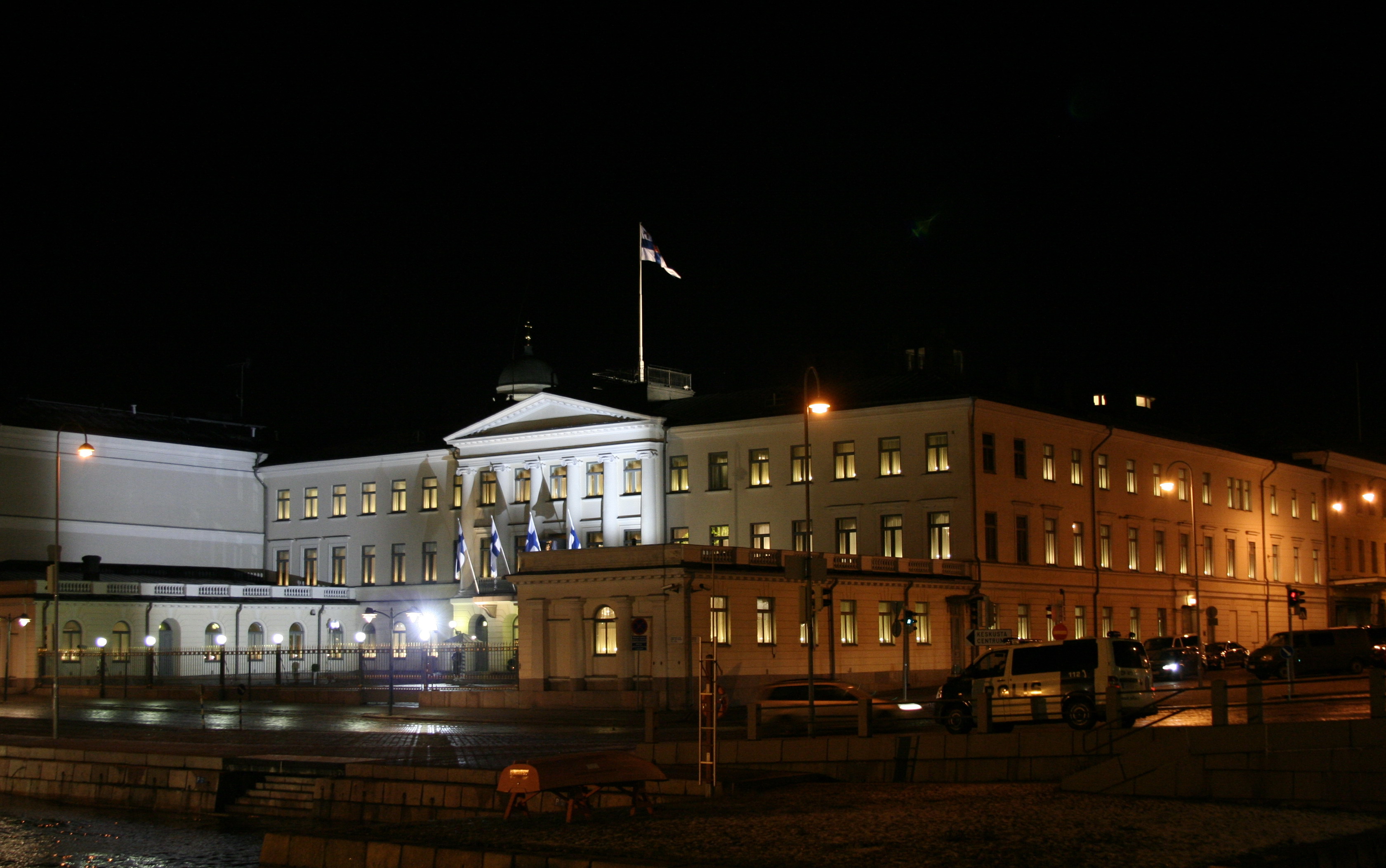
Presidential Palace, Helsinki
On 16 July 2018, in a press room overlooking Helsinki's Market Square, Donald Trump and Vladimir Putin walked out together to face the world's cameras. The building behind them had hosted such moments before. It is the Presidential Palace of Finland, and its job since 1845 has been to receive guests whose decisions ripple beyond its walls — first as a Russian emperor's residence, later as the Finnish presidency's official seat. The building itself was never meant to be either. A merchant built it in the 1820s as a stately home, and the imperial machine of three subsequent eras simply moved in.
A Merchant's House, Reluctantly Imperial
In the early 19th century the site held a salt warehouse — a working corner of a busy harbor. Then one of Helsinki's most prominent merchants, Johan Heidenstrauch, bought the entire lot. Between 1816 and 1820 he built himself a stately residence with two wings and a colonnaded central hall. The result was so grand that contemporaries thought it resembled a palace more than a merchant's home. They were not wrong, and the Russian government noticed. In 1837 the Heidenstrauch residence was purchased for 170,000 rubles to serve as the Governor-General of Finland's home. But Tsar Nicholas I had bigger ideas. He wanted Helsinki — capital of his Grand Duchy of Finland — to have an Imperial Palace where the Emperor of Russia could stay when he visited. So the merchant's mansion was rebuilt yet again.
Engel Builds Helsinki
The architect chosen for the rebuilding was Carl Ludvig Engel. If you have walked anywhere near Senate Square in Helsinki you have seen his work — the Lutheran Cathedral above the steps, the Government Palace, the University, the Senate building. Engel essentially designed neoclassical Helsinki out of nothing in the years after 1816, when the Russians moved Finland's capital from Turku and decided to build a properly imperial seat. Engel directed the palace renovation between 1843 and 1845; after his death his son Carl Alexander finished the work. Even Giacomo Quarenghi — the Italian architect who designed much of imperial Saint Petersburg — looked over the plans. The new wing along the north side of the courtyard contained a chapel, a ballroom, and a banquet hall on the second floor, all in direct connection with the original reception rooms. The palace was completed in 1845, then mostly stood empty.
The Tsars Who Came
It took nine years for any Romanov to actually visit. Nicholas I's son Grand Duke Constantine stayed for a month in February 1854 — the first imperial use of the building. After Nicholas I died in 1855, his son Alexander II turned out to be the palace's most active resident. He came in 1863 to open the Diet of Finland in the Great Ballroom, which had been converted into a Throne Room with the imperial throne placed on a dais. He returned in 1876 to open another session. The Throne Room continued to host the opening and closing of the Diet until 1906. Then in 1917 the Russian Revolution swept the empire away. Finland declared independence in December of that year, and after a brief and brutal civil war the new republic needed a presidential residence. The Imperial Palace became the Presidential Palace in 1919. The throne came down.
Where the World Comes to Helsinki
As one of three official residences of the Finnish president, the palace has hosted nearly every major figure of the post-war era. Royal visitors include Carl XVI Gustaf of Sweden, Olav V of Norway, Elizabeth II, Juan Carlos I, the Shah of Iran, and Emperor Akihito. American presidents Gerald Ford, Ronald Reagan, and George H. W. Bush have all stood in the same rooms. Pope John Paul II, Tito, Khrushchev, Yeltsin, Xi Jinping, Shinzō Abe — they have all been received here. The building has nearly 3,000 square meters of floor space, with private apartments for the president's family and offices for the Presidential Cabinet, but visiting heads of state stay elsewhere now, at Mäntyniemi or other state guesthouses. Helsinki has long been the chosen meeting ground when American and Russian leaders need neutral terrain. The 2018 Trump-Putin summit was the most recent example. The building that began as a salt warehouse continues to absorb history without remarking on it.
From the Air
The Presidential Palace stands at 60.17°N, 24.96°E, in central Helsinki on the north side of Esplanadi, overlooking Market Square (Kauppatori) and the South Harbour. From the air it appears as part of the dense pale neoclassical core that Engel built — distinguishable by its position directly on the harbor edge, with the Lutheran Cathedral's dome dominating the skyline immediately behind. EFHK (Helsinki Vantaa Airport) is 18 km north. From cruising altitude on transits across the Gulf of Finland between EETN (Tallinn, 90 km south) and EFHK, the central Helsinki peninsula is unmistakable. ULLI (St. Petersburg Pulkovo) lies 380 km east. The harbor with its ferries gives the best visual orientation for the palace location.