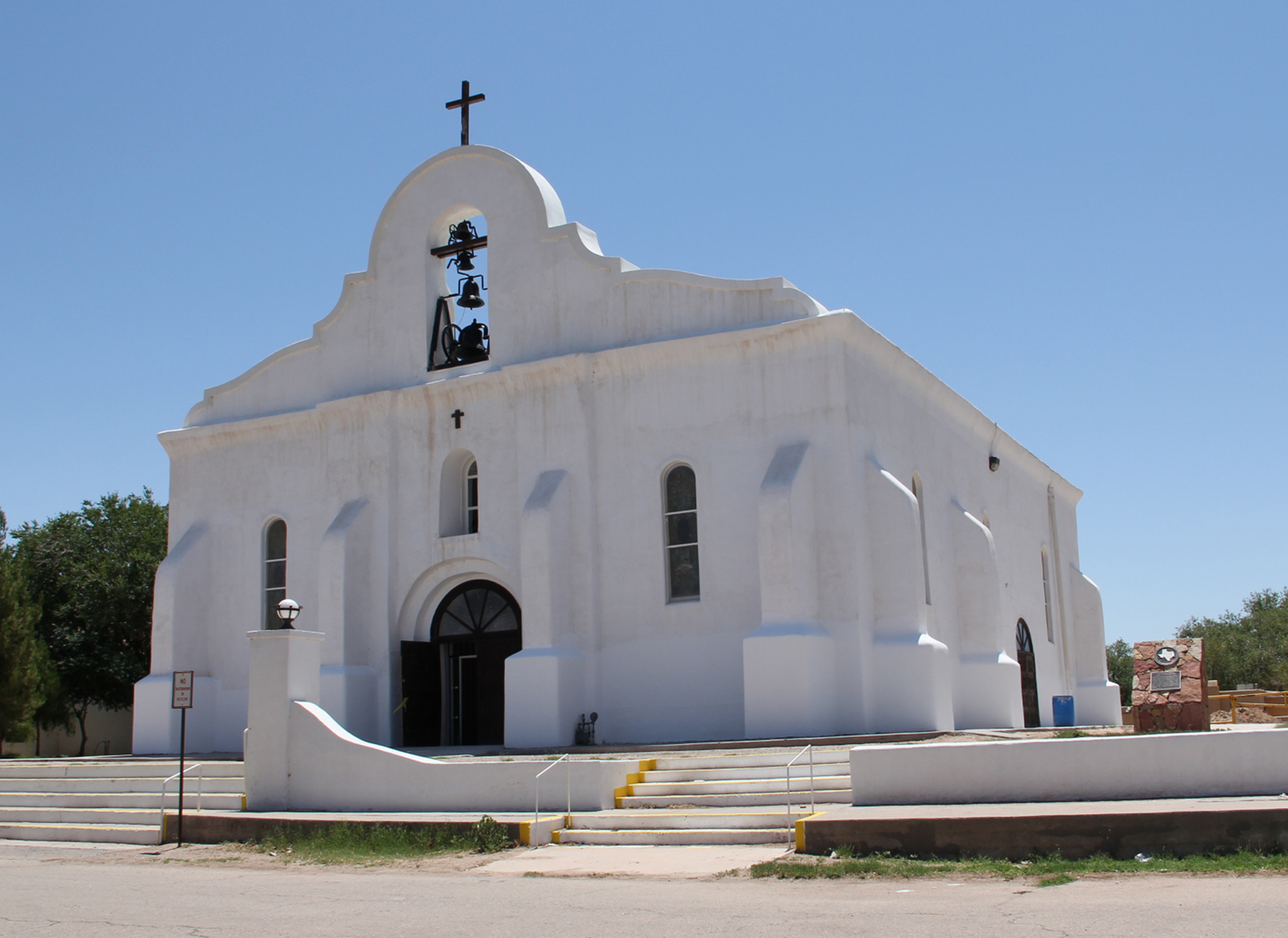
Presidio Chapel of San Elizario
In the dusty central square of San Elizario, Texas, seventeen miles southeast of El Paso, stands a simple whitewashed chapel that has anchored this community since 1877. But the sacred ground beneath it tells a much older story. Spanish soldiers established a presidio here in 1790 to protect travelers on the Camino Real, the royal highway connecting Mexico City to Santa Fe. The chapel that serves the town today is the fourth to occupy this site, its predecessors claimed by the unpredictable Rio Grande and the passage of empires.
Outpost on the Royal Highway
The presidio, or military outpost, was moved to this location in 1790 to guard one of the most important routes in colonial North America. The Camino Real stretched over 1,500 miles from Mexico City through Paso del Norte (now Ciudad Juarez) to Santa Fe. Soldiers stationed here protected not only travelers and settlers but also the nearby Ysleta and Socorro missions. For three decades, Spanish troops kept watch over this strategic point where the Rio Grande carved its path through the Chihuahuan Desert. The original chapel served the spiritual needs of these soldiers and their families, standing as a visible symbol of Spanish authority on the northern frontier.
Between Two Nations
When Mexico won independence from Spain in 1821, the military presence at San Elizario began to decline. Then in 1829, the Rio Grande demonstrated why building permanent structures near its banks was a gamble: floodwaters destroyed the chapel entirely. A replacement was built, only to see the region change hands again during the Mexican-American War. After 1848, San Elizario found itself on the American side of a newly drawn border. California volunteers garrisoned the presidio to prevent Mexican reoccupation, and by 1850 American troops had taken their place. The chapel continued to serve an increasingly diverse congregation as the town evolved from Spanish outpost to Mexican village to American settlement.
Fire and Rebirth
By the 1870s, the second chapel had become inadequate for the growing community. Construction of the present structure began, and in 1877 the new Presidio Chapel of San Elizario opened its doors. Built in the Spanish Colonial style with plastered adobe walls painted brilliant white, it reflected both European architectural influences and the practical building traditions of West Texas. The chapel's exterior appearance has remained remarkably unchanged since that time, though it nearly met the same fate as its predecessors. In 1935, fire badly damaged the building. The community rebuilt it, preserving its historic character while ensuring its survival for future generations.
A Living Landmark
Today the chapel stands as one of the last examples of adobe architecture in West Texas. It was listed on the National Register of Historic Places in 1972 and remains an active place of worship within the Catholic Diocese of El Paso. The building anchors San Elizario's historic district, which includes other structures from the Spanish and Mexican periods. Unlike museum pieces frozen in time, the Presidio Chapel continues to host baptisms, weddings, and funerals for families whose roots in this valley stretch back generations. The white walls still catch the morning light as they did when Spanish soldiers knelt here two centuries ago.
From the Air
The Presidio Chapel of San Elizario sits at approximately 31.58N, 106.27W in the lower Rio Grande valley, about 17 miles southeast of El Paso International Airport (KELP). The town of San Elizario is visible as a small cluster of buildings along the river valley, with the chapel's white walls and distinctive profile marking the historic central square. The Rio Grande forms the international border immediately to the south. Approach from the north or east for the best view of the historic district. The flat agricultural fields of the valley contrast with the stark desert terrain beyond, making the green ribbon of the river corridor clearly visible from altitude.