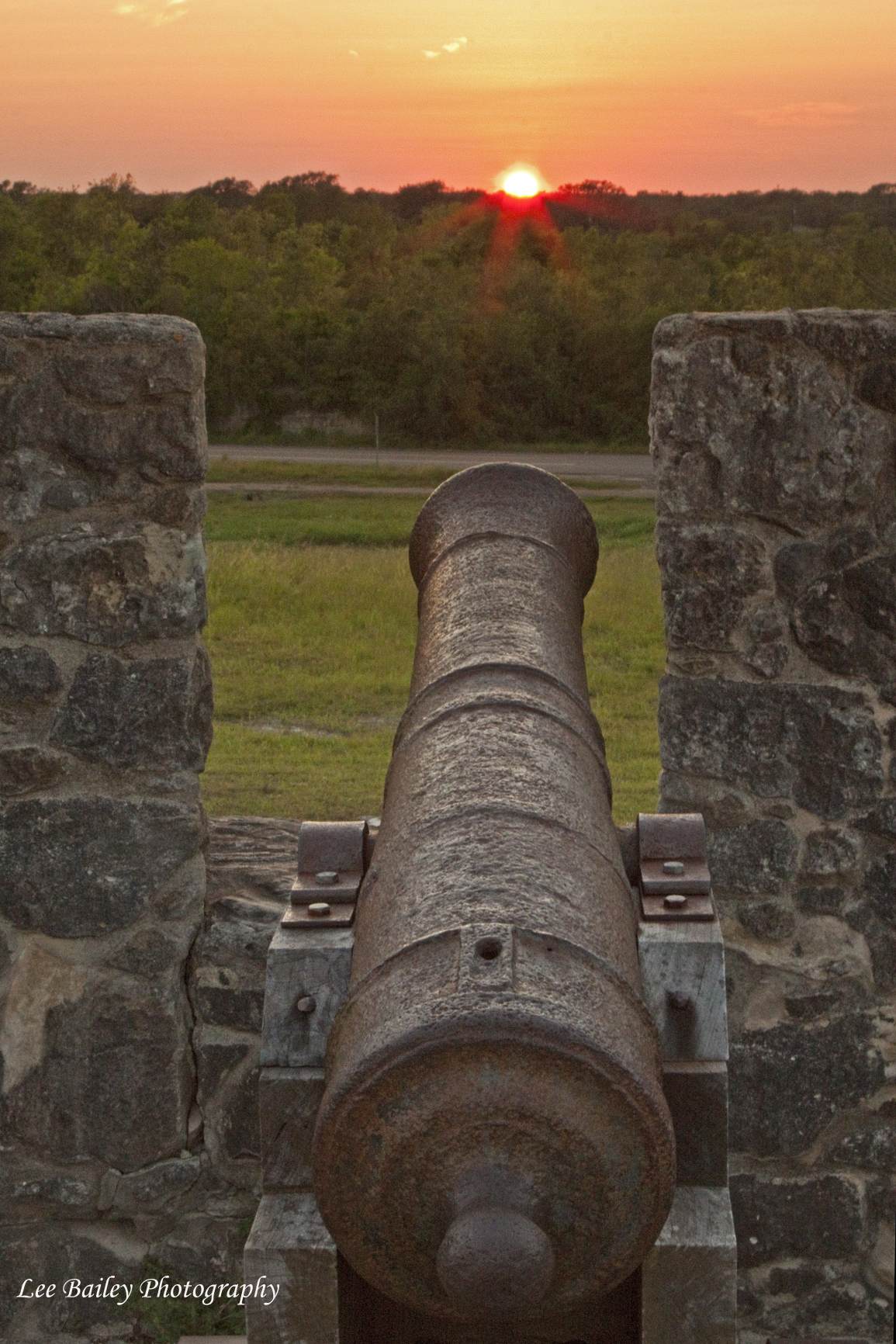
Presidio La Bahía
Spain built Presidio La Bahía on the ashes of someone else's failure. In 1721, the Marquis de San Miguel de Aguayo planted the Spanish flag on the exact site where Robert de La Salle's French colony had collapsed three decades earlier on the shores of Matagorda Bay. The message was blunt: this coast belongs to us. Over the next century, the fort would be relocated twice, rebuilt in stone, besieged, captured by insurgents, renamed Fort Defiance by Texian rebels, and finally turned into the site of the war's most infamous atrocity. Today it stands in Goliad, Texas, the most significant surviving Spanish colonial presidio in the state, owned not by the government but by the Catholic Diocese of Victoria.
A Fort That Refused to Stay Put
The presidio's first two decades were a study in restlessness. Founded in 1721 at La Salle's old fort site near Matagorda Bay, it was moved inland to the Guadalupe River in 1726 after priests at the nearby Mission Espíritu Santo failed to convert the Karankawa people. It stayed there for 23 years before a 1747 inspection by José de Escandón determined it should relocate again, this time to the banks of the San Antonio River. The move came in October 1749. By February 1750, a garrison of 50 soldiers occupied the new site, protected by six eight-pound cannons. Captain Manuel Ramírez de la Piszena had personally paid to have a stone house built for himself while his troops lived in barracks or temporary wood homes. After the Seven Years' War ended France's claims to Texas, the Marqués de Rubí inspected Spain's frontier and recommended that La Bahía be kept and rebuilt in stone. By 1771, it had become the only Spanish fortress guarding the entire Gulf Coast from the Rio Grande to the Mississippi River.
Sieges, Rebels, and Republics
La Bahía's walls saw combat long before the Texas Revolution. During the Mexican War of Independence, the Republican Army of the North captured the presidio in late 1812. Governor Manuel María de Salcedo laid siege for four months but could not retake it, finally lifting the siege on February 19, 1813. Royalist forces under José Joaquín de Arredondo eventually reclaimed the fort months later. In 1817, Henry Perry led another assault but was defeated near Coleto Creek. By 1821, Mexico had won independence from Spain, and La Bahía became one of two major garrisons in Mexican Texas, the other being the Alamo at Béxar. The presidio sat at the strategic midpoint between Béxar, the political capital, and Copano, the primary port on the Texas coast.
Thirty Minutes at Midnight
The Texas Revolution reached La Bahía swiftly. In October 1835, roughly 125 Texian militia from Matagorda marched on the presidio, originally hoping to kidnap Mexican General Martín Perfecto de Cos. They learned Cos had already left for Béxar, but pressed on after local Tejanos reported that Colonel Juan López Sandoval held the fort with only 50 men. In the predawn hours of October 10, the Texians attacked. The Mexican garrison opened fire, wounding Samuel McCulloch, a freed slave, in the shoulder. Within 30 minutes, the garrison surrendered. The Texians seized the presidio and its cannons and renamed the fort 'Fort Defiance.' Colonel James Fannin took command and soon found himself caught between two crises: William B. Travis at the Alamo begged for reinforcements, and General José de Urrea's army was marching up the Gulf Coast toward Goliad.
The Failed March and the Massacre
Fannin's attempt to relieve the Alamo became a catalog of misfortune. On February 26, 1836, he set out with 320 men, four cannons, and supply wagons. A wagon broke down almost immediately. Six hours were lost crossing the San Antonio River. A cold front struck that evening, leaving the poorly dressed soldiers shivering in rain. By morning, the oxen had wandered off and no one had packed food. After two days, Fannin's column had barely left sight of the fort. The relief mission was abandoned. After the Alamo fell on March 6, Sam Houston ordered Fannin to retreat to Victoria. Fannin delayed until March 19, then moved slowly with nine artillery pieces but little food or water. Mexican forces under Urrea caught him on the open prairie near Coleto Creek. After two days of fighting, Fannin surrendered. Despite Urrea's appeals for clemency, Santa Anna ordered the prisoners executed. On Palm Sunday, March 27, 1836, approximately 425 to 445 Texian captives were marched outside the presidio walls and shot. The Goliad massacre killed more Texians than the Battle of the Alamo.
What Remains on the River
The presidio was restored in the 1960s and designated a National Historic Landmark in 1967. Herbert Malloy Mason called it one of 'the finest examples of Spanish ecclesiastical building on the North American continent.' The stone walls, chapel, and defensive turrets still overlook the San Antonio River. Adjacent to the presidio stands the Fannin Memorial Monument, commemorating those executed in the massacre. The Catholic Diocese of Victoria operates it as a public museum, one of the rare cases where a Spanish colonial military site remains in private religious hands rather than state ownership. The surrounding community that grew up around the fort became the city of Goliad, its name an anagram of Hidalgo, the father of Mexican independence whose revolution first brought war to these walls.
From the Air
Located at 28.647°N, 97.382°W on the San Antonio River near Goliad, Texas. The presidio's stone walls and chapel are visible at lower altitudes, sitting on a gentle bend of the river. Best viewed at 1,500-3,000 ft AGL. Nearest airports: KGAD (Goliad County Airport, approximately 3 nm NE), KVCT (Victoria Regional Airport, 25 nm SE). The Fannin Memorial Monument is visible adjacent to the presidio grounds.