Presidio of San Francisco
In 1946, President Harry Truman offered the Presidio of San Francisco as the site for the United Nations headquarters. A UN committee came, inspected the 1,500-acre former military post at the foot of the Golden Gate Bridge, and ultimately chose New York instead. It would be another half-century before the Presidio found its post-military purpose, becoming the first national park site required by Congress to achieve complete financial self-sufficiency. The deadline was 2013. The Presidio hit the goal in 2005, eight years early, by doing something no other park had done: leasing its 800 historic buildings to private tenants, from tech startups to museums to a prep school.
Three Flags in 250 Years
New Spain established El Presidio Real de San Francisco on September 17, 1776, the same year American colonists declared independence on the opposite coast. The garrison numbered just 33 men in 1783. When Mexico won independence from Spain in 1821, the flag changed but the fortress remained. By 1835, the garrison had relocated to Sonoma, leaving a small detachment at a Presidio in decline. In 1846, Lieutenant John C. Fremont crossed the Golden Gate in a boat, 'capturing' the undefended post without resistance. He spiked a cannon that remains on the grounds today. The United States had claimed California, and the Presidio would serve as an active Army installation for the next 148 years, through the Civil War, the Spanish-American War, both World Wars, Korea, Vietnam, and finally Desert Storm in 1991.
The Orders Signed Here
During World War II, Lieutenant General John L. DeWitt commanded the Western Defense Command from the Presidio. On this ground, in these buildings, he signed 108 Civilian Exclusion Orders that directed the internment of Japanese Americans under Executive Order 9066. The paradox was devastating: while Japanese American families were forced into camps, Japanese Americans from those same families were being trained as military interpreters at a language school the Presidio itself had established. Entire trains of wounded soldiers arrived from the battles of Okinawa and Iwo Jima to receive care at Letterman Army Hospital. The Presidio's history is not simple, and the National Park Service does not pretend otherwise.
The First Park Rangers
Between 1890 and 1914, soldiers stationed at the Presidio became the nation's first park rangers, patrolling the newly created Yosemite and Sequoia National Parks before any civilian ranger force existed. The Buffalo Soldiers of the African American 9th Cavalry Regiment served here, the same regiment that had charged with Theodore Roosevelt at San Juan Hill in Cuba. When Roosevelt visited the Presidio in 1903, these soldiers formed his honor guard. The post assembled, trained, and deployed forces for the Spanish-American War in the Philippines, making it the staging ground for America's first major military engagement in the Pacific. General Frederick Funston, who earned the Medal of Honor in those campaigns, was commanding the Presidio when the 1906 earthquake struck San Francisco.
Lucasfilm and Legacy
George Lucas won the development rights in 1999, beating out several rival proposals including one from the Shorenstein Company. The $300 million Letterman Digital Arts Center replaced portions of the old Letterman Hospital, housing Industrial Light & Magic, Lucas Licensing, and Lucas Online across nearly 900,000 square feet of office space. The Internet Archive made its home in Building 116 from its founding in 1996 until 2009. The Walt Disney Family Museum occupies another historic structure. Andy Goldsworthy has installed four environmental sculptures across the grounds: Spire in 2008, Wood Line in 2011, Tree Fall in 2013, and Earth Wall in 2014. In 2022, the Presidio Tunnel Tops opened, creating 14 acres of parkland atop the tunneled highway that replaced the seismically unsafe Doyle Drive viaduct.
From the Air
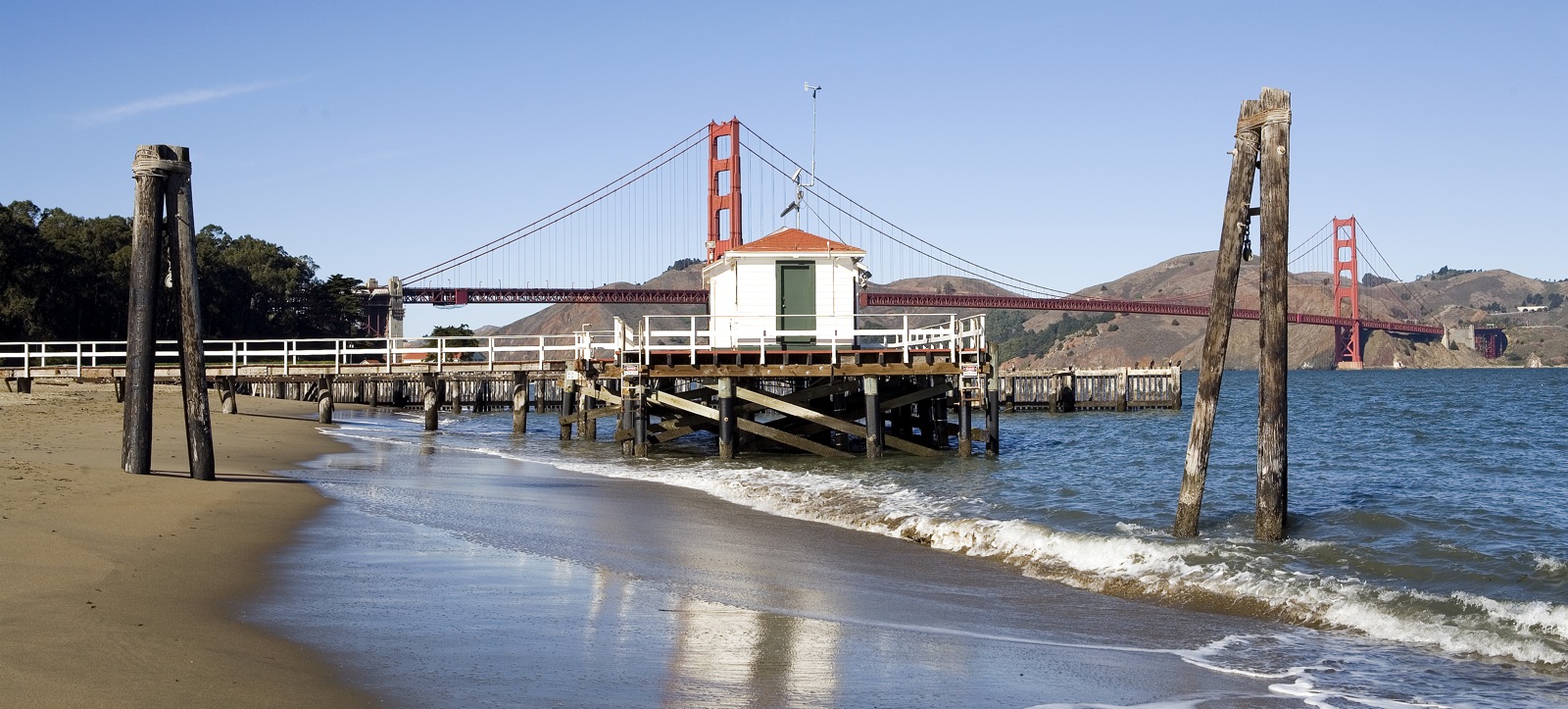
The Presidio occupies the northern tip of the San Francisco Peninsula, its 1,500 acres of eucalyptus groves and historic buildings framed by the Pacific Ocean to the west and San Francisco Bay to the east. The Golden Gate Bridge crosses directly over the park's northwest corner at Fort Point, a brick and granite fortification completed in 1861 that now sits literally beneath the bridge's roadway. Crissy Field, the restored former airfield along the bay shore, appears as a green strip between the Main Post and the water. The red tile roofs of the Spanish Colonial Revival buildings cluster around the central parade ground. Four creeks wind through the terrain, their riparian corridors darker ribbons against the surrounding urban forest. At least four coyote families have made their home here, wild predators thriving within sight of downtown San Francisco.
From the Air
Located at 37.798N, 122.466W at the northern tip of San Francisco Peninsula, directly at the southern anchorage of the Golden Gate Bridge. The Presidio's 1,500 acres are immediately recognizable from the air by the contrast between dense eucalyptus forest, red-tile-roofed historic buildings, and the restored wetlands of Crissy Field along the bay. Fort Point sits directly under the Golden Gate Bridge. Within San Francisco Class B airspace. Nearby airports: KSFO (12nm S), KOAK (10nm E). Best viewed at 2,000-3,000 feet AGL on approach to or departure from the Golden Gate.