Pretoria Pit Disaster
Of the 345 workers who descended the No. 3 shaft of the Pretoria Pit on the morning of 21 December 1910, four were brought back alive. One died immediately. One died the next day. Joseph Staveley and William Davenport were the only men who walked away. The explosion at the Hulton Colliery near Westhoughton, Lancashire, killed 344 men and boys four days before Christmas, devastating a community where nearly every household lost a father, a son, or both.
The Morning Shift
The Hulton Colliery Company employed roughly 2,400 workers in 1910, operating across five coal seams of the Manchester Coalfield: the Trencherbone, Plodder, Yard, Three-Quarters, and Arley mines. About 900 workers reported for the day shift on that December morning. The 345 who descended the No. 3 bank pit shaft were heading for the Plodder, Yard, and Three-Quarters seams. The men who worked the other seams, accessed through the No. 4 shaft, were unharmed by what followed. What exactly ignited the firedamp underground was never determined with certainty. The explosion tore through the workings with the speed and finality that characterized coal mine disasters of the era -- one moment the shift was proceeding normally, and the next, the pit had become a tomb.
Four Days Before Christmas
The scale of the loss was almost incomprehensible. Of 345 men underground, 341 died in the blast or its immediate aftermath. William Turton, a rescuer, died fighting a fire in the No. 3 pit, and one man died in the Arley Mine of No. 4 Pit, bringing the total to 344. In a community the size of Westhoughton and Over Hulton, that number meant the destruction of an entire generation of working men. These were not abstractions on a casualty list. They were the breadwinners, the fathers, the sons, the neighbors. They were men who had walked to the colliery in the dark that morning expecting to walk home again. The disaster fell just before Christmas, compounding the grief with a season that should have brought families together. Instead, Westhoughton buried its men.
A Long Reckoning
The Hulton Colliery Explosion Relief Fund was established to support the families left behind, but as with many disaster relief efforts of the era, the support was inadequate for the scale of need. The fund made payments for decades. John Baxter, the last recipient, died in January 1973, more than sixty years after the explosion. The fund was finally dissolved in 1975, its remaining assets transferred to other miners' relief funds. That payments continued for over six decades speaks to the depth of the wound the disaster inflicted on the community. Children who lost fathers in 1910 grew old and died still receiving support from a fund created in the aftermath.
Remembered in Stone
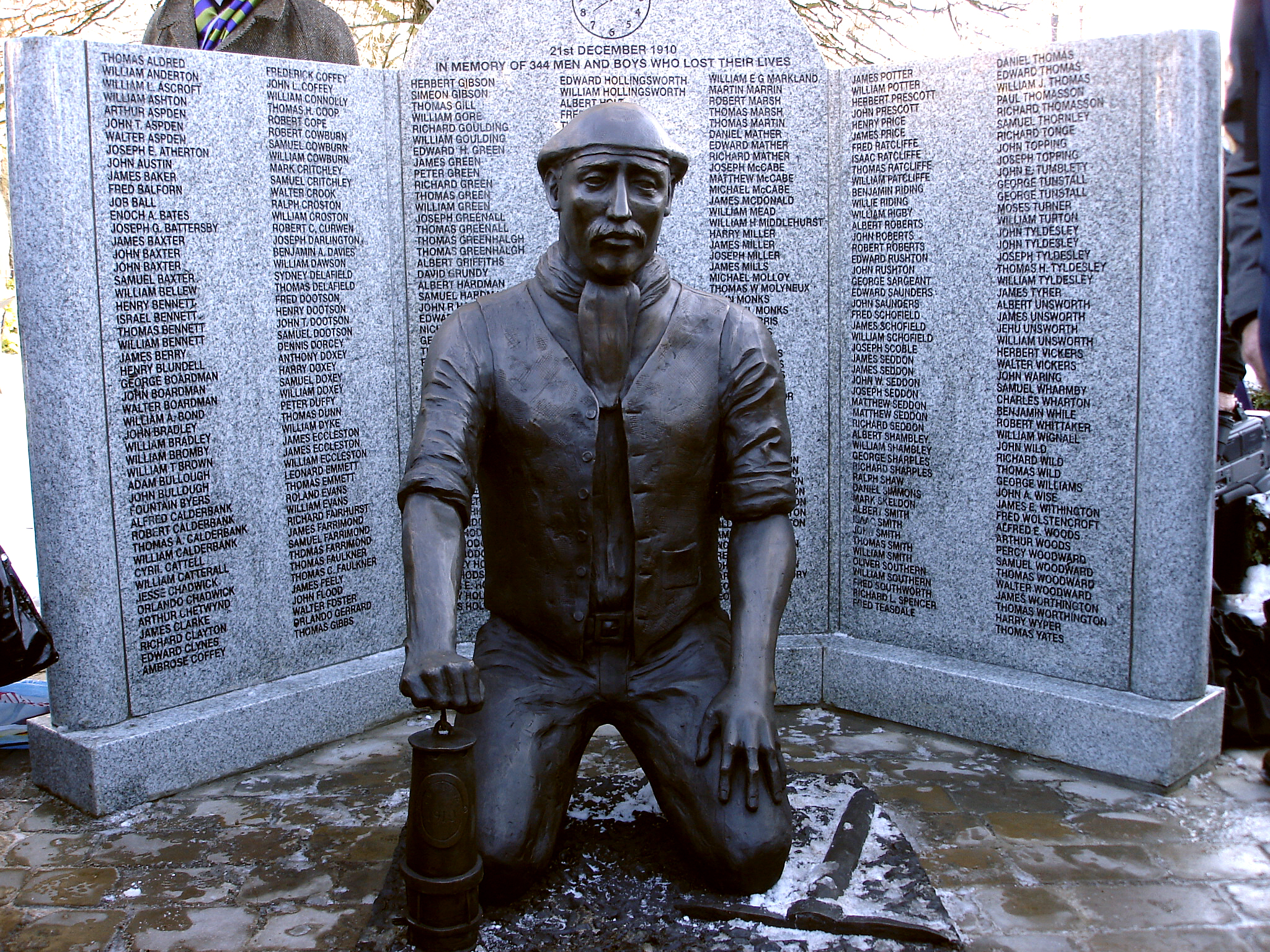
A memorial stands in Westhoughton cemetery, where a service is held each year. Artifacts from the disaster are displayed at Westhoughton Central Library. In 2010, almost exactly a century after the explosion, a statue by sculptor Jane Robbins was unveiled opposite Westhoughton church. A second memorial was erected the same year at the end of Broadway, on the border between Atherton and Over Hulton, about 300 yards from the No. 4 shaft from which the survivors and the dead were raised. In 2008, an anonymous firsthand account of the disaster was discovered, written by a man who had accompanied the rescue team. And in 2005, students and staff at Westhoughton High School wrote and performed a play called Sleep, Comrade Sleep, reprised for the centenary in 2010. The play's title captures something of what Westhoughton still carries: a community's duty to remember the men and boys who went underground on a December morning and never came back.
From the Air
Located at 53.54°N, 2.49°W in Over Hulton, Westhoughton, northwest of Bolton in Greater Manchester. The colliery site is no longer visible, but Westhoughton and its memorial landmarks are identifiable. Nearest airports: Manchester (EGCC) approximately 12 nm southeast, Bolton area. The terrain is flat Lancashire coalfield country.