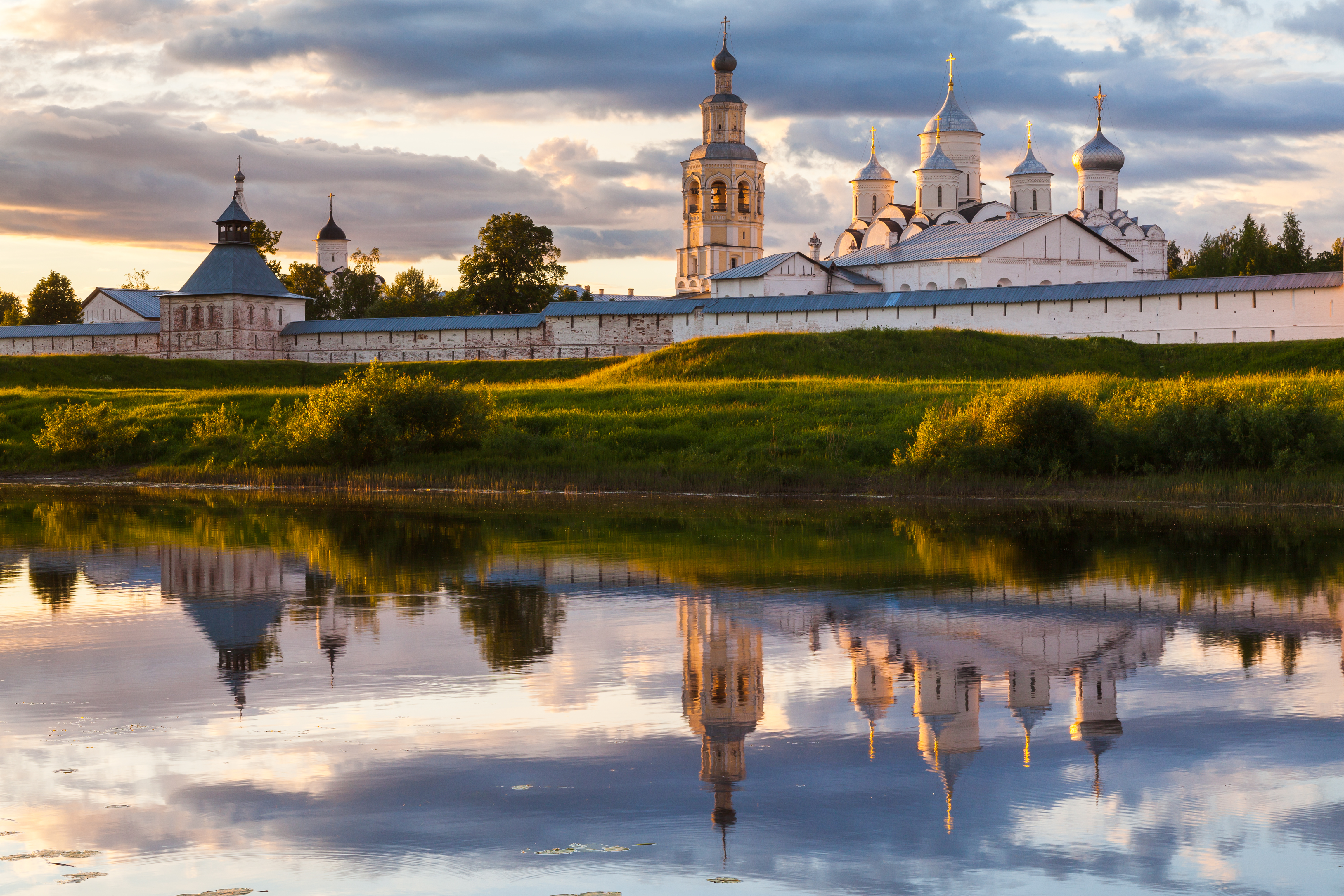
Priluki Monastery
Demetrius of Priluki was looking for solitude, and the world kept following him. He left Pereslavl-Zalessky because it felt too crowded. He tried the Obnora River, but the locals made clear he was unwelcome. So he walked further north, into the vast forests of the Russian interior, until he reached a meander of the Vologda River -- a priluka, in the old language -- and decided this bend in the water would be the place. He built a wooden church, a few cells, and began to pray. That was sometime in the 1370s. The spot he chose would become one of the most important monastic foundations in the Russian North, a walled citadel of faith that attracted the patronage of grand dukes, the prayers of tsars, and eventually the attention of armies and revolutionaries alike.
A Monk's Retreat, a Duke's Outpost
What Demetrius sought as a hermitage, the Grand Dukes of Moscow saw as a strategic foothold. Beginning with Dmitry Donskoy, the Muscovite rulers poured support into the Spaso-Prilutsky Monastery -- not merely out of piety, but to extend their political influence deep into the Russian North. The monastery became a dual instrument: spiritual authority and territorial claim wrapped in the same stone walls. By the 16th century, it controlled more than 100 villages and nearly 3,000 male peasants, a small kingdom administered from cloisters. The fortified walls that still encircle the complex were not decorative. They were built to withstand siege.
The Cross and the Conqueror
In 1528, Vasily III of Moscow arrived at Priluki with his wife Elena Glinskaya. They had been childless for years and set out on a desperate pilgrimage across the northern monasteries, praying for an heir. Their prayers were answered -- their son became Ivan the Terrible. Before his decisive siege of Kazan in 1552, Ivan prayed before the monastery's most sacred relic: a Cilician ivory cross, an object believed to carry miraculous power. The cross became so entwined with Russian royal destiny that its later confiscation by the Soviets felt less like an act of atheism than an exorcism. Between these royal visits came catastrophe: on December 16, 1612, Polish-Lithuanian raiders known as the Lisowczycy captured and burned the monastery, one of countless acts of destruction during the Time of Troubles.
Cells Turned to Cages
The Soviet closure came in August 1924. The Cilician cross was seized, the ancient library scattered, the icons dispersed to various state collections. The monastery's buildings -- designed for contemplation -- were repurposed with grim efficiency. They served as living quarters, a depot, a museum, and for a time, a prison. Monks' cells became actual cells. The transformation was not unusual in Soviet Russia, where hundreds of monasteries suffered similar fates, but Priluki's conversion carried a particular irony: a place founded by a man fleeing the world became a place from which the world would not let people leave.
Restoration and Memory
Comprehensive restoration began in 1954, eventually giving the complex what preservationists describe as a "medievalized" appearance -- not quite the original, but a thoughtful interpretation of what these walls once looked like. In 1991, the monastery was re-established as an active religious community. Today, the relics of Saint Demetrius remain: his staff, his penance chains, and his bones, venerated in one of the monastery's churches. The graveyard holds another kind of relic -- the Neoclassical tomb of Konstantin Batyushkov, the Romantic poet who lived from 1787 to 1855 and spent his final, mentally troubled decades in Vologda. Most surviving buildings date from the 16th and 17th centuries, their white walls and green roofs visible across the flat Vologda landscape like a small fortified city unto itself.
From the Air
Located at 59.26N, 39.89E on the bank of the Vologda River, approximately 5 km northeast of Vologda city center. The walled monastery compound with its white walls, towers, and green-domed churches is clearly visible from low altitude. Nearest airport: Vologda (ULWW). Best approach from the southwest, following the river meander. The flat terrain and open farmland surrounding the monastery make it easy to spot at 2,000-3,000 feet AGL.