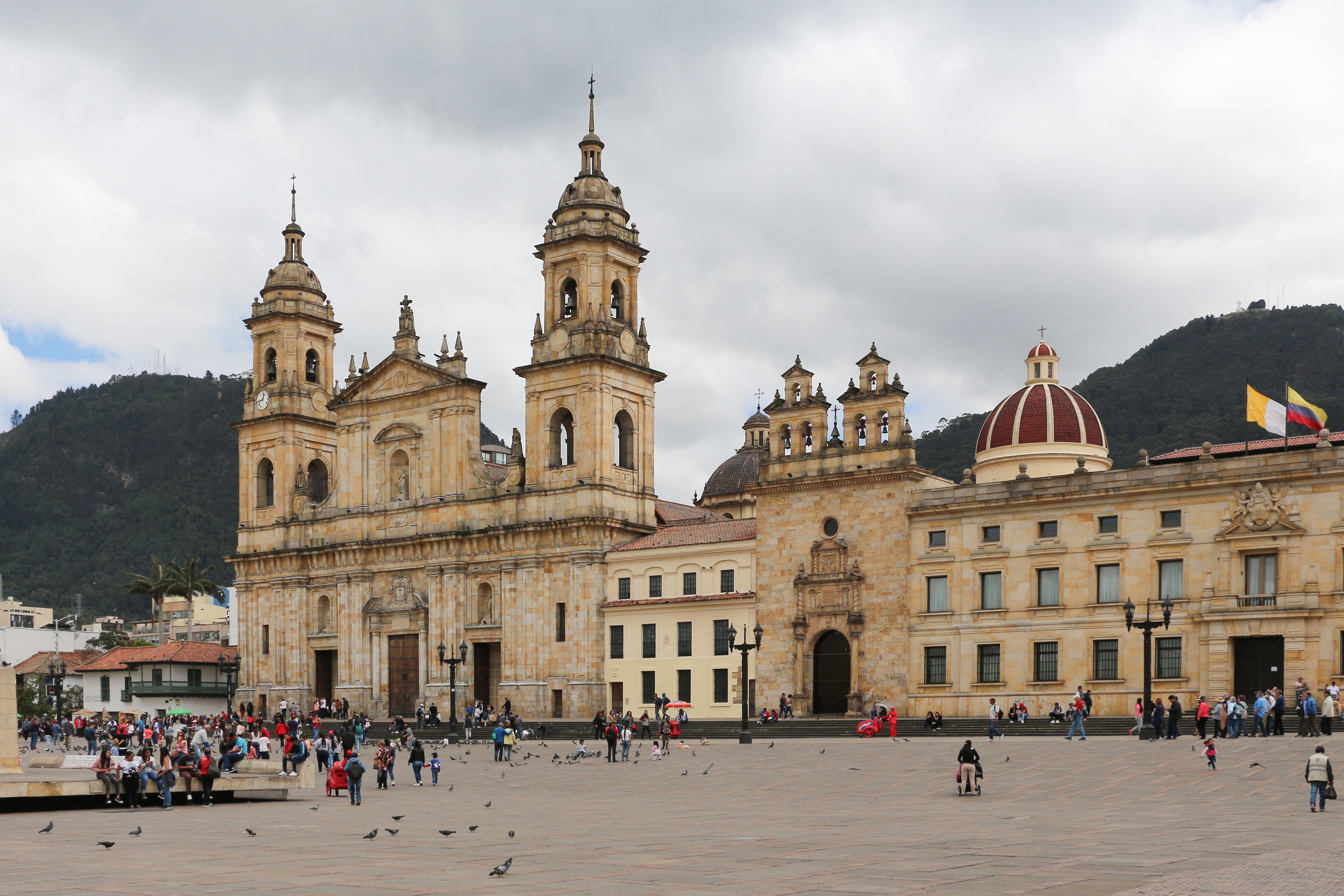
Primatial Cathedral of Bogotá
The cathedral you see today is the fourth one. The first was mud and straw, celebrated in 1538 by a Dominican friar who had followed the conquistadors up onto the Bogotá savanna. The second collapsed on the eve of its opening. The third was killed by an earthquake in 1785. Only on the fourth attempt - begun in 1807, finished in 1823, designed by the Capuchin friar-architect Domingo de Petrés - did the Primatial Cathedral of Bogotá finally stand for good. It has stood since, on exactly the spot where Colombia's oldest Mass was celebrated.
Four Cathedrals, One Corner
On August 6, 1538, Friar Domingo de las Casas said Mass in a chapel of mud and thatched roof on what would become the eastern edge of the Plaza de Bolívar. That tiny building was the first cathedral of the city that would be called Bogotá. In 1553 Archbishop Juan de los Barrios organized a second attempt - mud walls and brick, a budget of 1,000 pesos that ballooned past 6,000, and then, on the eve of inauguration in 1560, the roof came down. Pope Pius IV granted it the title of cathedral anyway in 1562. In 1572 Barrios personally carried the first stone for a third try, shaming his parishioners into hauling their own stones in imitation. That church held until July 12, 1785, when an earthquake left it beyond saving. The final rebuild began in 1807 under Petrés and was consecrated in 1823. It took 285 years from the first Mass to get the cathedral right.
Petrés's Latin Cross
The building is a neoclassical basilica in the form of a Latin cross, covering 5,300 square meters. It has five naves - a central one and two side naves at equal height, plus two narrower aisles lined with chapels - supported by Corinthian, Doric, and Ionic pilasters that climb in disciplined tiers. Sixteen chapels open off the aisles. The twin towers, rebuilt after an 1827 earthquake, stand 52 meters tall; the south tower is consecrated to Saint Barbara, patroness against lightning, and the north carries a clock. Above the main door, a marble slab dated MDCCCXIV (1814) carries Petrés's own inscription dedicating the work to the Immaculate Conception. The dome, held up by four pendentives, is painted indigo and marked with thirteen tongues of fire.
The Founder's Tomb
In the Chapel of Saint Elizabeth of Hungary rests Gonzalo Jiménez de Quesada - the Spanish lawyer-turned-conquistador who, in 1538, pushed a column of men up from the Magdalena River onto the Bogotá savanna and declared the founding of the city of Santafé. His sarcophagus, sculpted by Luis Alberto Acuña on a white marble altar, sits where his city was born. A few meters away lies the bust of Antonio Nariño, the independence-era thinker who first translated the French Declaration of the Rights of Man into Spanish. In Chapel V, the painter Gregorio Vásquez de Arce y Ceballos (1638-1711), whose colonial canvases hang throughout Colombia, is buried among his own works. A cenotaph remembers Policarpa Salavarrieta, the young seamstress-spy executed by firing squad in this same Plaza de Bolívar in 1817. The cathedral is, in effect, a memory of the city's making.
Our Lady of El Topo
Behind the main altar, in a semicircular chapel 29 meters long, hangs a painting that has been venerated here since 1610 - more than two centuries older than the building around it. Our Lady of El Topo shows the Virgin bent over the body of her dead son, Saint Joseph on one side, Saint Francis on the other. Attribution is uncertain; art historians suspect the school of Luis de Morales, the 16th-century Spanish painter known as El Divino. The central silver altar is 18th-century Doric work, embossed and chased, patiently polished through the earthquakes that destroyed three cathedrals around it.
The Largest Organ in Colombia
The cathedral's pipe organ is the largest in Colombia: 58 stops, four manual keyboards, a pedalboard, and roughly 4,500 pipes. It was built by Aquilino Amezua, a Spanish master organ-builder of the late 19th century, and it had gone badly out of tune by the 2010s. Between 2013 and 2016, the Spanish firm Gerhard Grenzing S.A. - the same company that has restored the organs of the cathedrals of Seville, Brussels, and Mexico - took it apart, rebuilt it, and handed it back. The restoration cost 2,515 million pesos, split between Colombia's Ministry of Culture, the National Tourism Fund, and the Archdiocese. Cardinal Rubén Salazar Gómez blessed the restored instrument on July 2, 2016. The inaugural concert was played by Juan de la Rubia, titular organist of the Sagrada Família in Barcelona. On Plaza de Bolívar, where political rallies, riots, and inaugurations have unspooled for four centuries, the organ's sound now carries across the square whenever the doors are open.
From the Air
The cathedral sits at 4.598°N, 74.075°W on the eastern side of Plaza de Bolívar in La Candelaria, Bogotá's historic core, at roughly 2,640 m (8,660 ft) elevation. The nearest airport is El Dorado International (SKBO), about 13 km west; the 52-meter twin towers and green neoclassical dome are visible from altitude in clear weather against the backdrop of the Eastern Hills (Cerros Orientales). Bogotá's high altitude and frequent afternoon clouds often obscure the savanna; mornings give the clearest view. The Palace of Justice and Capitolio Nacional flank the plaza to the north and south.