Prince Gong's Mansion
The man who built this mansion was executed for corruption. The prince who gave it its name tried to modernize a dying empire. The grandson who inherited it mortgaged it to Benedictine monks. And during the Cultural Revolution, it manufactured air conditioners. Prince Gong's Mansion, the largest and best-preserved imperial mansion in Beijing, has a biography so improbable that no novelist would dare invent it.
Corruption Made Stone
The mansion was constructed in 1777 for Heshen, a court official whose rapid ascent under the Qianlong Emperor made him one of the wealthiest and most powerful men in the Chinese empire. Heshen's corruption was legendary -- estimates of his amassed fortune suggested it equaled the imperial treasury's revenue for 15 years. When the Jiaqing Emperor succeeded his father in 1799, one of his first acts was to accuse Heshen of corruption, confiscate his property, and order him to hang himself with a silk cord. The mansion passed to Prince Qing, the Qianlong Emperor's youngest son. Half a century later, in 1851, the Xianfeng Emperor gave it to his sixth brother, Prince Gong -- the reformist statesman who would negotiate with Western powers during the Second Opium War and help establish China's first modern foreign office.
A Compound of 60,000 Square Meters
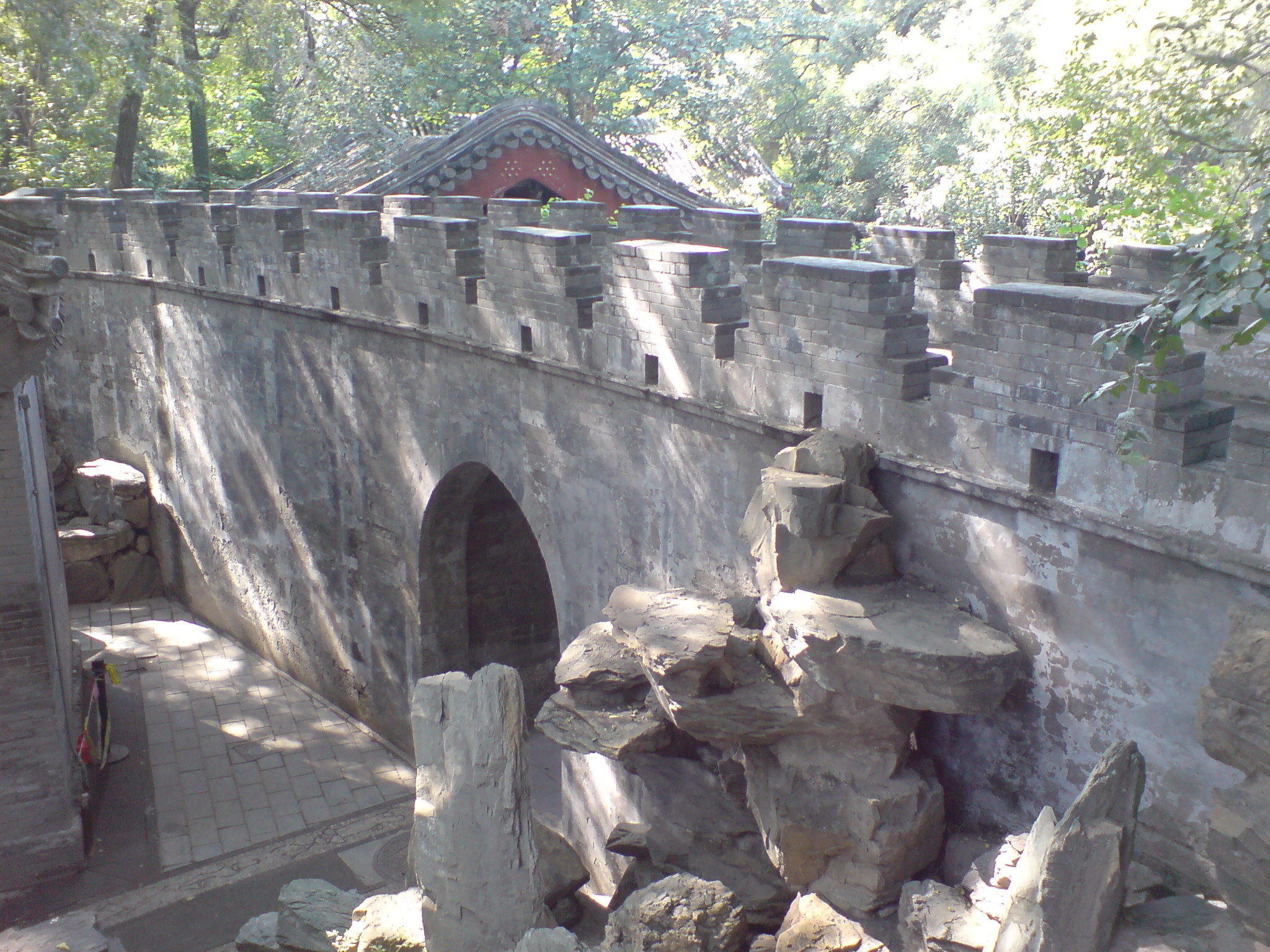
The mansion covers a total area of 60,000 square meters, making it one of the most expansive private residences in Beijing. The southern half contains the living quarters: several siheyuan courtyards, two-story buildings, and a grand Peking opera house where performances once entertained the aristocracy. The northern half is given over to a 28,000-square-meter garden featuring 20 scenic spots, pavilions, artificial hills built with rocks from Lake Tai in Jiangsu Province, and ornamental ponds. An eight-meter-long stone stele bears the Chinese character for "fortune" in calligraphy attributed to the Kangxi Emperor. The entire compound is an encyclopedia of Qing-era aristocratic taste, from the placement of its rocks to the proportions of its halls.
From Catholic University to Factory Floor
The mansion's twentieth century was a study in transformation through upheaval. In 1921, after the Qing dynasty's collapse, Prince Gong's grandson Puwei mortgaged the property to the Order of Saint Benedict. The Catholic monks invested heavily in restoration and converted the compound into Furen Catholic University, which operated until the priests were expelled from China in 1951. During the Cultural Revolution, the mansion was requisitioned by the Beijing Air Conditioning Factory -- its courtyards and opera house repurposed for industrial production. The revival began in the 1980s. In 1982, the mansion was declared a Major Historical and Cultural Site Protected at the National Level, and in 1996, it reopened as a tourist attraction.
Monuments at Risk
Renovation works costing 200 million yuan were completed in time for the 2008 Summer Olympics, restoring much of the complex to its former condition. The mansion now hosts permanent exhibitions on its own history alongside temporary art shows. Yet the structure remains fragile. The World Monuments Fund placed the Grand Theater of Prince Gong's Mansion on its 2018 watch list of monuments at risk, a reminder that even the most celebrated historic sites require constant vigilance. For visitors, the mansion offers something rare in a city that has relentlessly modernized: an intimate sense of how imperial Beijing's aristocracy actually lived, in gardens designed for contemplation and halls built to impress, in a space where corruption, reform, religion, and revolution each left their mark.
From the Air
Located at 39.937N, 116.380E in Xicheng District, just north of the Shichahai lakes. The extensive garden and courtyard compound is visible as a large green space amid the hutong neighborhoods northwest of the Forbidden City. Nearby airports: Beijing Capital International (ZBAA) 26 km NE, Beijing Daxing International (ZBAD) 48 km S. Best viewed at 2,000-4,000 ft.