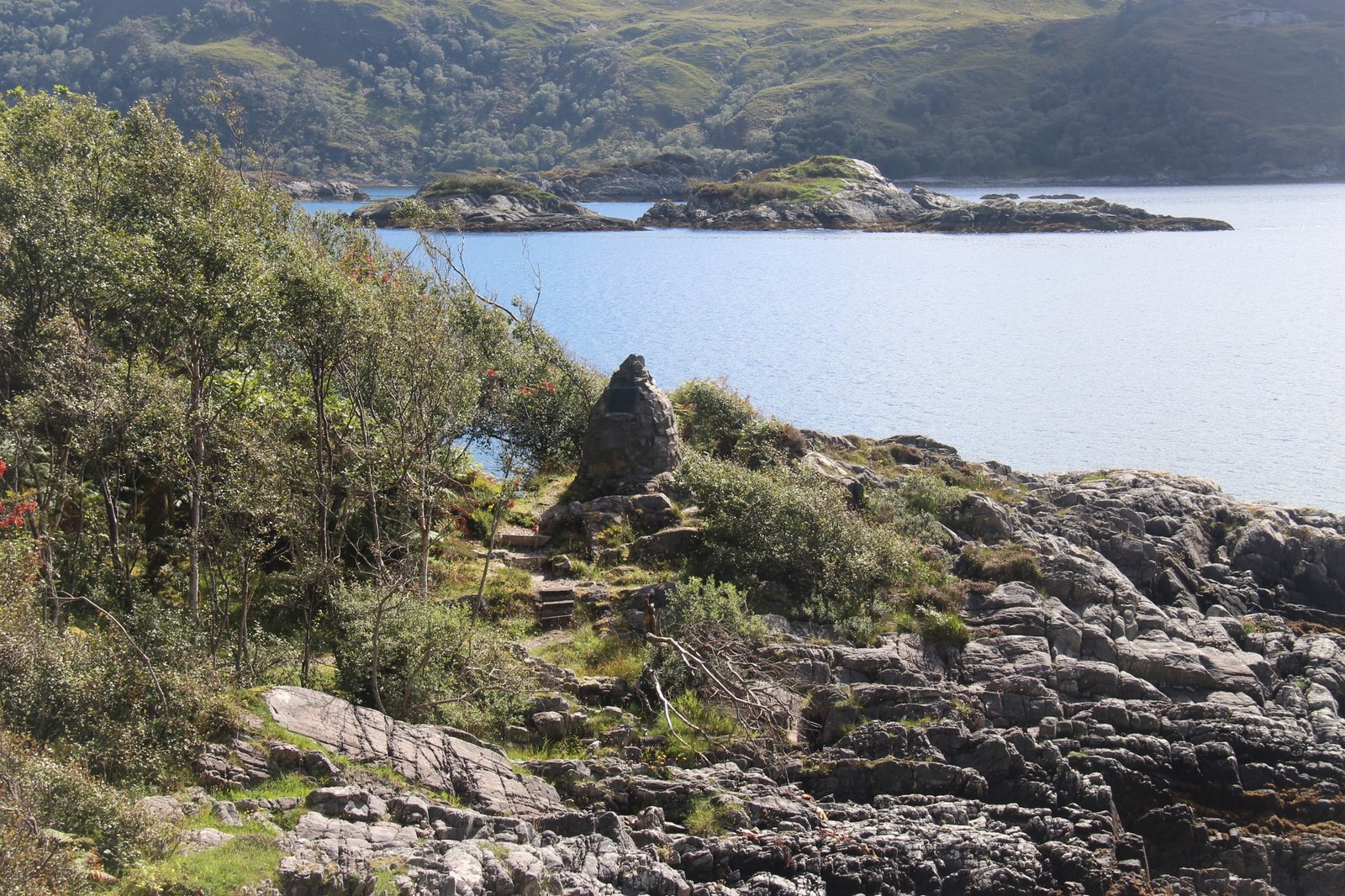
Prince's Cairn
The same stretch of shoreline saw him arrive and saw him leave. On 25 July 1745, Charles Edward Stuart stepped ashore at Loch nan Uamh from the French privateer Du Teillay, setting foot on mainland Britain for the first time with seven companions and a plan to reclaim the British throne for the House of Stuart. Fourteen months later, after raising an army, winning battles, marching to within 125 miles of London, and then losing everything at Culloden, he returned to the same loch. On 20 September 1746, the French frigate L'Heureux carried him away from Scotland. He never came back. A stone cairn on the shore marks the spot, erected two centuries later by people who had not forgotten.
The Loch of Arrivals and Departures
Loch nan Uamh -- the loch of the caves -- is a sea loch in Lochaber, tucked into the coast between Arisaig and Moidart. Its strategic value lay in its obscurity: sheltered from the open sea, accessible by galley but invisible from passing ships, it was the kind of place where a man could land unnoticed. The Du Teillay, a 16-gun privateer, brought Prince Charles and his companions to Eriskay on 23 July 1745. After one night on the island, they sailed to Loch nan Uamh, where Charles first touched mainland soil. He stayed at the Clanranald farm at Borrodale before crossing the Sound of Arisaig to Moidart. In August, he raised the Jacobite standard at Glenfinnan, beginning the Rising of 1745. The campaign that followed would take him to Edinburgh, to victory at Prestonpans, to the gates of London, and finally to the killing field at Culloden on 16 April 1746.
Five Months in the Heather
After Culloden, Charles became the most hunted man in Britain. The government posted a reward of thirty thousand pounds for his capture -- an almost inconceivable sum -- yet not a single Highlander betrayed him. For five months he evaded government troops, hiding in caves, bothies, and the open hills. Ten days after the battle, on 26 April 1746, he fled from Loch nan Uamh to the Hebrides with a small party including Colonel John William O'Sullivan and the navigator Donald MacLeod. The crossing nearly killed them: the weather was terrible, the boat filled with water, and MacLeod -- who knew these seas as well as anyone -- believed they were lost. The Prince reportedly told his praying companions that the clergyman among them should pray if he wished, but the rest would be better employed bailing. They survived, reaching Eriskay the next morning. Months of island-hopping followed, including the famous crossing disguised as Flora MacDonald's maid, before Charles finally returned to the mainland.
The Cairn and the Piper
On 19 September 1746, Charles arrived at Loch nan Uamh from Cluny's Cage, a refuge on the slopes of Ben Alder where he had hidden with Ewen MacPherson of Cluny. Accompanying him were Donald Cameron of Lochiel, the war poet John Roy Stewart, and other fugitive Jacobites. The French frigate L'Heureux lay at anchor in the loch. Throughout the day, the exiles boarded the ships. The next morning, the vessels weighed anchor and sailed from Scotland. Charles Stuart, the Young Pretender, died in Rome in 1788 without ever returning. On 4 October 1956, more than 200 people gathered on the small promontory where tradition placed his departure. The 1745 Association unveiled a cairn of local stone, draped with the cross of Saint Andrew and surrounded by clan banners. Diana Hay, 23rd Countess of Erroll and Scotland's Lord High Constable, led the ceremony alongside Sir Donald Hamish Cameron of Lochiel, 26th Chief of Clan Cameron. As the Countess lifted the drape, the cairn's builder, John MacKinnon of Arisaig, played a piobaireachd on the bagpipes. He was joined by Angus MacPherson, a noted piper descended from Cluny's own piper, who had hidden with Charles on Ben Alder two centuries before. The cairn's plaque carries its inscription in both Gaelic and English, adjacent to the A830 road sometimes called the Road to the Isles.
From the Air
Prince's Cairn sits at 56.895N, 5.745W on the shore of Loch nan Uamh in Lochaber, adjacent to the A830 road (Road to the Isles). The cairn is on a small promontory by the loch shore and is difficult to spot from altitude, but Loch nan Uamh itself is a prominent sea loch. Nearest airfield is Oban Airport (EGEO) approximately 45 nm south. The Loch nan Uamh Viaduct carrying the West Highland Line is nearby. Beasdale railway station lies approximately 2.5 miles to the west. Glenfinnan, where the Prince raised his standard, is approximately 10 nm east-southeast.