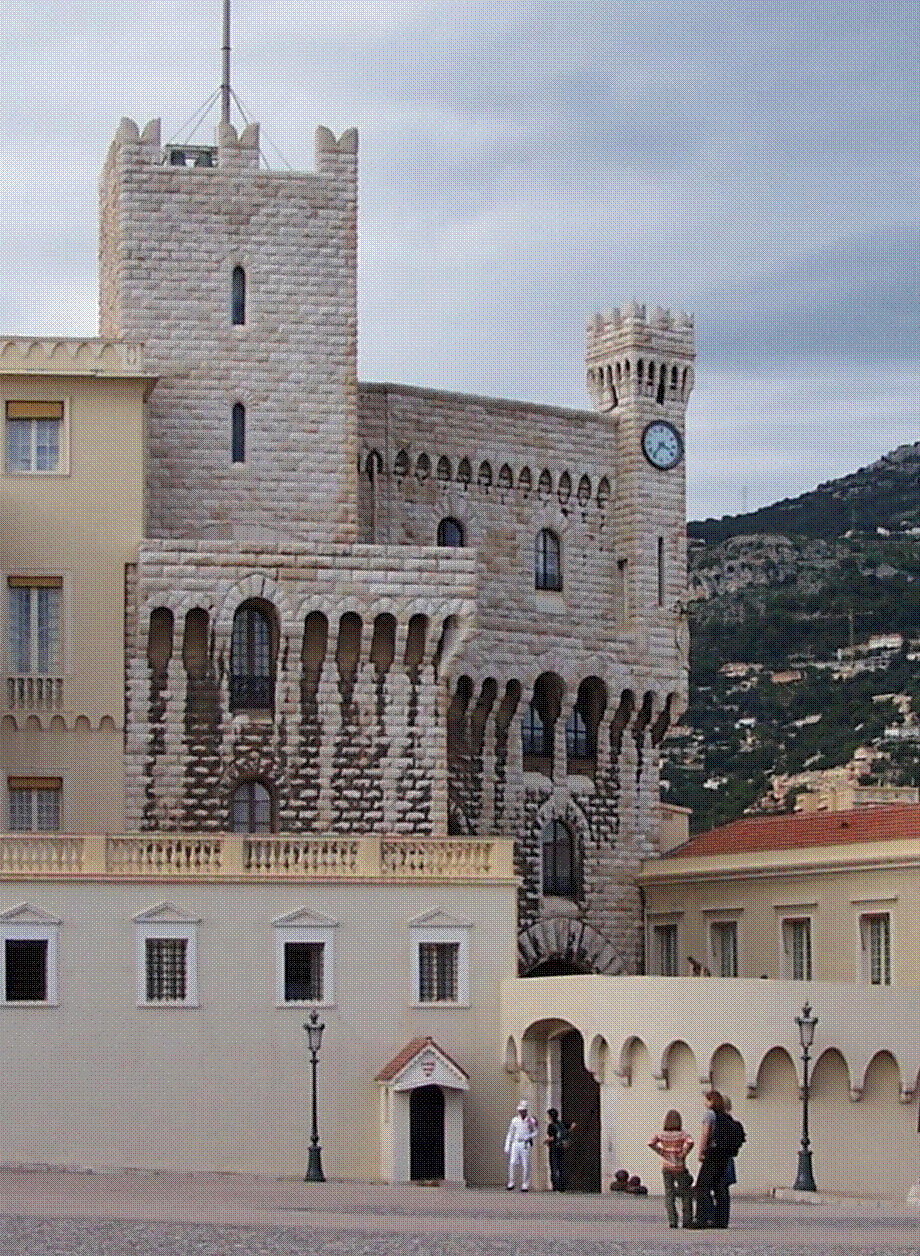
Prince's Palace of Monaco
The story begins with a deception. On the night of 8 January 1297, Francois Grimaldi approached the fortress gate disguised as a Franciscan friar. When the guards admitted the humble monk, he drew a sword and opened the gates for his soldiers. The Grimaldis have held this rock ever since -- more than seven centuries of unbroken possession, through sieges, bombardments, revolutions, and the constant threat of absorption by larger neighbors. The coat of arms of the Prince of Monaco still depicts two monks with drawn swords, a permanent reminder that this dynasty began with a trick.
Fortress to Palace
The original structure, built in 1191 as a Genoese fortress, was a functional military installation on a strategic promontory overlooking the Mediterranean. Under the Grimaldis, who ruled first as feudal lords and later as sovereign princes, the fortress gradually transformed. The family's power depended on fragile agreements with larger neighbors -- Genoa, France, Spain, Sardinia -- and the palace's architecture records these shifting alliances. Renaissance galleries were added during periods of relative security; fortifications were strengthened when threats loomed. By the 17th century, the Grimaldis had achieved formal sovereignty, and the building began its long evolution from defensive stronghold to princely residence, though it never entirely shed its martial origins.
Surviving the Storm
The palace's history is a catalog of near-destruction. It has been bombarded by foreign navies, besieged by rival powers, and looted during the upheavals that periodically swept the region. During the French Revolution, the Grimaldis lost their throne and the palace was sacked. The family regained control after Napoleon's fall, but the building they returned to bore the scars of occupation and neglect. Restoration became a multigenerational project, with successive princes adding comforts while preserving the medieval and Renaissance elements that connected the palace to its origins. The result is a layered structure where 12th-century walls coexist with ornate state apartments.
The Rock and Its Rituals
The palace sits atop the Rock of Monaco in the old quarter of Monaco-Ville, surrounded by the Cathedral of Our Lady Immaculate and the Oceanographic Museum. Each day at 11:55 AM, the Changing of the Guard ceremony takes place in the palace square, a tradition maintained by the Carabiniers du Prince. The ceremony draws tourists who gather on the cobblestones where Francois Grimaldi's soldiers once stormed in. Parts of the palace are open to the public during summer months, offering access to the state apartments, the Throne Room, and the Cour d'Honneur, the courtyard where open-air concerts are held against a backdrop of frescoed galleries and Carrara marble staircases.
A Dynasty's Anchor
Today, the palace remains the official residence of Prince Albert II and the Grimaldi family, making it one of the oldest continuously occupied royal residences in Europe. Its survival is inseparable from the survival of Monaco itself -- a microstate of barely two square kilometers that has maintained its independence since the 13th century through diplomatic skill, strategic marriages, and the sheer stubbornness of a family that began as invaders and became the longest-reigning dynasty in European history. The palace embodies that persistence. It is neither the grandest nor the most beautiful royal residence on the continent, but no other has been held by the same family for so long against such consistent odds.
From the Air
Located at 43.73N, 7.42E atop the Rock of Monaco. The palace complex is clearly visible from the air, crowning the rocky promontory between Port Hercules and Fontvieille. Nice Cote d'Azur Airport (LFMN) is 12 km west. Monaco Heliport (LNMC) at the harbor. Best viewed at 2,000-3,000 ft from the south, where the palace and Rock form a distinctive coastal landmark.