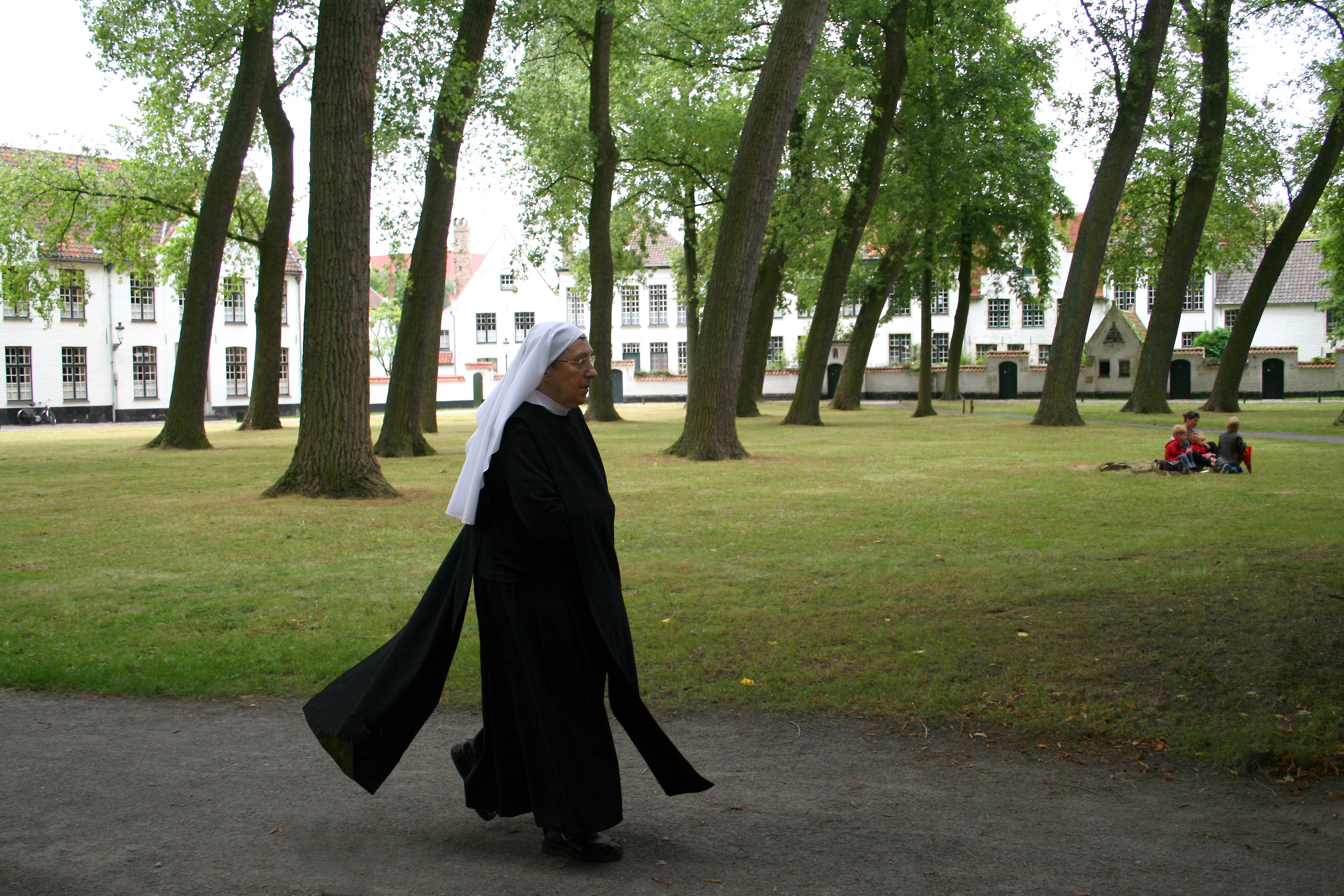
Princely Beguinage Ten Wijngaerde, Bruges
Thirty white-painted houses encircle a courtyard where silence has been the rule for nearly eight centuries. The Princely Beguinage Ten Wijngaerde in Bruges preserves something rare: the physical and spiritual architecture of a movement that offered medieval women an alternative to marriage or the cloister. Before 1240, pious women gathered at a domain called de Wingarde, Old Dutch for vineyard, though the name more likely describes the low-lying meadows that surrounded this southern corner of the city. What they built here would outlast the movement that created it.
A Third Path for Medieval Women
The beguines were neither nuns nor laywomen but something unprecedented in medieval Europe. They took no permanent vows, could leave to marry, owned property, and supported themselves through textile work and teaching. This autonomy made ecclesiastical authorities uneasy, but in Bruges, the community flourished. By 1245, it was recognized as an independent parish. In 1299, King Philip the Fair of France placed it under direct royal protection, bestowing the title that remains today: Princely Beguinage. That royal endorsement shielded the community through centuries of political upheaval, allowing the beguines to maintain their unusual status on the margins of religious life.
Architecture of Quiet Lives
The complex speaks of modest prosperity frozen in time. A Gothic church anchors the grounds, while the houses around the central courtyard date from the late 16th, 17th, and 18th centuries. Visitors enter through the Wijngaard Bridge, a three-arched stone crossing, then pass beneath an entrance gate built in 1776 by master mason Hendrik Bultynck. Above a bay near the entrance, the image of Saint Elizabeth of Hungary watches over arrivals, patron of many beguinages across the Low Countries. The first house past the gate has been preserved as a museum, its rooms furnished with 17th and 18th-century furniture, paintings, and the lacework that beguines were renowned for producing.
From Beguines to Benedictines
The last beguine residents have passed into history, but the courtyards have not fallen silent. In 1927, Canon Rodolphe Hoornaert established a Benedictine community here, and the houses along the western side were enlarged to form the Monasterium De Wijngaard, a priory of Benedictine nuns. The transition preserved the contemplative character that has defined this place since medieval times. Where beguines once gathered for prayer and returned to their individual households, Benedictine sisters now follow the ancient rhythms of the Divine Office. The walls that witnessed eight centuries of women's spiritual independence continue to shelter lives of prayer.
A Living Heritage Site
The beguinage belongs to a broader UNESCO World Heritage designation recognizing these distinctive communities across Belgium and France. Of all the beguinages that once dotted Bruges, this is the only one preserved intact. The white-painted facades, the carefully maintained gardens, and the persistent quiet create an atmosphere that transport visitors centuries backward even as the city hums beyond the walls. A second gate leads to the Sas House via the Sas Bridge, extending the peaceful domain. Tourists come in thousands, but the rules of respect posted at the entrance ask them to honor what the residents have always known: some places are sanctuaries because people choose to make them so.
From the Air
Located at 51.201N, 3.223E in the southern part of Bruges historic center. From the air, look for the distinctive rectangular courtyard surrounded by white buildings, adjacent to the Minnewater lake. The Gothic church tower provides a visual anchor. Nearest airports: Ostend-Bruges (EBOS) 25km west, Brussels (EBBR) 100km southeast. Best viewed at lower altitudes for courtyard detail.