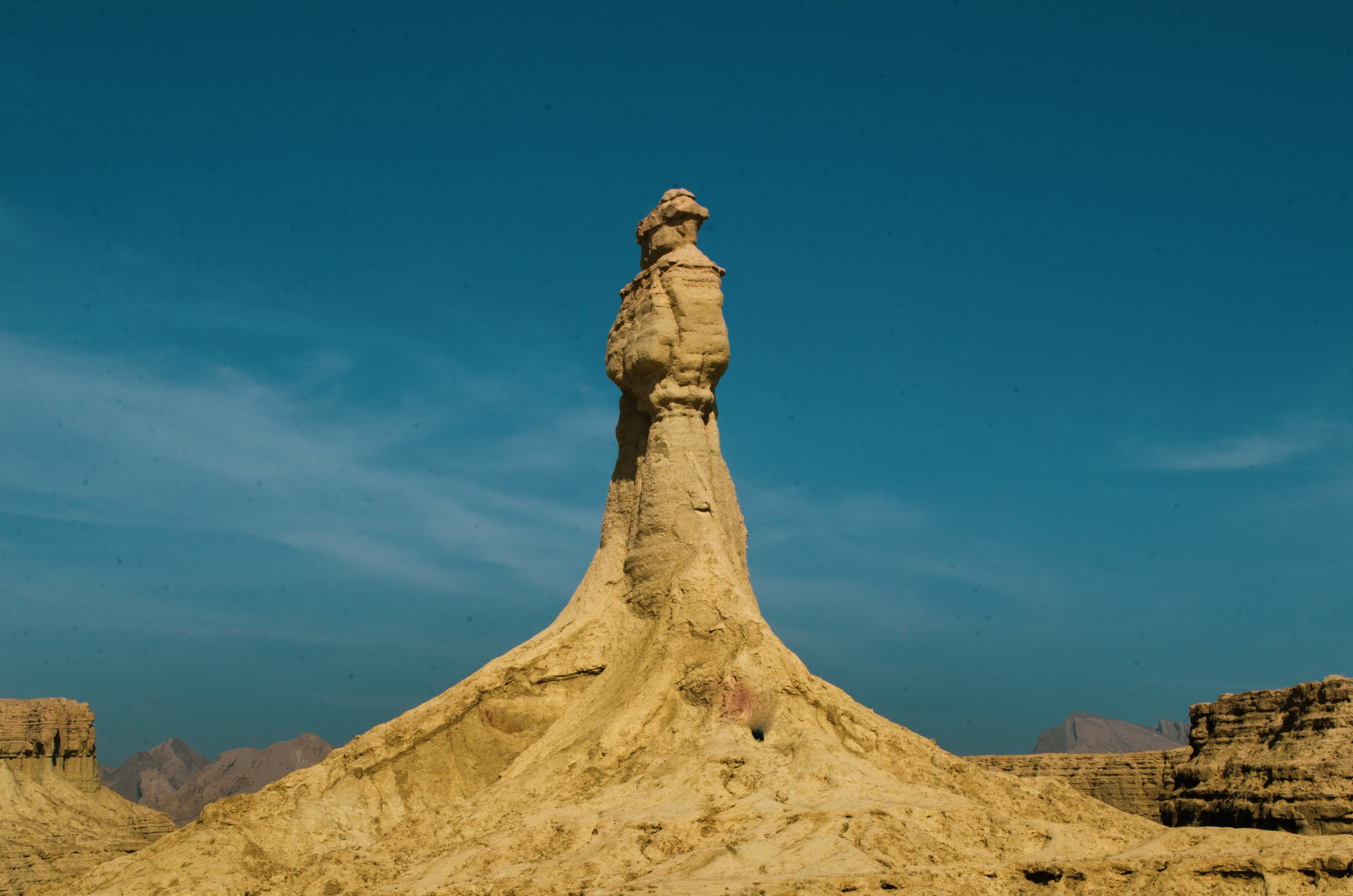
Princess of Hope
She stands alone in the desert, a crowned figure in flowing robes, gazing toward a horizon she will never reach. The Princess of Hope is not a statue. No human hand carved her. She is a hoodoo -- a geological term for a tall, thin column of rock left standing after softer surrounding material has eroded away -- and she owes her uncanny resemblance to a regal woman entirely to the patient work of ocean winds and the forces of erosion acting on the rock formations of Pakistan's Hingol National Park. When American actress Angelina Jolie encountered this formation during a UN goodwill mission to Pakistan in 2002, she gave the pinnacle its name. It stuck, and the Princess of Hope became one of the most photographed natural landmarks along the Makran coast.
Carved by Invisible Hands
The Princess stands in the Lasbela District of Balochistan, within a mountainous landscape riven with gorges and sculpted into forms that seem deliberately shaped. A joint study by the University of Geneva and the University of Tehran documented 36 distinct rock formations along this coastal strip, all products of the same relentless process: ocean waves depositing layers of soil and sediment against rocks of varying hardness, while tidal surges and desert storms carved away the softer material. Layers of deposited soil between 1 and 10 meters thick were observed on these rocks, growing thicker with distance from the beach. The result is a landscape that resembles an archaeological complex -- as if an ancient civilization had left its monuments behind. The Princess is the most famous of these formations, but she has company, including the nearby Balochistan Sphinx.
The Makran's Open-Air Gallery
Hingol National Park, where the Princess stands, covers 6,100 square kilometers of some of the most varied terrain in Pakistan. The park contains six distinct ecosystems, from arid subtropical forest to coastal semi-desert, and its rock formations have been drawing visitors since the Makran Coastal Highway opened in 2004. Before the highway, reaching this stretch of coast required a punishing two-day journey over dirt tracks from Karachi. Now the drive takes six to seven hours, and the Princess of Hope has become a waypoint for travelers heading west toward Gwadar. The formation rises from the earth beside the highway, visible to anyone willing to stop and look. From a distance, the resemblance to a human figure is striking; up close, the geological reality of layered sediment and differential erosion becomes clear, but the illusion persists in memory.
A Fragile Monument
Hoodoos are inherently temporary. The same erosion that created the Princess continues to work on her, and at some point -- centuries or millennia from now -- she will topple. The rock formations of the Makran coast are geologically young, products of relatively recent tectonic activity along the Arabian and Eurasian plates. The Makran coastal strip sits atop a subduction zone where these plates meet, and the ongoing geological processes that built these formations will eventually destroy them. For now, the Princess stands as a reminder that the most arresting beauty is often the least permanent, and that the forces of nature, given enough time, can produce sculptures that rival anything made by human hands.
From the Air
Located at 25.43N, 65.30E within Hingol National Park, Lasbela District, Balochistan, Pakistan. The formation is visible from the Makran Coastal Highway (N-10). Nearest airports are Karachi (OPKC) to the east and Gwadar (OPGD) to the west. Best viewed at 1,000-3,000 feet AGL. The surrounding terrain features dramatic gorges, layered rock formations, and desert landscape. The Balochistan Sphinx formation is nearby.