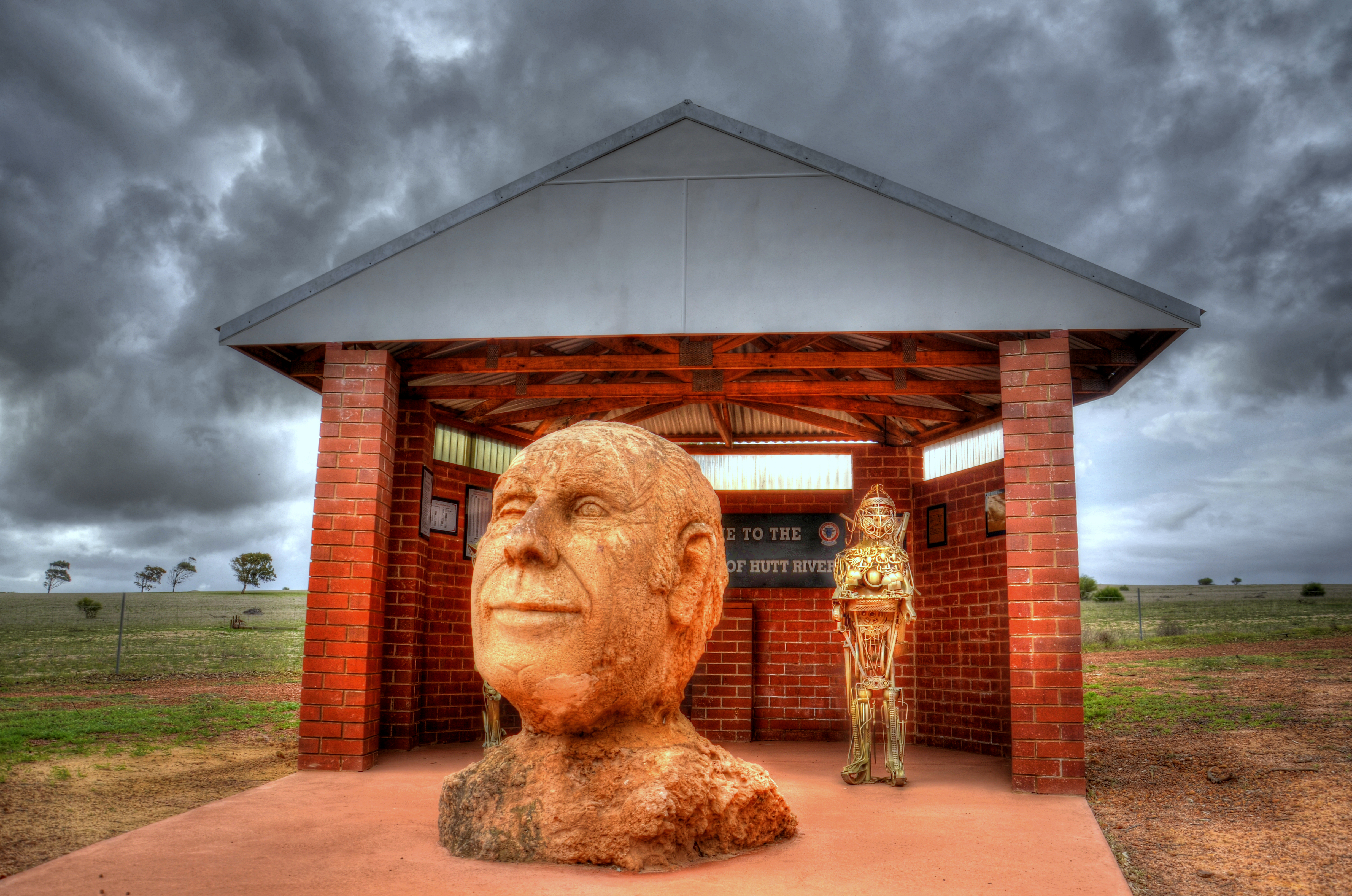
Principality of Hutt River
In December 1977, a wheat farmer in Western Australia declared war on the Commonwealth of Australia. He notified the authorities of the cessation of hostilities several days later. The farmer was Leonard Casley, and the nation he was defending was his own: the Principality of Hutt River, a 75-square-kilometer patch of farmland north of Perth that he had proclaimed a sovereign state seven years earlier. No government on Earth ever recognized it. That did not stop Casley from ruling for forty-five years, issuing passports, minting currency, and welcoming 40,000 tourists annually to what he insisted was a foreign country.
A Quarrel Over Wheat Quotas
The origin of Australia's most famous micronation was not ideology or philosophy but agricultural bureaucracy. In 1970, the Western Australian government imposed wheat production quotas that the Casley family considered ruinous. Five farming families at Hutt River initially banded together to fight the restrictions. Leonard Casley lodged a protest with the Governor of Western Australia, Sir Douglas Kendrew. The governor did not help. During the correspondence that followed, Casley claimed the governor-general's office once inadvertently addressed him as the "Administrator of the Hutt River Province," a clerical slip he treated as legally binding recognition of sovereignty. On 21 April 1970, Casley declared his farm an independent province and continued selling his wheat in open defiance of the quota. He believed Australian law gave the federal government two years to respond to his declaration, and when no formal response came, he proclaimed de facto autonomy on 21 April 1972.
Prince Leonard's Realm
What began as a protest hardened into performance, and eventually into something like belief. Casley styled himself "Prince Leonard" and bestowed royal titles on family members. The principality issued its own currency, the Hutt River Dollar, pegged one-to-one with the Australian dollar and minted by Canada's Lombardo Mint. Over fifty sets of postage stamps were released, building a solid global collector following. Passports were printed, entry and exit visas stamped, and a government apparatus assembled complete with a cabinet, an ADC, and a legislation committee that drafted a provisional constitution in 1997. The principality's claimed territory, larger than several internationally recognized countries, sat along the Hutt River near the town of Northampton. Its permanent population never exceeded twenty-three, but Casley insisted on a worldwide citizenry of 14,000.
Fatuous, Frivolous, and Vexatious
The Australian legal system was never amused. Casley was prosecuted in 1977 for failing to furnish documents to the Australian Taxation Office. His appeals to the Supreme Court of Western Australia were dismissed. In 2007, the High Court of Australia rejected his arguments as "fatuous, frivolous, and vexatious." In 2017, Justice Le Miere ordered Casley to pay more than $2.7 million in unpaid taxes, declaring that his sovereignty argument "has no legal merit or substance. Anyone can declare themselves a sovereign in their own home but they cannot ignore the laws of Australia or not pay tax." Yet the principality survived these defeats with a showman's resilience. When asked about the state's position on Prince Leonard, Western Australian minister Brendon Grylls offered the best summary anyone managed: "Only that Prince Leonard is an enigma."
Tourists at the Border
For all its legal absurdity, Hutt River became a genuine tourist destination. Forty thousand visitors a year, predominantly international, made the drive north from Perth to have their passports stamped at the border gate, meet the prince, and buy coins and stamps. The National Museum of Australia once included a display stating that Casley had "successfully seceded from Australia." Queen Elizabeth II sent good wishes for the principality's forty-sixth anniversary in 2016, a correspondence that delighted Casley enormously, though the letter from Buckingham Palace was a standard courtesy reply to his birthday congratulations to the Queen. Hong Kong's corporate registry briefly recognized the principality as a valid place of incorporation, a loophole the Australian Taxation Office worked quickly to publicize as potentially illegal.
Dissolution and Dust
Leonard Casley stepped down in 2017 after forty-five years and died in February 2019. His youngest son Graeme inherited the title of prince, a $2.5 million tax debt, and a principality in decline. Tourist numbers had fallen, agricultural revenue had dried up, and the tax office was closing in. In December 2019, Prince Graeme announced the closure of the borders. On 3 August 2020, compounded by the financial impact of the COVID-19 pandemic, the principality was formally dissolved after exactly fifty years. The land was sold to settle the tax dispute. What remains is a story too strange to have been invented: a wheat farmer who declared independence, minted coins, declared and ended a war, hosted tens of thousands of tourists, annoyed the High Court, charmed a queen, and ultimately lost it all to the one enemy no micronation can defeat: the tax man.
From the Air
Located at 28.08S, 114.48E, approximately 517 km north of Perth along the coast road near Northampton, Western Australia. The former principality is visible as a large farming property along the Hutt River. Geraldton Airport (YGEL) is the nearest significant airfield, about 65 km to the south. The terrain is flat to gently rolling agricultural land, best viewed at 2,000-3,000 ft AGL. The Indian Ocean coastline is visible to the west.