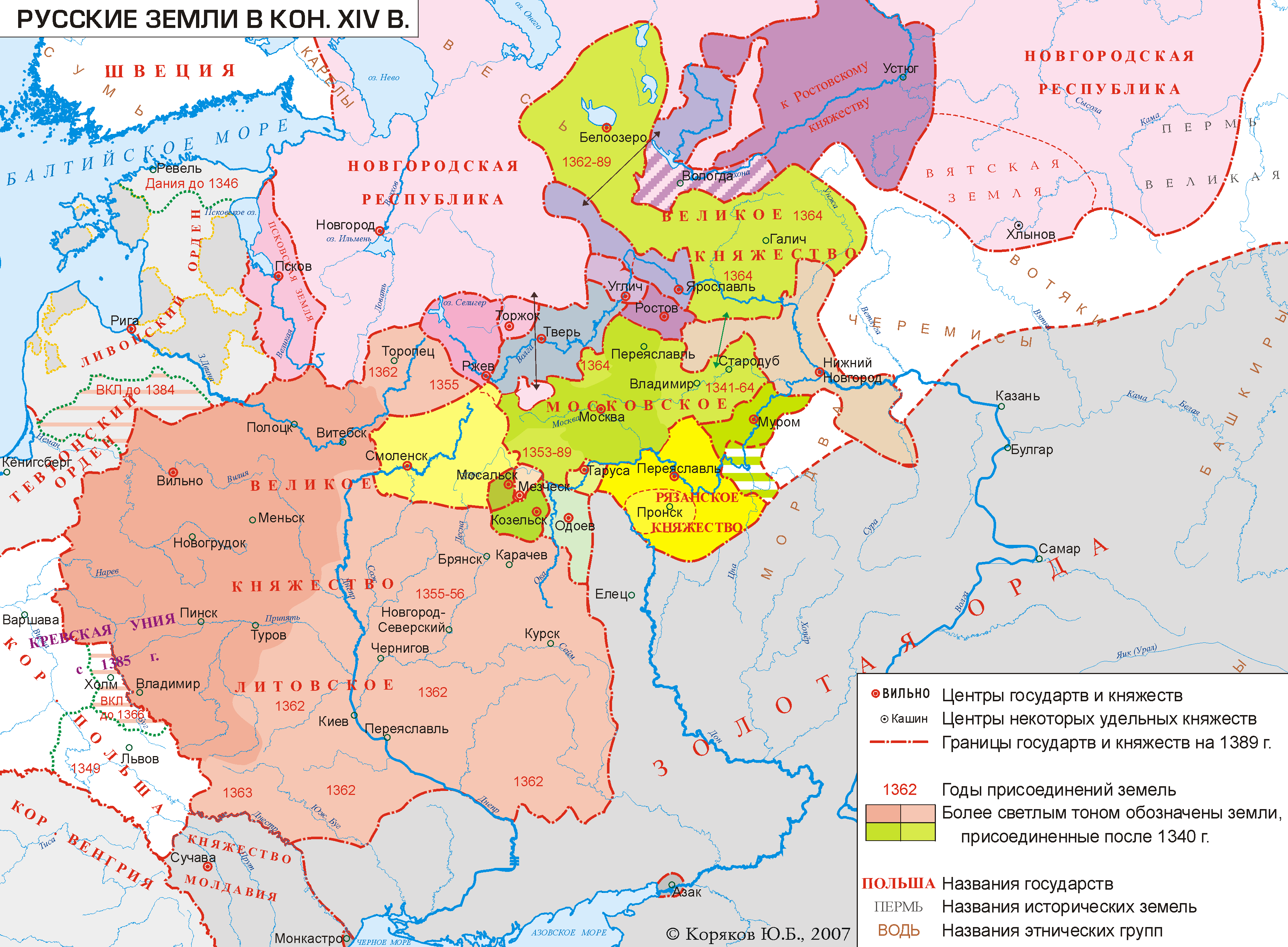
Principality of Tver
In 1318, Prince Mikhail of Tver was summoned to the Golden Horde, imprisoned for a month, tortured, and executed. His crime was not treachery or incompetence but success: Tver had grown too powerful, and the Mongol khans preferred a weaker, more pliable Moscow as their instrument of control in the Russian lands. That fatal miscalculation of Mongol politics set in motion a rivalry that would shape the future of Russia for two centuries, fought not primarily on battlefields but in the tent courts of the steppe, where Russian princes competed for Mongol favor with the desperation of men whose cities hung in the balance.
Born from the Wreckage of Kievan Rus'
When the Mongol invasion tore through northeastern Rus' between 1237 and 1241, it left a landscape of charred cities and shattered principalities. Vladimir, Ryazan, and dozens of smaller towns were devastated. But Tver, perched on the Upper Volga about 170 kilometers northwest of modern Moscow, escaped the worst. Refugees streamed in from the ruined cities to the south and east, swelling Tver's population during the very decades when its neighbors lay in ashes. In the 1240s, Grand Prince Yaroslav Vsevolodovich detached the city from the Pereyaslavl-Zalessky principality and gave it to his son. By 1246, Yaroslav Yaroslavich had become the first Prince of Tver, founding a dynasty that would rule for nearly 240 years. The principality's position on the Volga trade route, connecting the northern fur lands with the Mongol capital at Sarai, brought wealth and ambition in equal measure.
The Game of Khans
Tver's golden age and its tragedy were inseparable from Mongol politics. Under Mikhail, who became prince in 1285 and grand prince of Vladimir by 1305, the principality reached its zenith. But power attracted scrutiny. Ozbeg Khan decided that Tver had grown too strong and threw his support behind Moscow's prince, Yuri Danilovich. In 1317, Yuri marched against Tver with Mongol backing. Mikhail defeated him at the village of Bortenevo, capturing Ozbeg's own sister, Konchaka, who was Yuri's wife. When Konchaka died in Tver's captivity, Yuri seized his chance, accusing Mikhail of her murder. Summoned to the Horde, Mikhail faced a gruesome end. His son Dmitry was executed in 1326; another son, Aleksandr, along with his own son Fyodor, were killed there in 1339. Three generations of Tver's ruling house perished at the hands of their Mongol overlords, their deaths orchestrated by Moscow's relentless diplomacy.
Fire and Submission
The year 1327 brought catastrophe from within. An anti-Tatar uprising erupted in Tver, a spontaneous explosion of resentment against Mongol tax collectors and their abuses. The Golden Horde's response was merciless: the city was burned to the ground, and a large portion of its population was killed or scattered. Moscow, which had stayed loyal to the khans, helped suppress the revolt and was rewarded with even greater authority. From that point forward, Tver fought from a position of permanent disadvantage. The principality still stretched from Kashin in the east to Zubtsov in the west, encompassing the Shosha River valley and the surrounding uplands, but its political weight had been broken. While Moscow absorbed one neighboring principality after another, Tver's borders remained essentially unchanged for the remaining 150 years of its existence.
The Final Act
By the 1470s, the contest was no longer between equals. Moscow under Ivan III had swallowed Novgorod, subdued Ryazan, and was pressing on all sides. Tver's last prince, Mikhail III, signed a series of treaties with Moscow that effectively reduced his principality to a vassal state. When Mikhail sought to counterbalance Moscow's dominance by forging an alliance with Lithuania, Ivan III treated the move as rebellion. In 1485, Moscow's army marched on Tver. The conquest was swift and final. After nearly two and a half centuries of independence, the principality was absorbed into the growing Muscovite state. Tver became a provincial city, its centuries of rivalry with Moscow reduced to a historical footnote. Yet the outcome had never been inevitable: had the khans chosen differently, had Konchaka survived, had the 1327 uprising never happened, the capital of Russia might sit today on the Upper Volga rather than the Moskva River.
Echoes on the Volga
Modern Tver retains little visible trace of its medieval greatness. The Transfiguration Church, one of the first major construction projects in northeastern Rus' after the Mongol invasion, is long gone. But the city's position on the Volga remains commanding, the same geographic advantage that once made it a trading hub and a contender for supremacy. The river still flows past the bluffs where princes once plotted against Moscow and where Mongol envoys arrived with demands that could mean life or death for a dynasty. Tver Oblast, roughly coterminous with the old principality's boundaries, covers the territory between Smolensk and Moscow where this struggle played out. For anyone tracing the origins of the Russian state, the story is incomplete without understanding how close Tver came to winning the contest that Moscow ultimately claimed.
From the Air
Located at 57.00°N, 36.00°E on the Upper Volga, approximately 170 km northwest of Moscow. The Volga River corridor is the primary visual landmark. Nearest major airport is Migalovo (UUEM) near Tver. Best viewed at medium altitude where the river valley and surrounding terrain are visible. Tver city sits at the confluence of the Volga and Tvertsa rivers.