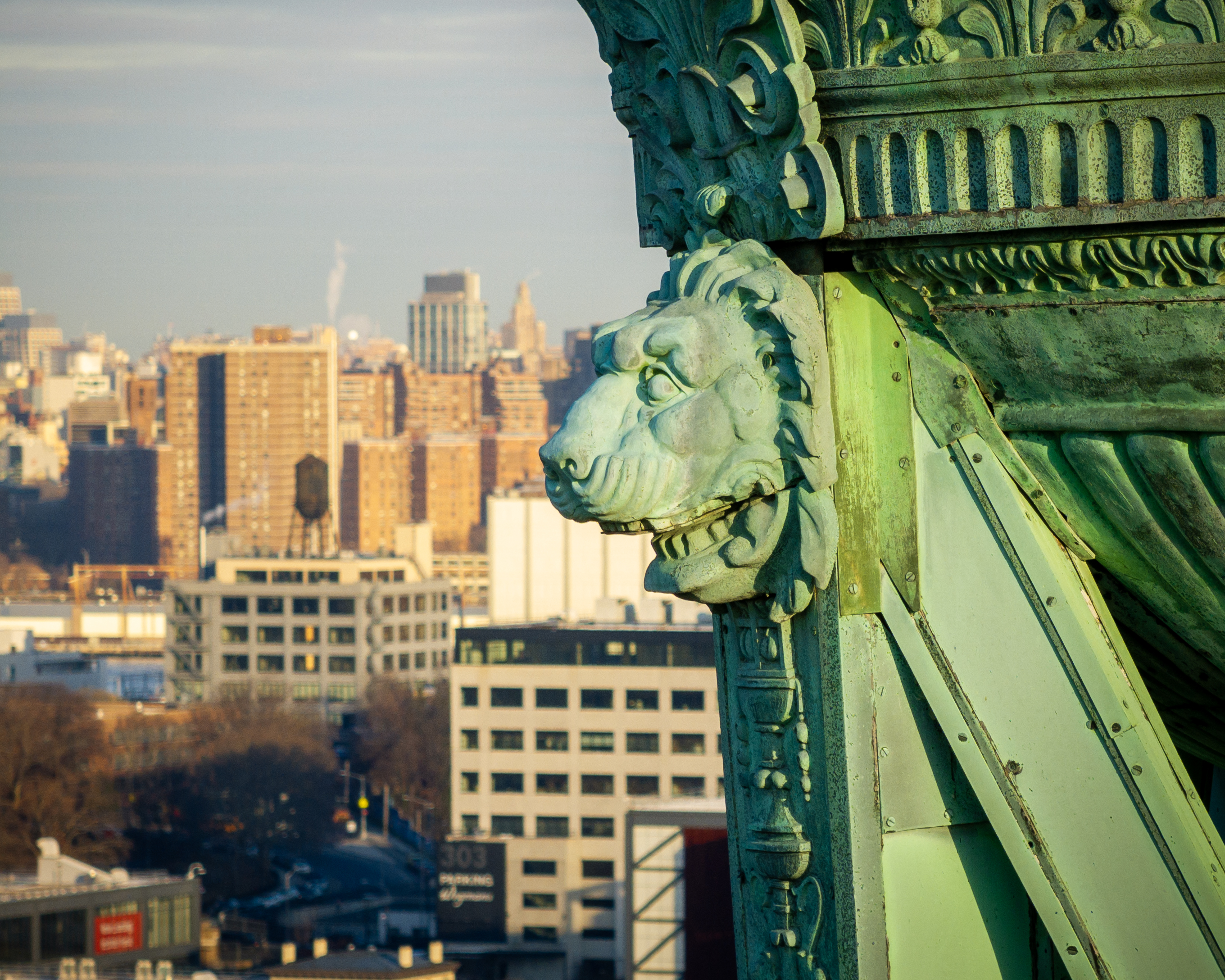
Prison Ship Martyrs' Monument: Brooklyn's Forgotten Dead
The skulls lay along the Brooklyn shore "as thick as pumpkins in an autumn cornfield." That was how one observer described the remains of American prisoners of war, left to rot on the banks of Wallabout Bay after the British prison ships emptied their dead into the shallows. More than 11,500 Americans perished aboard sixteen British vessels anchored in New York Harbor during the Revolutionary War, a toll greater than all the battle deaths of the Revolution combined. For decades after independence, their bones washed from the eroding shoreline, surfaced during construction, and filled casks and hogsheads collected by horrified citizens. Today, those remains rest in a crypt beneath a 149-foot Doric column in Fort Greene Park, Brooklyn, crowned by an eight-ton bronze funeral urn designed by Stanford White of McKim, Mead & White.
The Floating Dungeons of Wallabout Bay
During the Revolutionary War, the British held American captives aboard decommissioned vessels anchored in the East River near what is now the Brooklyn Navy Yard. Conditions were catastrophic. Disease, starvation, and deliberate neglect killed prisoners by the thousands. Those who died were disposed of quickly, either tossed overboard or given shallow burials along the muddy Brooklyn shore. When the war ended in 1783, no one came for the dead. Wallabout Bay was a rural backwater, little visited by New Yorkers, and the remains of the fallen simply lay where tide and erosion deposited them. A New York Times report from 1877 noted that the dead had come from every state in the Union. Officials from the local Dutch Reformed Church tried to recover the bones, but the property owner resisted. Construction workers at the nearby Naval Yards began filling casks and boxes with bones they unearthed, unsure what else to do.
Politics, Pockets, and a Monument That Never Was
The dead might have remained forgotten had partisan politics not intervened. In the early 1800s, the Democratic-Republicans, led by the Tammany Society under Benjamin Romaine, seized on the prison ship martyrs as a political cause, a counterpoint to the Federalists' statue of George Washington erected in 1803. Anti-British sentiment, stoked by trade disputes and Thomas Jefferson's Embargo Act of 1808, gave the movement momentum. On May 26, 1808, a grand ceremony re-interred the collected bones in a vault near the Navy Yard waterfront, in what is now Vinegar Hill. New York State voted $1,000 for Tammany to build a monument. The Society pocketed the money and never built it. A small square building with an eagle on the roof was the best the dead received. It fell into disrepair. Romaine spent years pleading for support, eventually pledging his own Revolutionary War pension for the cause. He died in 1844 and was interred alongside the martyrs, having been a prisoner on the ships himself.
Stanford White's Grand Column
It took until the turn of the twentieth century for the monument to become reality. After additional bones surfaced during Brooklyn Navy Yard excavations in 1899, renewed public interest finally produced funding. In 1902, Congress appropriated $100,000, New York State contributed $25,000, the city added $50,000, and private donors covered the final $25,000. The renowned architect Stanford White was commissioned to design the memorial. White created a soaring granite Doric column topped by an eight-ton bronze brazier, a funeral urn sculpted by Adolph Weinman. A grand staircase of 99 granite steps rises in three stages to the column's base, where four open-winged bronze eagles once stood guard. President-elect William Howard Taft dedicated the monument on November 14, 1908, declaring of the dead: "They died because of the cruelty of their immediate custodians and the neglect of those who, in higher authority, were responsible for their detention."
Cycles of Neglect and Renewal
The monument's history mirrors the nation's uneven memory of its earliest fallen. By 1921, the twin helix stairways inside the column, once open to visitors for a dime, were closed. In 1923, vandals battered the bronze crypt door from its hinges. The four bronze eagles were stolen, recovered from a recycling yard with their wings partially melted, and eventually removed for safekeeping in 1962. For decades they sat outside the Parks Commissioner's office in the Central Park Arsenal, the subject of unfulfilled promises to return them. Robert Moses reopened the monument in 1937 with a new staircase and elevator, but both were removed by 1949. A major $5.1 million restoration was completed in 2008 for the centennial, when more than 500 people gathered to relight the beacon atop the column. Two original eagles and two replicas finally returned to Fort Greene Park that year. Inside the crypt, twenty slate boxes hold sorted bone fragments, the individual identities of the dead long since lost.
The Crypt Beneath the Hill
Descend three steps through a copper-clad door at the base of the staircase, follow a short passageway into the hill, and you enter the brick-lined crypt. The floor is concrete, the walls and ceiling bisque-colored brick. Slate coffins line shelves on both sides, the bones sorted by type because individual bodies could never be reassembled. A visitors center displays Revolutionary War weapons and uniform buttons uncovered in the park, along with a list of 8,000 known prisoners copied from British War Department records. The monument sits atop what was once Fort Putnam, built in 1776 to defend New York from the British. The irony is hard to miss: the hill that American soldiers fortified for war became the final resting place for Americans whom that war consumed. The U.S. Department of the Interior initially declined to grant national designation, noting that the prisoners had not died at this site. But the bones are here, and so is the memory.
From the Air
The Prison Ship Martyrs' Monument (40.6918N, 73.9756W) stands at the highest point of Fort Greene Park in Brooklyn, New York. The tall Doric column with its bronze urn is visible from moderate altitude, rising above the tree canopy of the park. The Brooklyn Navy Yard is immediately to the north, and the Manhattan Bridge and Brooklyn Bridge are visible to the west. Nearby airports: KJFK (John F. Kennedy, 20km SE), KLGA (LaGuardia, 12km NE), KEWR (Newark Liberty, 18km SW), KTEB (Teterboro, 20km NW). Best viewed at 1,500-2,500 feet AGL approaching from the East River. The park's rectangular shape and the column's prominent position at its summit are distinguishing landmarks.