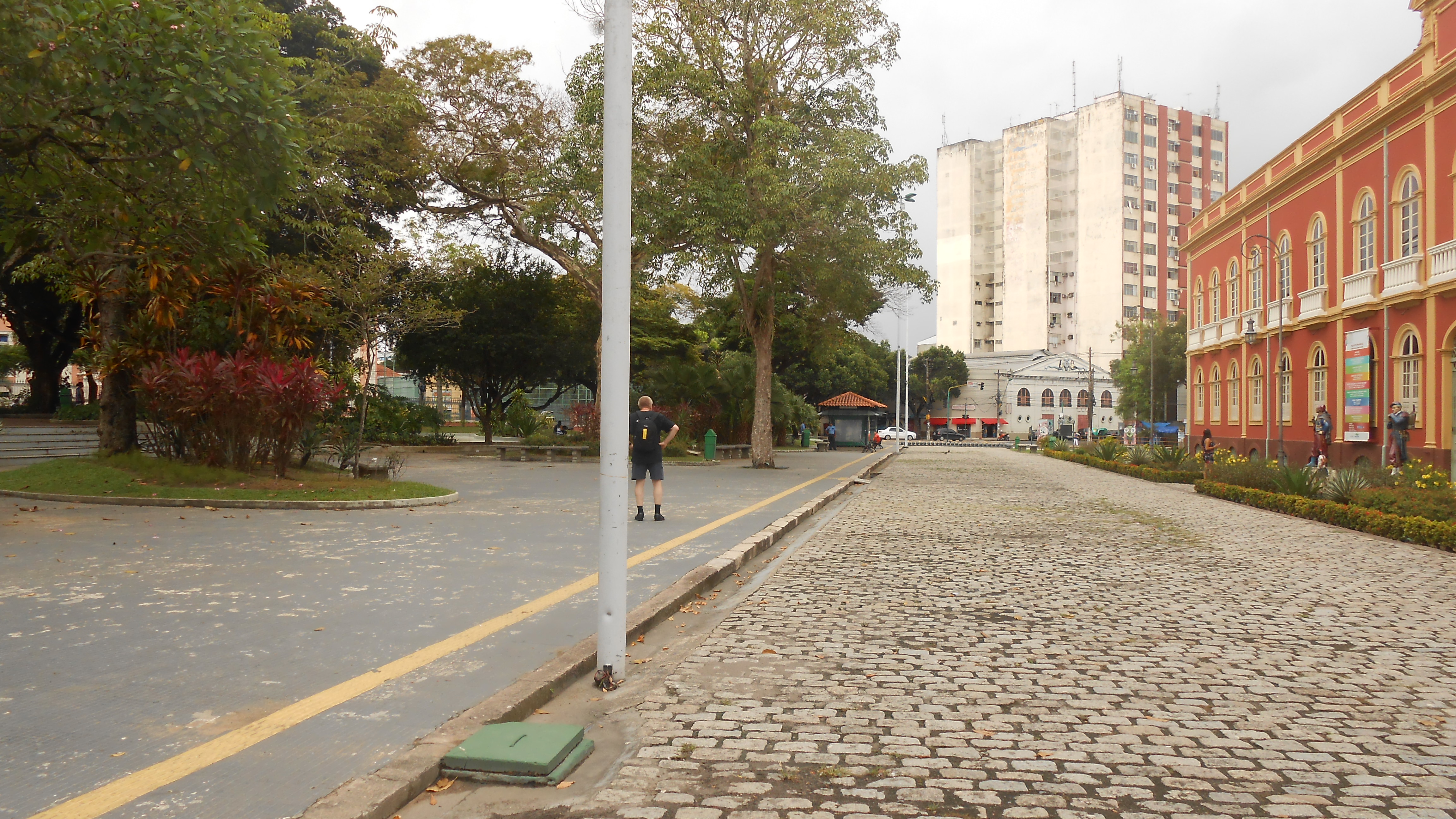
Provincial Palace
Alexandre Paulo de Brito Amorim began building the Palacete Provincial in 1861 as a house for his family, and he never finished it. What happened next is a kind of architectural adoption: a captain of the National Guard bought the half-built mansion, sold it to the president of the province, and by the time the construction was completed on March 25, 1874, the house that was supposed to be a private residence had become the seat of a government. The palace has been a home to power, a police headquarters, and finally a museum complex ever since.
A House That Became a Capital
For a building in the historic center of Manaus, the Palacete Provincial does a lot of different jobs. From 1875 until 1888, it was where the presidents of the Province of Amazonas lived and governed. In the early years it also housed the Provincial Assembly, the Public Works Department, the Public Library, and the Liceu Provincial, a school that later became the Colegio Amazonense D. Pedro II. Picture the building in the 1870s, with bureaucrats moving between offices, lawmakers arguing in a converted drawing room, and a library humming in a wing that was meant to be bedrooms. Cities this far up the Amazon did not have the luxury of one-purpose buildings. The palace was the state, compressed into a single structure.
The Painters Who Came for the Rubber
Between the 1890s and the First World War, Manaus was flooded with money from the rubber boom, and that money reshaped the city into something genuinely cosmopolitan. Painters, photographers, and architects came from southern Brazil and from Italy, drawn by the work available among wealthy rubber barons and a government that wanted monuments. Crispim do Amaral, Fernandes Machado, Aurelio de Figueiredo, and Antonio Parreiras all spent stretches in the city painting commissioned works that now hang in the palace's Pinacoteca. The Amazon Theatre, inaugurated in 1896 a few blocks away, was the grand symbol of that era, but the artistic infrastructure ran deeper. Art classes were added to public schools, and the Academia Amazonense de Belas Artes trained a generation of local painters before the rubber economy collapsed and the work dried up.
A Century in Uniform
When the province stopped governing from the palace in 1888, the building was handed to the Amazonas Military Police, and it stayed with them for more than a hundred years. For most of the twentieth century, what had been the governor's reception rooms were full of weapons, uniforms, and the filing cabinets of a provincial police force. The Tiradentes Museum, named for the patron of Brazil's military police, opened inside the palace in 2009 with sixteenth-century armor, old fire department equipment, and the personal notebooks of officers long gone. In the Flagrant of History exhibition, visitors can watch archival video of ceremonies and hear the report of antique sidearms being fired. The building's century of police service is preserved as a kind of house museum of the force itself.
Five Museums Under One Roof
The Amazonas Secretariat for Culture runs the palace today, and they have managed to fit five distinct museums inside it. The Pinacoteca do Estado holds more than a thousand works covering Brazilian art of the nineteenth and twentieth centuries, with a focus on painters from Amazonas. Modernists like Alfredo Volpi and Ciceero Dias share wall space with Manoel Santiago's Curupira, an oil from the 1930s that pulled the figure of an Amazonian forest spirit into the nationalist painting of that decade. The Bernardo Ramos Museum of Numismatics holds more than seventeen thousand coins, banknotes, medals, and decorations assembled by a single Manaus collector. An archaeology museum, a museum of image and sound, and the Tiradentes Museum round out the complex. A single ticket puts you in the heart of five different collections.
The Clube da Madrugada
After the rubber collapse, Manaus's cultural life went quiet for decades. In the 1950s a group of painters and writers decided to wake it back up. They called themselves the Clube da Madrugada, the Dawn Club, and they met at the palace and at the nearby Amazonas Public Library. The founders included the painters Moacir Andrade, Afranio de Castro, Oscar Ramos, and Anisio Mello, and the writers Antistenes Pinto, Alencar e Silva, and Jorge Tufic. Their manifesto was anarchic and libertarian, and their goal was to make avant-garde art in a city that had fallen off the national cultural map. Works by several Clube members hang in the Pinacoteca today, a loop closed by the building that sheltered them.
From the Air
Located at 3.14 degrees S, 60.02 degrees W in the historic center of Manaus, about two blocks from the Amazon Theatre and half a kilometer from the floating quays of the Port of Manaus. The nearest airport is Eduardo Gomes International (SBEG), about 15 km north. Best viewed from 3,000 to 5,000 feet over the colonial core, where the pale palace facade and the red roof of the Amazon Theatre stand out against the denser modern city.