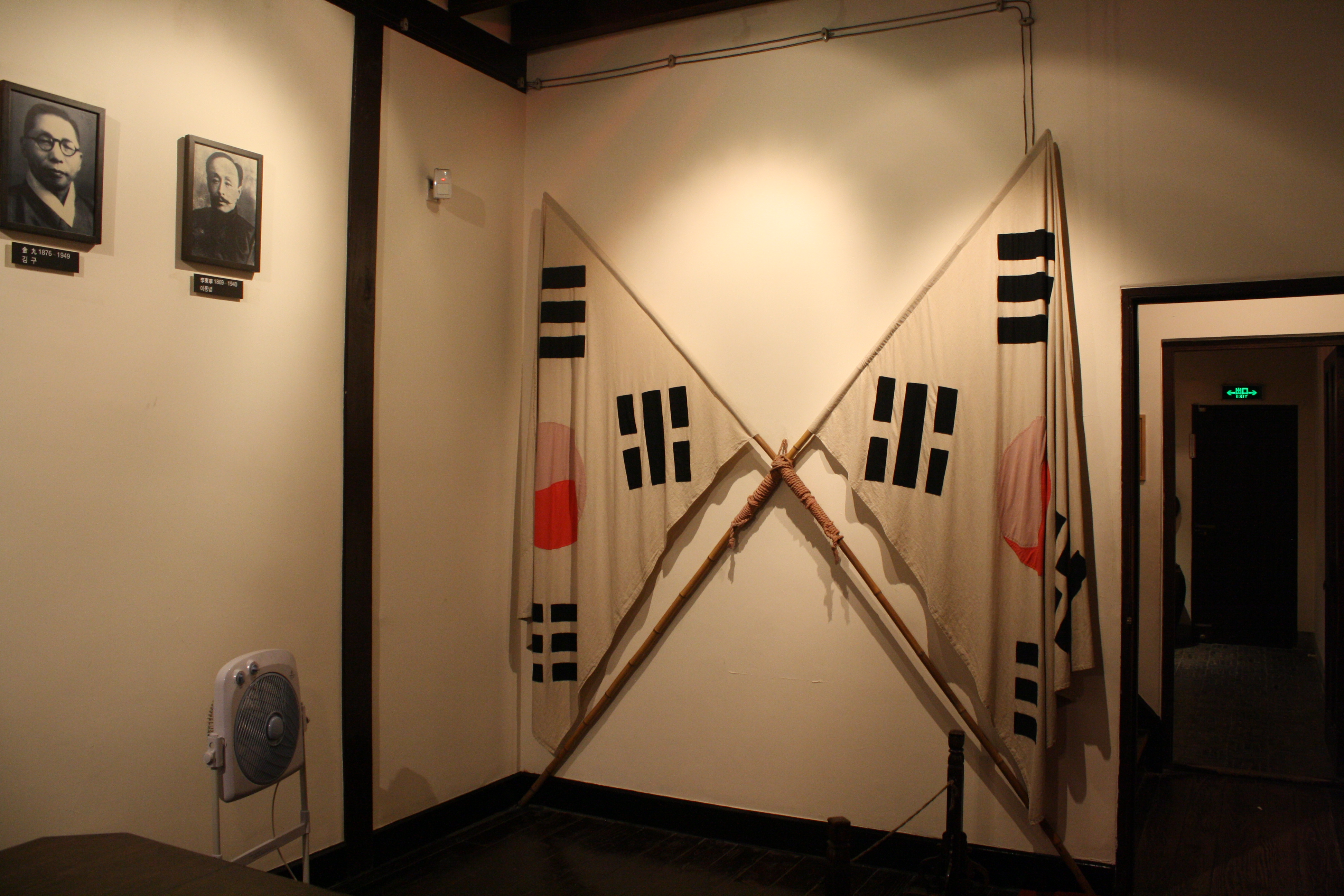
Provisional Government of the Republic of Korea
The name came first. On April 11, 1919, in a rented building in Shanghai's French Concession, Korean exiles declared the existence of the 'Republic of Korea' and drafted a provisional constitution establishing a democratic government with three branches. There was no territory to govern, no army to command, and no international recognition. Japan had annexed Korea nine years earlier, and the delegates who gathered in Shanghai were refugees, intellectuals, and activists united by a single conviction: that a nation could exist in principle even when it had been erased from the map.
Born from Protest
The immediate catalyst was the March First Movement, a massive nonviolent uprising that swept Korea on March 1, 1919, when an estimated two million Koreans took to the streets demanding independence from Japanese colonial rule. Japan responded with lethal force, killing thousands. The brutality convinced Korean nationalists abroad that organized political resistance required a formal government structure, not just demonstrations. Within weeks, multiple provisional governments were declared in Korea, Vladivostok, and Shanghai. By September 1919, these competing bodies had merged under the Shanghai-based government, with Syngman Rhee serving as its first president. The KPG adopted a presidential system modeled on democratic republics, a radical choice in an era when monarchy had been Korea's only form of governance.
Wandering Government
Shanghai offered relative safety in its international concessions, but after Japan invaded China in 1932, the KPG began a long retreat westward. The government relocated repeatedly, moving through Hangzhou, Zhenjiang, Changsha, Guangzhou, and Liuzhou before settling in Chongqing in 1940. Each move meant abandoning offices, networks, and local support. Kim Ku, who served as president of the KPG for much of this period, held the fractious coalition together through force of personality and an unwavering commitment to independence. The Kuomintang government of Chiang Kai-shek provided economic and military support, recognizing the KPG as a useful ally against Japan. France and the Soviet Union also offered assistance, though recognition of the KPG as a legitimate government remained elusive.
The Korean Liberation Army
In September 1940, the KPG established the Korean Liberation Army in Chongqing, giving the government-in-exile its first military force. Under the command of General Ji Cheong-cheon, the army recruited Korean conscripts who had deserted from the Imperial Japanese Army and trained them for guerrilla operations. The KLA fought alongside Chinese Nationalist forces and later cooperated with the British in operations in India and Burma. By the war's end, the KLA was planning a joint operation with the U.S. Office of Strategic Services to infiltrate the Korean Peninsula, but Japan's surrender in August 1945 came before the plan could be executed. The army never had the chance to liberate its homeland by force.
Recognition Denied
Despite 27 years of continuous operation, the KPG was never formally recognized by any Allied power as Korea's legitimate government. When Japan surrendered on August 15, 1945, the United States established a military administration in southern Korea rather than handing power to the provisional government. KPG leaders returned to Korea as private citizens, not as heads of state. The rejection was devastating. Syngman Rhee, Kim Ku, and other KPG figures competed for influence in the chaotic postwar landscape, their wartime unity dissolving into factional politics. Kim Ku was assassinated in 1949 by a South Korean army officer, a murder that remains a painful chapter in the nation's history.
The Constitution Endures
South Korea's current constitution traces its legal lineage directly to the KPG's founding charter. The preamble of the Republic of Korea's constitution explicitly invokes the spirit of the March First Movement and the provisional government's democratic ideals. Several buildings used as KPG headquarters in Shanghai and Chongqing have been preserved as museums, visited by South Korean tourists as sites of patriotic pilgrimage. In Seoul, the former KPG headquarters in the Seodaemun area stands as a memorial. The provisional government's legacy is complicated, as scholars debate how much credit it deserves for Korean independence versus the broader geopolitical forces that ended Japanese rule. But its constitutional vision, a democratic Korean republic, ultimately prevailed over competing models, embedding itself in the DNA of the modern state.
From the Air
The KPG's Seoul memorial is located near 37.57N, 126.97E in Seodaemun District. From the air, the area sits northwest of central Seoul near Gyeonggyojang. Nearest airports: Gimpo International (RKSS) approximately 12 km west, Incheon International (RKSI) approximately 50 km west. The Joint Security Area at Panmunjom, where the KPG's dream of reunification remains unresolved, lies about 50 km to the north.