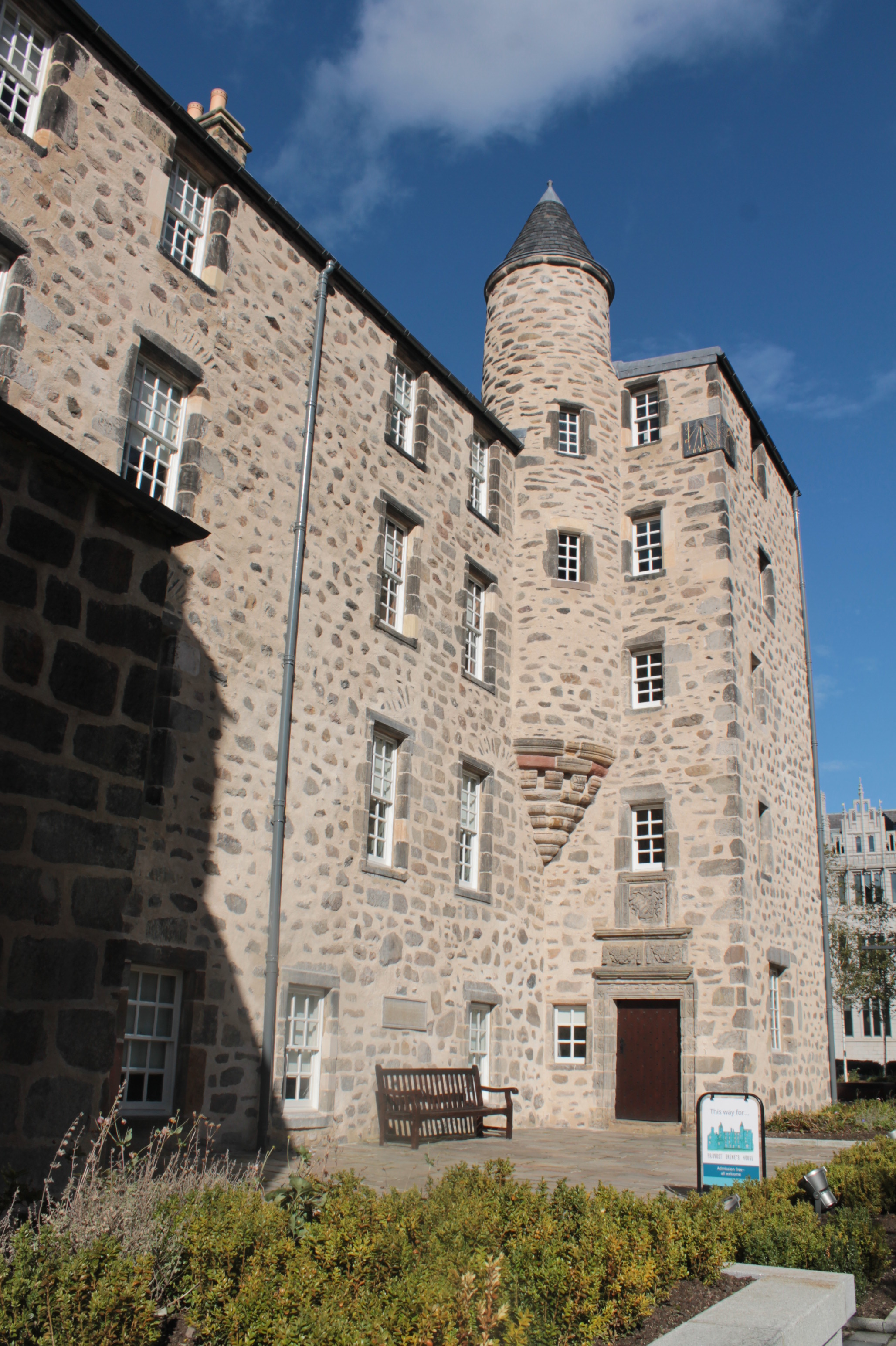
Provost Skene's House
Climb to the attic gallery of Provost Skene's House and you will find something unexpected: a Renaissance painted ceiling, complete with strapwork decoration and religious scenes, commissioned by a member of the Lumsden family in an era when Aberdeen was still a medieval burgh of narrow streets and granite walls. The ceiling survived the Reformation, survived centuries of neglect, survived the modernisation that erased most of the city's medieval domestic architecture. It is the most remarkable thing inside the most remarkable old house in Aberdeen.
1545 and Standing
Built in 1545, Provost Skene's House is a rare survival of Aberdeen's medieval burgh architecture. It takes its name from Provost George Skene, who bought the property in 1669 and is thought to have commissioned the elaborate plaster ceilings that adorn several rooms. The house sits in central Aberdeen, midway between the Kirk of St Nicholas and Marischal College, embedded in a city that has otherwise been thoroughly rebuilt in granite. Window sizes were enlarged in the mid-18th century, but the building's envelope and interior remain substantially intact -- a time capsule surrounded by centuries of change.
A Queen Mother Opens the Door
In 1953, Queen Elizabeth the Queen Mother opened the building to the public as a Period House and Museum of Local History. The rooms were furnished in the styles of the 17th, 18th, and early 19th centuries, creating a walk through Aberdeen's domestic evolution. A Costume Gallery displayed period dress. Coin collections and local history exhibits filled the remaining spaces. For decades, the house served as a quiet reminder of how Aberdonians once lived, a counterpoint to the imposing granite civic buildings that dominated the surrounding streets.
Reopened and Reimagined
In 2021, after extensive renovations, Provost Skene's House reopened with a new identity. The period rooms were replaced with displays celebrating prominent figures connected to Aberdeen -- singers, writers, doctors, and business owners who were born, lived, or worked in the city. Only the Painted Gallery, with its extraordinary Renaissance ceiling, was retained from the earlier incarnation. The museum is free to the public and rated three stars by the Scottish Tourist Board. The renovation reflects a broader trend in Scottish museum practice: moving from recreated rooms toward personal stories, letting individual lives carry the weight of history.
The Last Medieval House
What makes Provost Skene's House significant is less what it contains than what it represents. Aberdeen's medieval domestic architecture has almost entirely disappeared, replaced by the granite Victorian city that visitors see today. This house, built when Mary, Queen of Scots was three years old, is one of the few survivors -- a building that remembers what Aberdeen looked like before the granite age. The Renaissance painted ceiling in the attic, the 17th-century plaster work on the walls, the proportions of rooms designed for a different century -- all offer a glimpse of a city that no longer exists except within these walls.
From the Air
Located at 57.15N, 2.10W in central Aberdeen on Guestrow. The house is embedded within the urban fabric and not individually visible from altitude. Nearest airport: Aberdeen (EGPD), approximately 5 miles northwest.