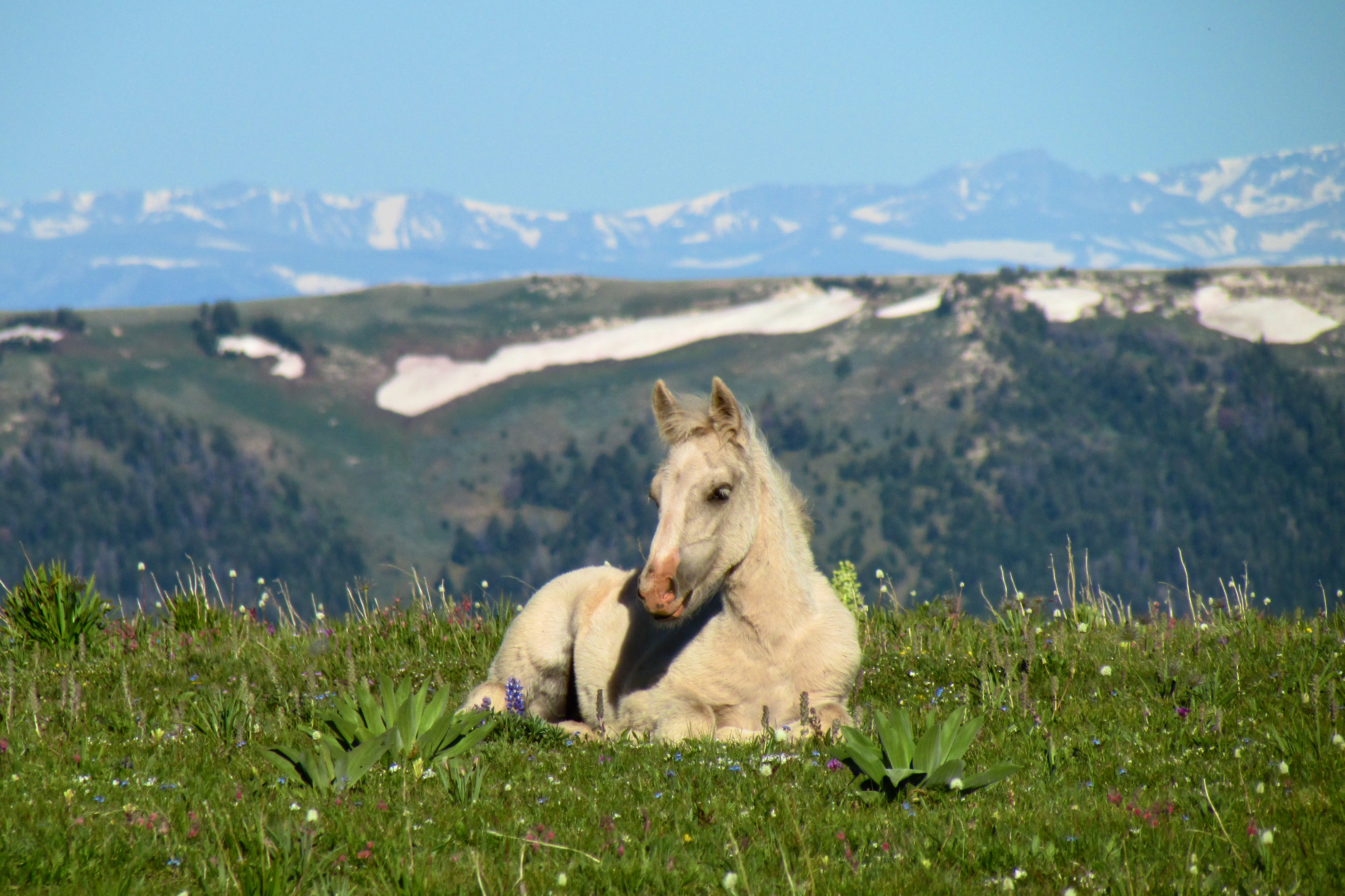
Pryor Mountains Wild Horse Range
In 1992, equine geneticist Dr. E. Gus Cothran delivered a verdict that changed how the world viewed a small herd of mustangs roaming the Montana-Wyoming border: "The Pryor herd may be the most significant wild-horse herd remaining in the United States." These horses carry a rare allele variant called Qac that links them directly to Spanish horses brought to the Americas centuries ago. They display primitive markings, dorsal stripes running down their backs and zebra-like bands on their legs, physical echoes of their ancient lineage. Nowhere else on Earth do horses like these still run free.
Ghosts of Spanish Conquest
Crow Indian tradition holds that horses arrived in the Pryor Mountains around 1725. By the time American pioneers reached the area in the late 1800s, thousands of feral horses roamed the high country. DNA testing has revealed their ancestry: linear descendants of Spanish Barbs, with genetic markers connecting them to the Colonial Spanish Horse type. Dr. D. Phillip Sponenberg of Virginia-Maryland Regional College of Veterinary Medicine studied the herd and concluded that physically, the horses conform precisely to this rare type. Nearly every horse on the range displays primitive markings that domesticated breeding programs long ago erased from most equine bloodlines.
The Woman Who Saved Them
By 1900, two to five million feral horses roamed federal lands. Within decades, government programs had killed hundreds of thousands, their carcasses sold for pet food. When the Bureau of Land Management ordered the Pryor Mountains horses removed in 1964, a woman named Velma Johnston began a campaign that would reshape American law. Johnston founded the International Society for the Protection of Mustangs and Burros in 1965 and rallied the Tillett family, local ranchers who claimed the horses as their own rather than see them slaughtered. After ABC News covered the controversy, mail flooded the BLM and Congress. On September 9, 1968, Secretary of the Interior Stewart Udall established the Pryor Mountains Wild Horse Range, the first refuge in America dedicated exclusively to wild horses.
A Legal Battle for Wildlife
The 1968 designation did not end the conflict. Ranchers continued pushing to remove the horses, arguing they competed with livestock for grass. In 1971, President Richard Nixon signed the Wild and Free-Roaming Horses and Burros Act, making it a federal crime to harass or kill wild horses on public land and declaring them living symbols of the historic and pioneer spirit of the West. When New Mexico challenged federal authority over the horses, the case reached the Supreme Court. In Kleppe v. New Mexico (1976), the justices ruled that wild horses are wildlife deserving federal protection. The Pryor Mountains herd became one of only three herds in America with a range dedicated solely to their existence.
Deep Time in Stone
The mountains themselves tell a story measured in tens of millions of years. The Pryor range formed in the late Cretaceous and early Tertiary periods, 70 to 60 million years ago, when magma welled up from below and cracked a vast limestone plateau into four pieces, uplifting the northeast corner of each. The Bighorn River flows along the fault line between the Pryor and Bighorn ranges, carving Bighorn Canyon deep into the ancient limestone. The mountains bear the name of Sergeant Nathaniel Hale Pryor of the Lewis and Clark Expedition, who chased stolen horses through this country in 1806.
A Fragile Balance
Managing the herd means balancing genetics against carrying capacity. Only five perennial water sources exist on the range, and historic overgrazing by livestock left limited forage. The BLM set the maximum population at 95 adult animals in 1992. Genetic testing in 1994, 1997, and 2001 showed diversity above the mean for feral herds in America. Beyond horses, the range shelters Rocky Mountain bighorn sheep, elk, gray wolves, cougars, and Montana's most diverse bat population with ten species identified. Visitors access the range via a paved road paralleling Bighorn Canyon. About a quarter of the refuge lies within Bighorn Canyon National Recreation Area, where the wild horses graze against a backdrop of cliffs and river.
From the Air
The Pryor Mountains Wild Horse Range straddles the Montana-Wyoming border at 45.05N, 108.32W. From 6,000-8,000 feet AGL, look for the distinctive limestone plateau of the Pryor range with Bighorn Canyon cutting through to the east. The refuge has no maintained airstrip; the nearest airport is Laurel, Montana. Billings Logan International (KBIL) lies about 45 miles northeast. Best viewing in early morning or late afternoon when horses move to water. The terrain is rugged with limited emergency landing options.