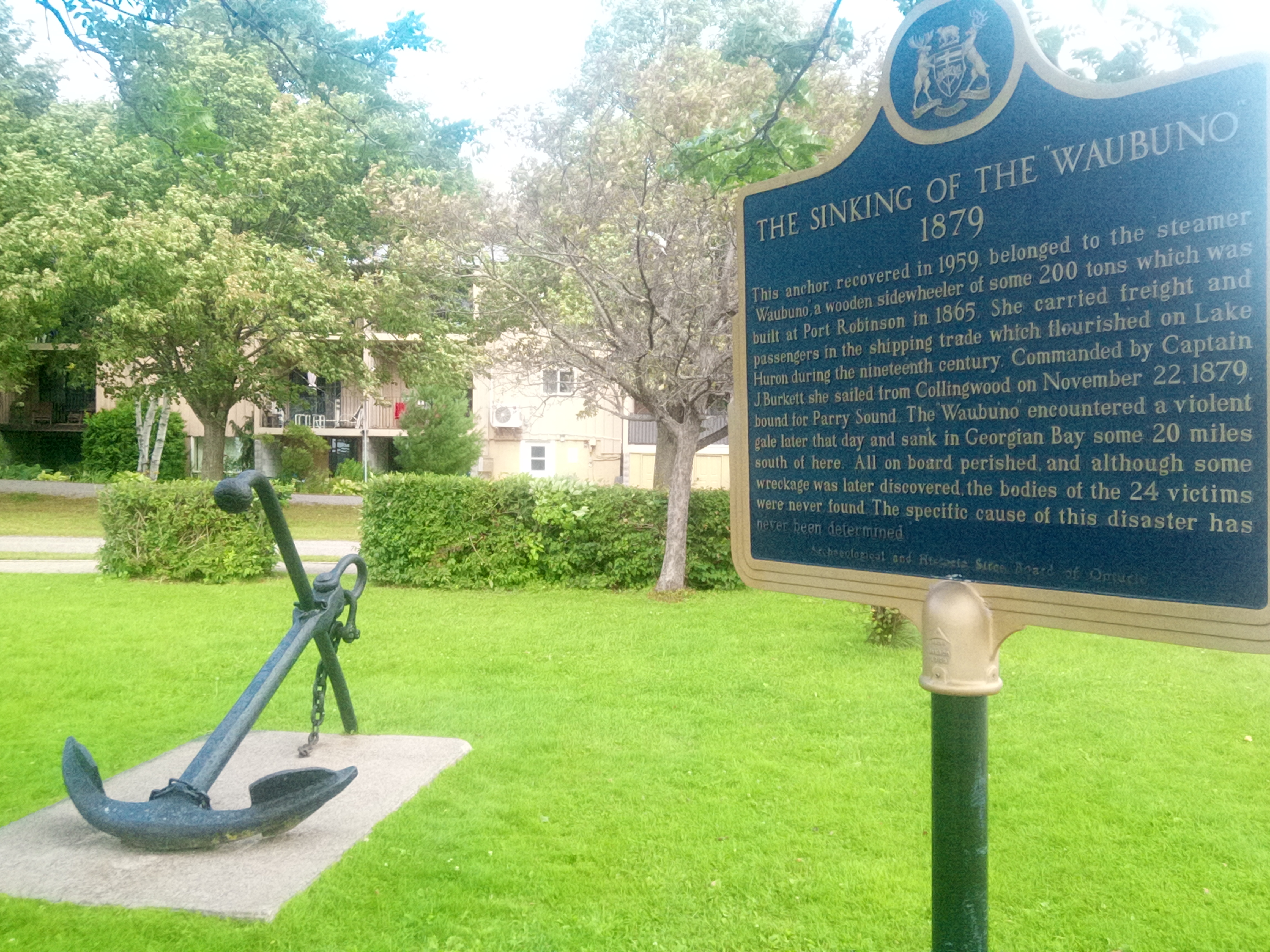
PS Waubuno
Her name meant sorcerer. In Algonquin, Waubuno translates to black magician, and the paddle steamer that bore the name seemed determined to live up to it. Built in 1865 at Port Robinson, Ontario, the side-wheel steamer spent fourteen years hauling passengers and freight between Collingwood and Parry Sound on Georgian Bay. By November 1879, she was leaking at the dock, her engines were failing, her false sides - installed the year she was built just to make her seaworthy - had never been replaced. Her owners at the Georgian Bay Transportation Company had already planned her retirement. But there was one more trip to make, one last load of freight worth ten thousand dollars, and winter was closing in. The Waubuno sailed into a snowstorm on November 22, 1879, and took every soul aboard with her.
A Ship Already Dying
The signs were impossible to miss. Two days after the Waubuno sank, a newspaper report noted she was "by many considered quite unfit for the route, especially at this season of the year." A December account was more damning: the boat had been leaking so badly at the dock the Sunday before her final voyage that water rose to the fire hole during Saturday night. The captain himself admitted he was afraid to take her out in heavy weather. The engines were said to be in very bad condition. The Georgian Bay Transportation Company had planned to replace her with a vessel carrying more modern engines and boilers by spring 1880. But November was not spring, and the aging steamer was pressed into service for what everyone knew would be her final season of cheap pleasure excursions and freight runs. She was heavily laden with cargo when she left Collingwood for the last time.
Into the Gale
The lighthouse keeper on Christian Island - thirty-five kilometers north of Collingwood and sixty kilometers south of Parry Sound - was the last person to see the Waubuno afloat. He noted the ship was faring well on her regular course. Then the winds came. What happened next has been debated for nearly a century and a half. Some speculated she turned northeast toward Moose Deer Point, seeking shelter on the eastern shore of Georgian Bay, but never reached it - overwhelmed by a living gale and blinding snow, her heavy load dragging her down as swell after swell struck her hull. Others believed she foundered six or seven miles south of the Western Islands, still on her regular course. No bodies were ever recovered. The Waubuno probably sank between nine and eleven in the morning, swallowed by Georgian Bay in the space of hours.
What the Divers Found
The mystery deepened in more recent times when divers discovered the Waubuno's anchors and windlass on the bottom near Haystack Rock, with her engine lying inshore of them. The evidence told a story the newspapers could only guess at: the Waubuno had tried to come to anchor when her crew realized they had missed the passage and had reefs under their lee. For a time the anchors held - and this, presumably, was when her distress signals were heard by distant ears. Then the windlass was torn from her deck by the force of wind and waves, and the vessel came downwind onto the reefs. Her machinery fell through her bottom on impact, and the destruction of the Waubuno proceeded. In March 1880, her upturned hull was found on Moberly Island, in a small bay in eleven feet of water, four miles from where wreckage had been collected the previous fall.
Marine Hearses from Collingwood
Citizens demanded a government inquiry into the sinking. They were thwarted. The local Collingwood Messenger newspaper fought to prevent any investigation - a stance that enraged the Northern Advance journal, which complained the Messenger's editor had never once visited the wreck site while their own reporters had examined the hull six or eight times. Inspectors who did examine the hull found the entire starboard bottom destroyed while the port side and keel were unscratched, evidence that pointed toward a boiler explosion blowing through the stern. When the same company lost another ship, the Simcoe, in November 1880, a local newspaper finally said what many had been thinking: Collingwood was gaining "an unenviable notoriety for sending to sea marine hearses." The Waubuno was not seaworthy, the paper declared, and there was reason to believe her owners knew it, "yet, for greed of gain, she was sent to sea." Legal cases against the owners dragged on through the 1880s and came to nothing.
The Sorcerer's Remains
Pieces of the Waubuno have surfaced over the decades - wreckage carried by currents, artifacts pulled from the lake bed by divers. A hull believed to be hers rests today in just fifteen feet of water near Wreck Island, an easily accessible dive site where the bones of the sorcerer's ship lie in the same Georgian Bay waters that claimed her. In Parry Sound, an anchor recovered from the wreck sits on public display with a commemorative plaque, a physical reminder of the twenty-four passengers and crew who boarded a ship everyone knew was dying. The Waubuno's story became a cautionary tale about the costs of profit over safety on the Great Lakes - a story told by Douglas Hunter in The Beaver magazine under the title that says it all: The Sorcerer's Ship.
From the Air
The Waubuno's wreck site is located near 45.12N, 80.17W in eastern Georgian Bay, between Christian Island and the Western Islands group. The wreck area lies roughly midway between Collingwood (to the south) and Parry Sound (to the north) along the bay's eastern shore. Look for the Thirty Thousand Islands scatter along the eastern Georgian Bay coastline. Christian Island is visible as a distinct island approximately 35 km north of Collingwood. Haystack Rock and Wreck Island, where remnants lie in shallow water, are among the small rocky islands in this area. Nearest airports: Parry Sound Area Municipal (CNK4) approximately 30 km north; Collingwood Airport (CNY3) approximately 50 km south. Best viewed at 3,000-5,000 ft to pick out the island channels where the Waubuno attempted to navigate during the storm.