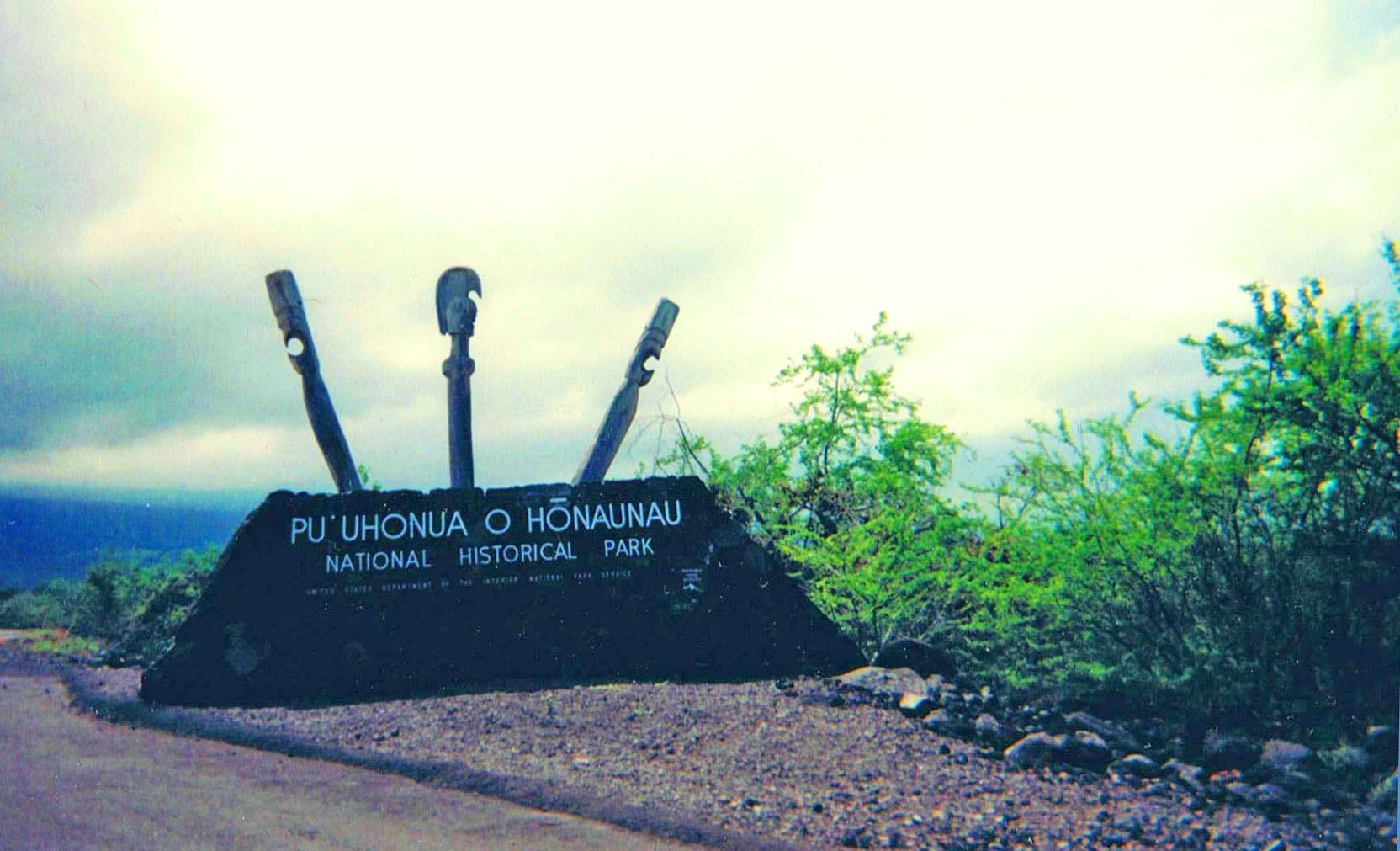
Pu'uhonua o Honaunau National Historical Park
Under the kapu system that governed ancient Hawaii, the rules were absolute and the penalties unforgiving. Step on a chief's shadow, eat a forbidden food, or let your shadow fall across the royal grounds, and the sentence was death. But there was one escape. If you could reach a pu'uhonua, a place of refuge, before your pursuers caught you, a priest would absolve you of your transgression, and you walked free. Pu'uhonua o Honaunau, on the western coast of the Big Island, was the most important such sanctuary in all of Hawaii. Its massive stone wall, twelve feet high and eighteen feet thick, still stands along the shoreline, separating the sacred refuge from the royal grounds where generations of Kona chiefs made their home.
Sanctuary and Second Chances
The concept of the pu'uhonua went beyond mere clemency. In a society where the kapu system regulated nearly every aspect of daily life, violations were inevitable. The place of refuge offered a social release valve, a way to preserve the authority of the laws while acknowledging human fallibility. Defeated warriors could also flee here during battle, along with non-combatants seeking shelter from conflict. Once inside the Great Wall, the kapu-breaker was under the protection of the gods. A kahuna pule, a priest, performed purification ceremonies, and the offender emerged cleansed. The absolution was complete. There was no lingering stigma, no reduced status. You simply returned to your life. The 420-acre site preserves this entire complex, including temple platforms, royal fishponds, sledding tracks, and remnants of coastal village life.
The Bones of Kings
At the heart of the refuge stands the reconstructed Hale o Keawe, a temple originally built around 1650 as the burial site for the ali'i nui Keawe'ikekahiali'iokamoku, the ruling monarch of the island. His son Kanuha, a Kona chief, built the temple, though the complex may have been established as early as 1475 under an earlier ruler. The temple's power was believed to radiate from the mana, the spiritual force, contained in the bones of the chiefs buried there. This mana extended protection over the entire pu'uhonua. The Kona nobility continued to inter their dead here until 1818, when the last person buried was a son of Kamehameha I. After the kapu system was abolished, the Hale o Keawe survived longer than any other Hawaiian temple. Lord George Byron, cousin of the English poet, looted it in 1825. Four years later, High Chiefess Kapi'olani removed the remaining bones and hid them in the Pali Kapu O Keoua cliffs above Kealakekua Bay, then ordered the temple destroyed.
Carved Guardians and a Singular Flag
Walking the grounds today, visitors pass carved wooden ki'i that stand sentinel at the Hale o Keawe, their fierce expressions meant to ward off evil spirits and mark the boundary between the ordinary world and the sacred. The temple and several traditional thatched structures were reconstructed in the 1960s, based on historical accounts and archaeological evidence. The site is one of only four places in Hawaii where the state flag can fly alone without the American flag, a distinction it shares with 'Iolani Palace, the Royal Mausoleum at Mauna 'Ala, and Thomas Square. This privilege speaks to the park's deep significance in Hawaiian sovereignty and cultural identity. Originally established in 1955 as the City of Refuge National Historical Park, the site was renamed in 1978 and again in 2000 under the Hawaiian National Park Language Correction Act to honor the Hawaiian spelling of its name.
Where Law Met Mercy
What makes Pu'uhonua o Honaunau extraordinary is not just its archaeological preservation but the principle it embodied. The kapu system was rigid by design, meant to maintain the cosmic order between the gods, the chiefs, and the common people. Yet built directly into that rigid system was this place where mercy overruled punishment. The Great Wall itself, constructed from interlocking lava rock without mortar, is an engineering feat that has withstood centuries of Pacific storms. Beyond it, the royal grounds slope down to the sea, where the turquoise water laps against tide pools filled with marine life. The bones were eventually moved to the Royal Mausoleum of Hawaii in Honolulu in 1858, but the mana of the place persists in a way that transcends religious belief. Standing inside the walls of the pu'uhonua, sheltered from the wind, watching the light shift across the lava stone, you understand why someone running for their life would have felt safe here.
From the Air
Located at 19.42N, 155.91W on the west coast of Hawaii's Big Island, south of Kailua-Kona. The park sits on a flat coastal lava shelf visible from low altitude. The Great Wall and Hale o Keawe temple reconstruction are identifiable near the shoreline. Kealakekua Bay is visible to the north. Nearest airport: Kona International (PHKO, approximately 20 miles north). Best viewed at 1,500-3,000 feet AGL along the Kona coast. Clear conditions typical on the leeward side.