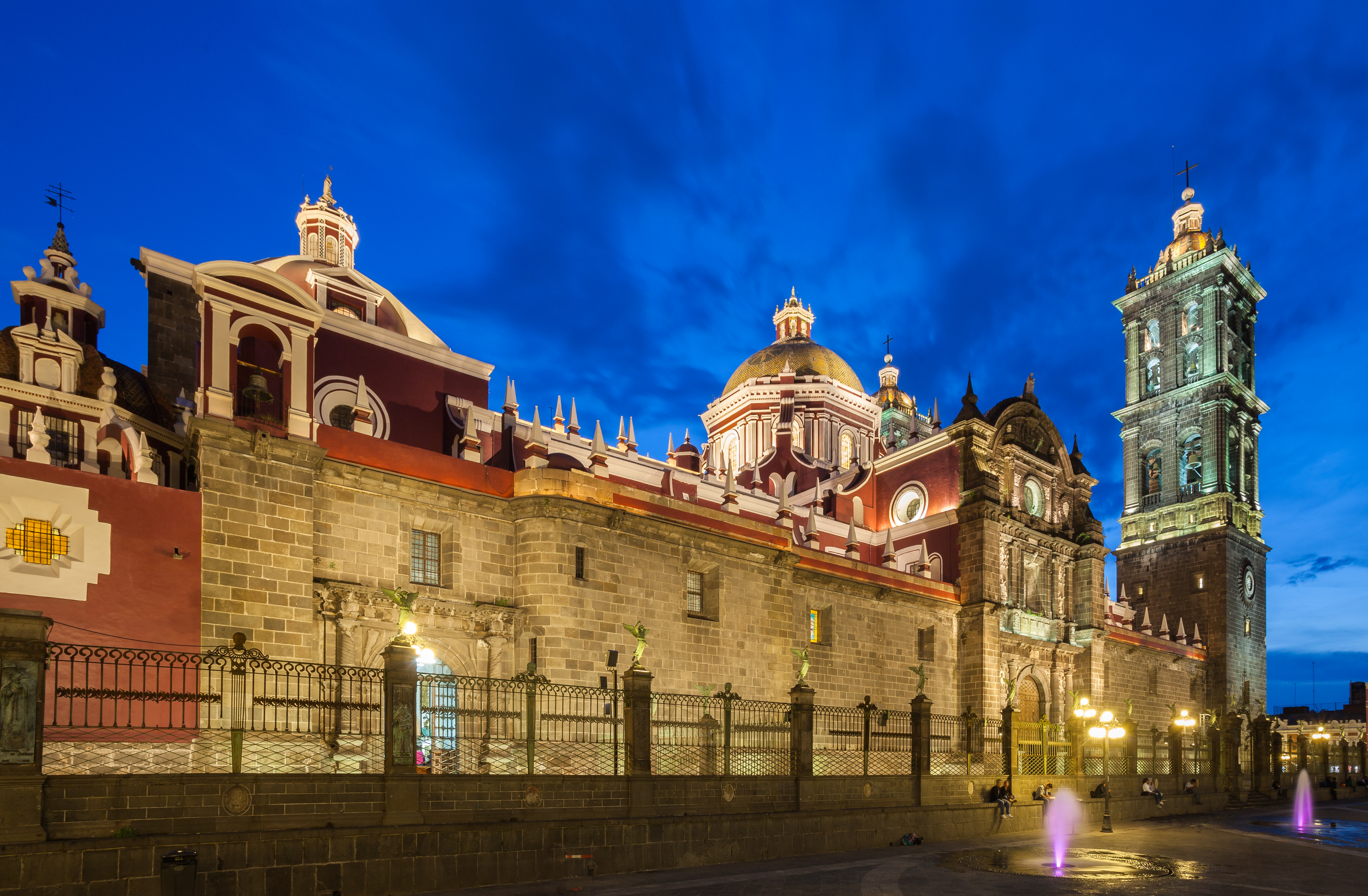
Puebla Cathedral
The heaviest bell weighs eight and a half tons. When Indian master Juan Bautista Santiago hoisted the "Campana Maria" through a narrow opening into the north tower on Saint Mark's Day in 1732, the feat seemed so improbable that locals credited angels with the work. The legend stuck -- and in a cathedral whose construction spanned three Spanish kings, two interrupted building campaigns, and one bishop who funded the project partly from his own inheritance, the intervention of angels may have been the simplest explanation available. The Basilica Cathedral of Puebla, formally dedicated to Our Lady of the Immaculate Conception, stands at the heart of Puebla's UNESCO-listed historic center. Consecrated on April 18, 1649, it beat the Metropolitan Cathedral of Mexico City to completion by four years, making it the first grand cathedral finished in the Americas.
Three Kings and a Bishop
Construction began in 1575 under Philip II of Spain and continued through the reigns of Philip III and Philip IV. For decades, progress stalled and restarted, with the original layout undergoing numerous modifications. The works ground to a complete halt in 1624. The turning point came in July 1640, when Bishop Juan de Palafox y Mendoza arrived in Puebla and threw himself into the project with extraordinary determination. Palafox launched a fundraising campaign that drew on every sector of Puebla society, supplementing it with his own personal inheritance and increased tithes -- the latter provoking a bitter confrontation with the Jesuits. He supervised 1,500 workers weekly. His architect, Gomez de Trasmonte, raised the central nave above the processional aisles, allowing natural light to flood the interior and giving the facade its distinctive pyramidal profile. When Palafox consecrated the cathedral on April 18, 1649, the towers remained unfinished and the facade incomplete, but the building was functional and magnificent. The celebrations that followed were bittersweet: Palafox, whose conflict with the Jesuits had led to his impending transfer to Spain, would soon leave behind the cathedral he had willed into existence.
Stone, Iron, and Marble
The cathedral measures 97.67 meters long by 51 meters wide, oriented like St. Peter's Basilica in Rome: altar to the east, main entrance to the west. Fourteen colossal Doric columns, nearly 15 meters tall, support forty vaults and two domes. The main dome rises over the crossing on an octagonal base with Ionic pilasters, its exterior surface covered in yellow and green azulejo tiles with evenly spaced stars. Every surface speaks to the ambition of its builders. The paving, laid in 1772, alternates red and black Santo Tomas marble brought from the Tepozuchil hill. Iron railings from around 1691 run from the chancel to the choir. The building is illuminated by 124 windows -- 27 of them round -- holding 2,215 panes of glass originally installed in 1664. The Puerta del Perdon, the central entrance, opens only on special occasions. Its facade rises 34 meters, adorned with stone statues of Saint Peter and Saint Paul in its niches, completed in 1664 and capped with a monogram of the Virgin Mary.
Towers That Touched the Sky
Both towers reach 70 meters, making them the tallest church towers in the Spanish colonial Americas at the time of their completion. The north tower -- the "Old Tower" -- was finished in 1678 under master builder Carlos Garcia Durango, who proudly noted in an inscription on the inner wall that no lives were lost during construction. The south tower followed in 1731, opening ceremonially on September 29, 1768. Each tower rises in three bodies: Doric, then Ionic, then an octagonal plinth, topped by brick-and-azulejo domes crowned with white Villeria stone globes and three-meter crosses. Only the north tower holds bells -- ten in all, including the massive Campana Maria. The towers have marked the city's most consequential moments: the bells rang when Agustin de Iturbide entered Puebla with the Army of the Three Guarantees on August 2, 1821, and again on the evening of May 5, 1862, when French troops withdrew after their defeat at the Battle of Puebla. According to the chronicles, virtually no one in the city slept that night.
A Museum in Sacred Dress
The cathedral's interior is a museum of New Spanish art accumulated over four centuries. The Altar of the Kings, designed by Juan Martinez Montanes and executed in Solomonic Baroque style, features oil paintings by the colonial master Cristobal de Villalpando, whose 1688 dome painting depicting the Triumph of the Eucharist is one of the few surviving tempera works in Mexico. The Stations of the Cross along the processional naves are by the celebrated eighteenth-century Oaxacan painter Miguel Cabrera. At the center stands the Cypress -- the Neoclassical main altar designed by Manuel Tolsa between 1799 and 1819, built around a bronze statue of the Immaculate Conception that weighs 920 kilograms. The choir contains 52 marquetry stalls inlaid with wood, bone, and ivory, and three organs, including the "International" organ with 3,376 pipes, built through collaboration between the United States, Germany, and Mexico, and inaugurated in 1973. Beneath the Cypress, accessed through four small doors opened only on All Souls' Day, lie the crypts of Puebla's bishops.
From the Air
Located at 19.043N, 98.198W in the heart of Puebla's UNESCO-listed historic center, at approximately 7,000 feet elevation. From 2,000-4,000 feet AGL, the cathedral's twin 70-meter towers are the most prominent landmarks in the old city, visible well before other structures. The broad zocalo adjacent to the north side provides clear sightlines. Puebla's Hermanos Serdan International Airport (MMHC/PBC) is approximately 15 km northeast. Popocatepetl volcano (active, restricted airspace) is visible to the west. Clear conditions typical in dry season.