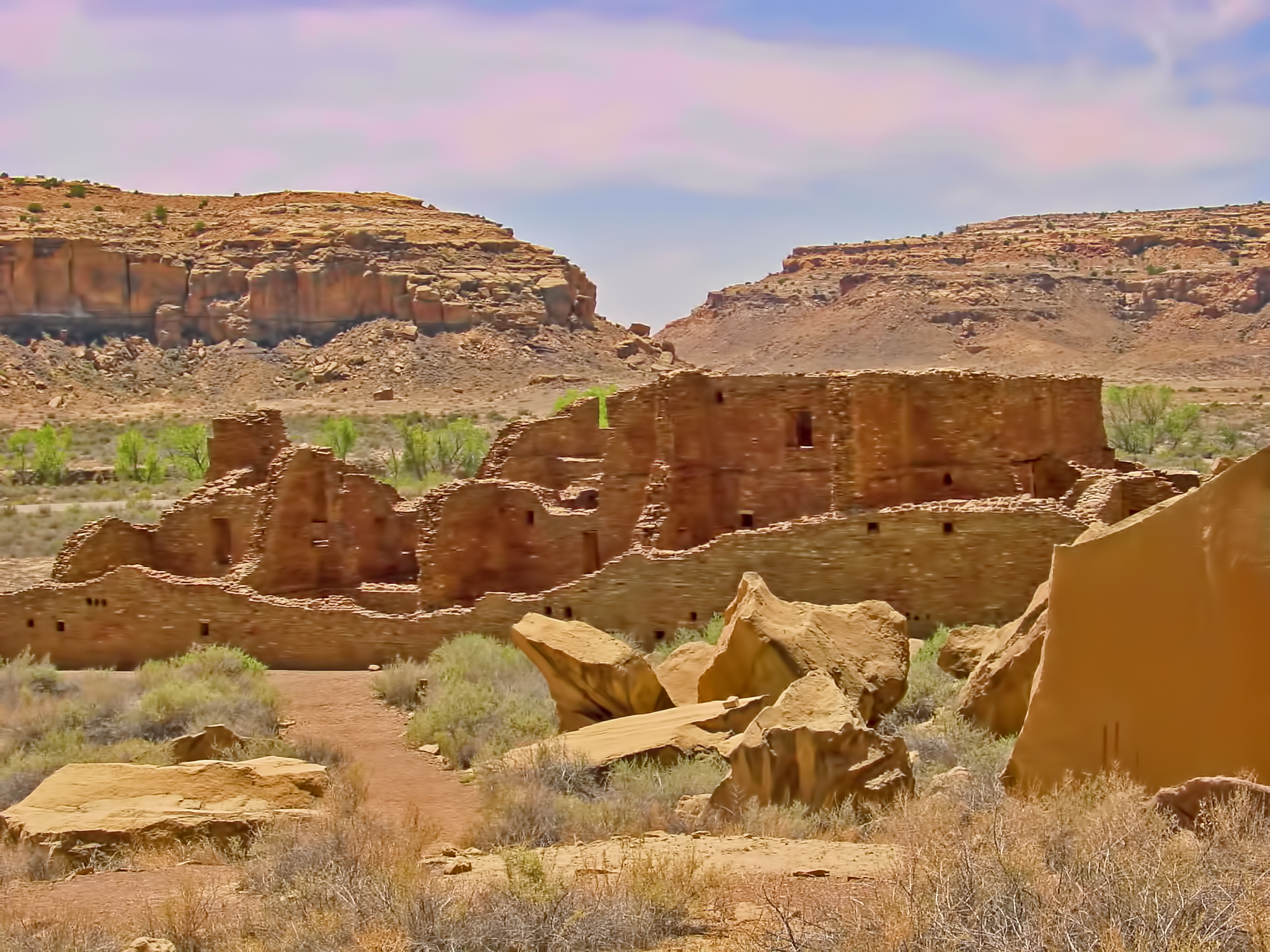
Pueblo Bonito
Somewhere around the year 900, someone at Pueblo Bonito drank chocolate. Traces of Mexican cacao, carried from at least a thousand miles to the south, have been detected in pottery sherds found among the structure's 800 rooms. Only 111 cylindrical jars of a style common in Central America have been recovered here, making each one a rare artifact of a trade network that stretched across the ancient Americas. This single detail captures the essence of Pueblo Bonito: what appears at first to be a remote ruin in a barren New Mexico canyon was, for three centuries, the center of something vast.
The Center of the Chacoan World
Pueblo Bonito stands as the largest and most celebrated great house in Chaco Culture National Historical Park. Built in stages between AD 850 and AD 1150 by the Ancestral Puebloans, the complex grew to encompass approximately 800 rooms across four and five stories. A precisely aligned wall runs north to south through the central plaza, dividing the structure into two symmetrical halves, each anchored by a Great Kiva. Over thirty additional kivas dot the complex, many associated with the large central courtyard. Anthropologist Brian Fagan has compared Pueblo Bonito to Stonehenge, Teotihuacan, and Machu Picchu. The National Park Service calls it 'the most thoroughly investigated and celebrated cultural site in Chaco Canyon' and 'the center of the Chacoan world.' The site's architecture encodes the builders' understanding of solar and lunar cycles, marked in both the petroglyphs on surrounding cliffs and in the orientation of the structure itself.
Room 33 and the Matrilineal Dynasty
Deep within the oldest section of Pueblo Bonito, a room designated by early excavators as Room 33 held a discovery that reshaped understanding of Ancestral Puebloan society. The oldest burial belonged to a man who died violently, interred with thousands of turquoise and shell beads and pendants forming necklaces, anklets, and bracelets. His is the richest burial ever excavated in the American Southwest. Over the following 330 years, thirteen more individuals were buried in the same crypt, accompanied by elite grave goods. Archaeogenomic analysis revealed that nine of these individuals shared mitochondrial DNA, meaning they were related through the female line. This was the first archaeological evidence of matrilineal descent among the Ancestral Puebloans, connecting them directly to their modern Pueblo descendants, many of whom still practice matrilineal succession. An elite family, inheriting status through their mothers, presided over Pueblo Bonito for more than three centuries.
Discovered by Outsiders, Claimed by History
U.S. Army Lieutenant James H. Simpson and his guide Carravahal stumbled upon Chaco Canyon during an 1849 military expedition. Carravahal gave the ruins their Spanish names, including Pueblo Bonito, meaning 'beautiful village.' Simpson published the first description of the canyon in his military report, illustrated by expedition artist R. H. Kern. Nearly half a century later, rancher Richard Wetherill and natural history student George H. Pepper began formal excavations in 1896, financed by New York philanthropists B. Talbot Hyde and Frederick E. Hyde, Jr. Over four years they uncovered 190 rooms and mapped all major structures. Among their finds were eight wooden flutes from Room 33, predecessors to the Native American flute. Wetherill later tried to file a homestead claim on the ruins, but the federal government invalidated it in 1904, taking formal possession of the site.
Built Beneath a Threat
The builders of Pueblo Bonito made a choice that still puzzles archaeologists. A massive section of the canyon wall loomed above the settlement, fractured and unstable. The Navajo called it 'tse biyaa anii'ahi,' the leaning rock gap. The Ancestral Puebloans knew the danger but built beneath it anyway, constructing structural reinforcements to compensate for the looming slab. In January 1941, the inevitable happened. The formation, known to modern visitors as Threatening Rock, collapsed. Weighing approximately 30,000 tons, it destroyed the structure's rear wall and a number of rooms. Archaeologist Mary Metcalf estimates that 805,000 person-hours were required to build Pueblo Bonito's main structure. The decision to build in the shadow of that rock speaks to a confidence, or perhaps a faith, that is hard to fully understand from a distance of a thousand years.
When the Trees Disappeared
Examination of pack rat middens revealed that when Pueblo Bonito was first constructed, Chaco Canyon was wooded with trees like ponderosa pines. Evidence survives in the structure itself: first-floor support beams cut from those ancient forests. Scientists hypothesize that during the pueblo's occupation, the valley was stripped of nearly all its timber for construction and fuel. This deforestation, combined with a period of drought, caused the water table to drop severely, rendering the land infertile. The Ancestral Puebloans, no longer able to sustain their population through agriculture, eventually moved on. Pueblo Bonito was inhabited for roughly 300 years, a span that serves as a stark lesson in how human activity can reshape a landscape. The canyon they left behind, silent and treeless, still holds the bones of the civilization that once thrived here.
From the Air
Pueblo Bonito is located at approximately 36.06N, 107.96W in Chaco Canyon, northern New Mexico. The canyon is remote, accessible by unpaved roads, but from the air the great house's distinctive D-shaped footprint is visible against the canyon floor. Best viewed at 2,000-4,000 feet AGL. The nearest airport is Farmington Four Corners Regional Airport (KFMN) about 75 miles to the north. Albuquerque International Sunport (KABQ) is approximately 160 miles to the southeast. The area is high desert with excellent visibility. Chaco Canyon runs roughly east-west, and the great houses line the canyon's north wall.