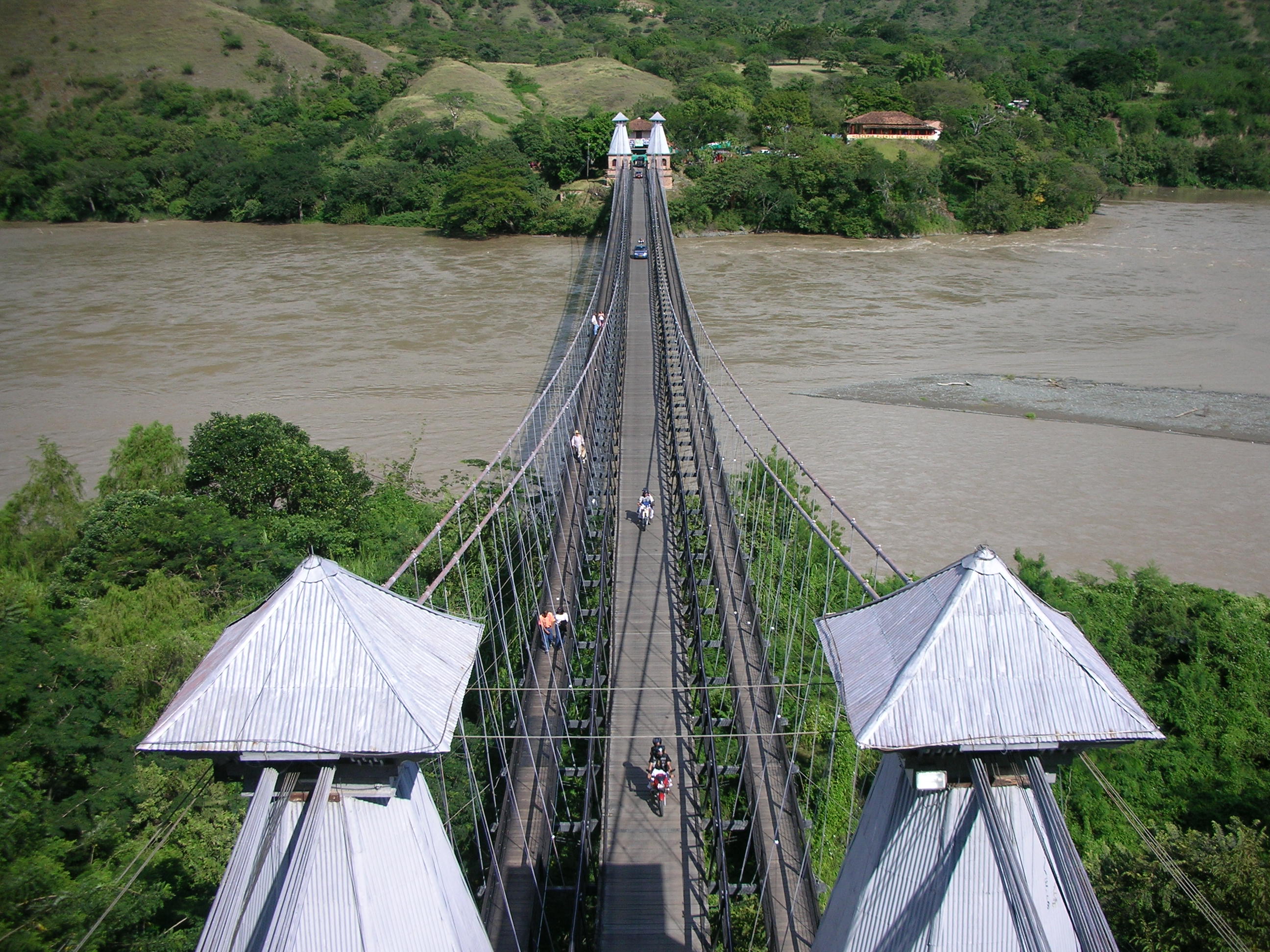
Puente de Occidente
Jose Maria Villa was born in 1850 in Sopetran, a small town in western Antioquia, and somehow ended up helping to build the Brooklyn Bridge. He studied engineering at the Stevens Institute of Technology in New Jersey, joined the Brooklyn Bridge construction team, and then came home to Colombia with an idea: he would build a suspension bridge over the Cauca River using the same hybrid cable-stayed design he had learned in New York. The Puente de Occidente, completed in 1895, stretches 291 meters across one of South America's most powerful rivers. When it opened, it was the longest suspension bridge on the continent.
From Hoboken to the Cauca
Villa's path from a Colombian mountain town to the Stevens Institute of Technology campus in Hoboken, New Jersey, was unusual for a 19th-century Antioqueno. At Stevens he studied the emerging science of suspension bridge engineering during the decade when the Brooklyn Bridge was redefining what cable-stayed structures could achieve. Working on John Roebling's masterpiece gave Villa both technical knowledge and a model to adapt. When he returned to Colombia, Antioquia's governor Marcelino Velez authorized the construction of a bridge to connect the municipalities of Olaya and Santa Fe de Antioquia across the Cauca River. Villa began work in 1887. The bridge's structural system -- a hybrid of suspension and cable-stayed elements -- directly echoes the Brooklyn Bridge, scaled down to fit a tropical river valley but carrying the same engineering DNA across an ocean and a continent.
English Steel, Local Stone
The bridge is supported by four pyramidal towers, two on each bank of the Cauca, each anchoring two cables. The cables and steel components were purchased from England, shipped across the Atlantic, and transported up the Magdalena River and overland to the construction site -- a logistical challenge that in 1880s Colombia required months of effort. The towers themselves, by contrast, were built from local materials, their masonry rising from the riverbank with a solidity that has endured more than a century of tropical weather, earthquakes, and the Cauca's seasonal flooding. The span carries a central roadway 3.10 meters wide, flanked by pedestrian walkways of 1.20 meters on each side. All three paths have wooden surfaces, and the total width reaches 8 meters. Cars and small trucks still cross it today, their weight distributed across the same cables that English foundries cast in the late 19th century.
The Longest Span on the Continent
When the Puente de Occidente opened in 1895, it was considered the third-longest suspension bridge in the world and the longest in South America. Initially, only pedestrians were permitted to cross. Vehicles came later, as the bridge proved it could bear the weight. The designation reflected not just engineering ambition but the strategic importance of connecting western Antioquia to the rest of the department across a river that had long divided communities and commerce. Santa Fe de Antioquia, on the west bank, was the former colonial capital of Antioquia, and the bridge reestablished its connection to the growing economic center of Medellin to the east. That connection, physically expressed in English steel and local stone, made the Puente de Occidente one of the most important civil engineering works of its era in the Americas.
Monument, Heritage, and Wooden Planks
On November 26, 1978, the bridge was declared a National Monument of Colombia, and it now sits on UNESCO's tentative World Heritage list -- recognition that its engineering significance extends beyond national borders. Significant restoration work was performed in 2014, reinforcing the structure while preserving its 19th-century character. Walking across the bridge today, the wooden planks flex slightly underfoot, and the suspension cables hum in the wind coming up the Cauca valley. The river below is wide, brown, and fast, carrying sediment from the Andes toward the Caribbean. From the western bank, the four stone towers frame the eastern hills like a gateway. Villa died in 1913, but his bridge outlived him by more than a century, still carrying traffic across the same river crossing he surveyed as a young engineer freshly returned from building bridges in New York.
From the Air
Located at 6.5778N, 75.7983W in western Antioquia, spanning the Cauca River between Olaya and Santa Fe de Antioquia. The 291-meter suspension bridge with its four pyramidal towers is clearly visible from the air against the wide brown river. Nearest airports: Olaya Herrera Airport (SKMD, approximately 50 km east in Medellin) and Jose Maria Cordova International Airport (SKRG, approximately 70 km east). Best viewed at 2,000-4,000 feet AGL following the Cauca River valley. Santa Fe de Antioquia, the former colonial capital, is visible on the western bank.