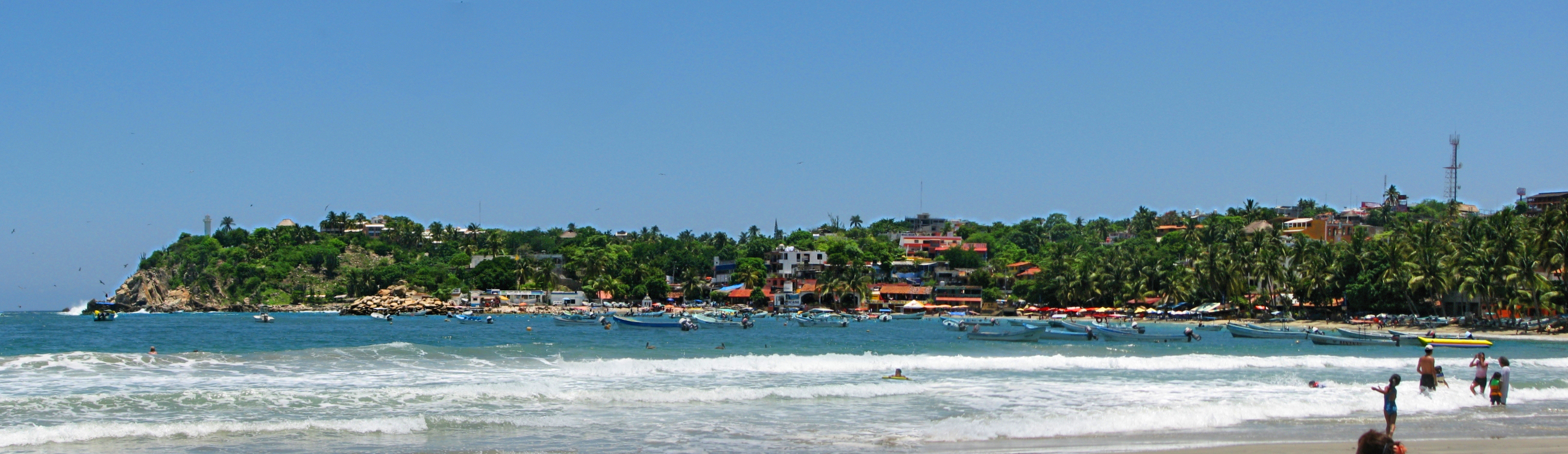
Puerto Escondido: The Hidden Port That Couldn't Stay Hidden
The name means "hidden port," and for decades it delivered on that promise. Puerto Escondido sat on Oaxaca's Pacific coast behind a wall of mountains so rugged that the road from Oaxaca City took seven white-knuckle hours - hairpin curves, washed-out pavement, craters where the hillside had simply slid away in the rains. Then, in early 2024, a new highway opened and cut the journey to three hours. The Semana Santa crowds that followed overwhelmed the town's infrastructure, its beach cleanup volunteers, and whatever remained of its reputation for isolation. Puerto Escondido is no longer hidden. What it still offers - enormous surf, bioluminescent lagoons, and beaches framed by green vegetation that never dries out - is worth finding even now that the finding is easy.
The Mexican Pipeline
Surfers discovered Puerto Escondido before tourists did, and the waves remain the town's primary draw. Playa Zicatela is the main event - a long beach break that produces powerful, hollow barrels comparable to Hawaii's Pipeline, earning it the nickname "the Mexican Pipeline." The waves are fast, heavy, and unforgiving, breaking over shallow sand in a way that punishes poor positioning. Summer months bring the biggest swells. Beginners have no business in the Zicatela lineup, but gentler breaks at Playa Carrizalillo and La Punta offer approachable waves and surf schools staffed by local instructors. The surfing community has created its own geography within the town: Punta Zicatela is where the wave-riders cluster, a neighborhood of board-rental shops, beachfront restaurants, and salt-crusted accommodations ranging from budget cabanas to design-conscious boutique hotels. At the southern end of La Punta, a short scramble over rocks leads to a grassy hilltop with views of both beaches and the lighthouse - the town's best sunset perch.
A Town of Neighborhoods
Puerto Escondido is not a single place so much as a string of neighborhoods connected by a coastal road and a shared postal code. El Centro is the working city - markets, bus stations, the Chedraui supermarket, internet cafes that still matter because mobile connectivity can fail for hours at a stretch. The Adoquin, or Playa Principal, is the original tourist strip, where restaurants serve seafood on the sand and fishermen launch pangas at dawn. Rinconada and Bacocho sit to the west, quieter and more residential. Punta Zicatela, to the southeast, is the backpacker and surfer zone, operating at a rhythm largely disconnected from the rest of town. And woven through all of it is a growing French expat community whose cafes and bakeries have added an unexpected Gallic accent to a fundamentally Oaxacan place. The whole sprawl is less walkable than smaller beach towns like Mazunte or Zipolite down the coast, but colectivos - shared taxis that run fixed routes through the crucero in El Centro - stitch the neighborhoods together for a few pesos per ride.
Oaxacan Roots on Pacific Sand
What distinguishes Puerto Escondido from generic beach destinations is its Oaxacan identity. The food here is not resort cuisine - it is tlayudas, mole, mezcal, fresh-caught dorado and huachinango prepared in the coastal Oaxacan style. The state of Oaxaca has one of the richest culinary traditions in Mexico, and Puerto Escondido benefits from that heritage even as it adapts it for travelers. Markets sell chapulines alongside avocados. Small restaurants serve pozole at prices that reflect local economics, not tourist markup, though the gap between the two is narrowing as the town grows. The Pacific setting adds its own dimension: the coastline here stays green year-round, unlike the drier stretches around Huatulco and Mazunte where deciduous forests shed their leaves in the dry season. That persistent greenery, framing beaches and rocky headlands, gives Puerto Escondido a lushness that photographs well and feels even better in person.
Growing Pains at the Edge of the Map
The 2024 highway changed everything and nothing. Puerto Escondido was already growing before the road arrived - the backpacker scene, the surf tourism, the digital nomads discovering cheap rents and reliable-enough Starlink connections had been building for years. The highway simply accelerated a process already underway, flooding the town with weekend visitors from Oaxaca City and day-trippers who previously would not have attempted the mountain crossing. Infrastructure has struggled to keep pace. Beach cleanups cannot match the volume of waste. Security concerns persist, particularly on isolated stretches of beach after dark, where robberies have been reported. Internet connectivity, paradoxically, remains unreliable for a town of this size and ambition. And yet the underlying appeal is durable. Nearby Lagunas de Chacahua National Park offers mangrove-fringed lagoons and bioluminescent night tours. Zipolite, down the coast, preserves its 1960s counterculture atmosphere. The Pacific keeps producing waves. Puerto Escondido's challenge is not relevance - it is managing the consequences of being discovered.
From the Air
Located at 15.862N, 97.072W on Oaxaca's Pacific coast. The town stretches along several beaches visible from the air, with Playa Zicatela's long surf break forming a distinctive white line of breaking waves. The bay at Playa Principal curves inward, creating a sheltered harbor area contrasting with the exposed beaches to the southeast. Highway 200 runs parallel to the coast, and the new highway to Oaxaca climbs northeast into the Sierra Madre del Sur. Nearest airport: Puerto Escondido International Airport (MMPS/PXM), located just north of town - it is close enough that landing aircraft pass directly over the beach neighborhoods. Best viewed at 2,000-4,000 feet. The multiple beach coves and rocky headlands make the coastline visually distinctive.