Pukeahu National War Memorial Park
Drive through the Arras Tunnel in Wellington and you pass through a memorial without knowing it. The one-way, 130-meter tunnel carries State Highway 1 beneath Pukeahu National War Memorial Park, and its walls are studded with 273 decorative red poppies -- one for each step in a journey that most drivers make in seconds, unaware they are passing beneath ground consecrated to the memory of war. The tunnel was named for the French town where New Zealand tunnellers dug beneath enemy lines during the First World War. Above it, on a hill the Ngai Tara iwi named Pukeahu -- "sacred hill" -- the memorials of nations that once fought each other now stand within walking distance of one another.
Burying a Highway for the Dead
The park exists because the New Zealand government decided to put a road underground. In 2005, the Ministry for Culture and Heritage began acquiring land on the northern side of Buckle Street, in front of the National War Memorial, with the vision of creating a unified memorial precinct. The problem was State Highway 1, which cut directly through the site, severing the memorial from the surrounding neighborhood with a stream of traffic. In August 2012, the government announced that the Buckle Street section would be moved into a cut-and-cover tunnel, allowing the park to extend seamlessly over the old road. The tunnel opened to traffic on 29 September 2014. The park itself opened on 18 April 2015, timed to coincide with the centenary of the Gallipoli landings. Prime Minister Helen Clark had articulated the vision as far back as 2004: a setting worthy of those New Zealanders who gave their lives in times of war. The engineering solution -- burying a national highway -- was proportional to the ambition.
Allies Carved in Stone
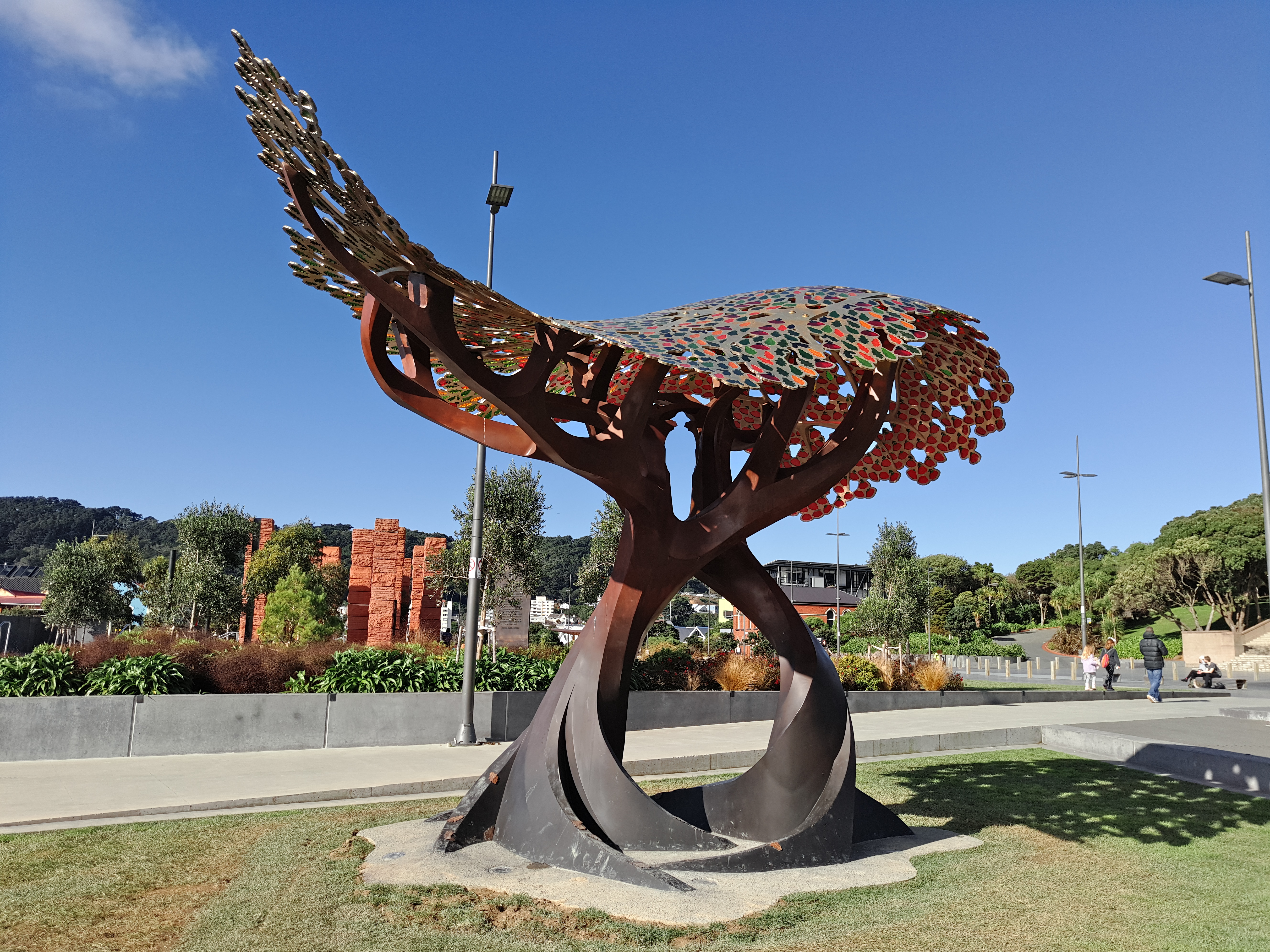
Walk the park and you walk through an atlas of grief. The Australian memorial, designed by architects Tonkin Zulaikha Greer, consists of fifteen red sandstone columns inscribed with artworks by both Aboriginal and Maori artists -- a shared vocabulary of loss between two nations whose soldiers landed together at Gallipoli on 25 April 1915. Australian Prime Minister Tony Abbott and New Zealand Prime Minister John Key dedicated it in April 2015. The French memorial, Le Calligramme, draws from the poetry of French soldier Guillaume Apollinaire, whose 1915 poem Le Chant de l'Honneur is inscribed in stone made partly of crushed Combe Brune stone from the Western Front -- material from the ground where the fighting happened, transported to the ground where the remembering happens. The United Kingdom memorial, designed and built by Weta Workshop, takes the form of two intertwining trees: a Royal Oak and a pohutukawa, their canopies merging into a single shelter. Between the branches, a silhouette of a lone soldier is visible. Its Maori name, Whakaruruhau, means shelter.
Former Enemies, Present Neighbors
What distinguishes Pukeahu from most war memorials is the presence of former adversaries. The Turkish memorial, unveiled in March 2017, features a bronze plaque with words of reconciliation widely attributed to Mustafa Kemal Ataturk cut through the metal, so that viewers look through the text to see a Turkish red pine planted directly behind it -- a tree descended from the original Lone Pine at Gallipoli. The German contribution, unveiled by President Frank-Walter Steinmeier in November 2017, is a tapestry titled Flandern, based on photographs of First World War battlefield sites. Artist Stephen Schenk described it as "a reminder of the untold misery and horror." These are not gestures of victory or defeat. They are acknowledgments that the dead on all sides were human beings caught in the same catastrophe, and that remembrance without reconciliation is incomplete.
A Shell from the Tunnels
Perhaps the most intimate memorial in the park honors Pacific Islanders who served in both World Wars. Titled Te Reo Hotunui o te Moana-nui-a-Kiwa -- The Deep Sigh of the Pacific -- it features a large bronze sculpture of a conch shell surrounded by remembrance poppies. The sculpture, designed by Michel Tuffery, was inspired by a real artifact: a conch shell found in a First World War-era tunnel in Arras, France, inscribed by Private Angene Angene, a Cook Islander who served on the Western Front. A soldier far from the Pacific carried a shell from home into the earth beneath a foreign battlefield, and someone found it there a century later. The sculpture makes that private act of longing monumental. Prime Ministers Jacinda Ardern and Cook Islands Prime Minister Mark Brown attended its dedication, closing a circle that began with one man, one shell, and one tunnel beneath Arras.
The Hill Remembers Everything
Pukeahu is not only a war memorial. A plaque unveiled in November 2019 commemorates the 1918 influenza pandemic, which killed around 9,000 New Zealanders -- a reminder that mass death takes many forms and that a memorial park need not limit its grief to battlefields. The park has also become a gathering place for the living. In 2024, a Waitangi Solidarity Hikoi was held on Waitangi Day, linking the site's themes of national identity and collective memory to ongoing conversations about the Treaty of Waitangi. The park has won awards for its architecture, landscape design, and use of indigenous timber. But its deepest achievement is spatial: by burying a highway and clearing a hilltop, Wellington created a place where walking is slow, sight lines are long, and the distance between the Australian columns and the Turkish pine is just far enough to require a visitor to pause, turn, and look again. The sacred hill earns its name.
From the Air
Located at -41.2989, 174.7772 in the suburb of Mt Cook, Wellington. The park sits on elevated ground south of the Parliament Buildings, with the National War Memorial carillon tower visible as a vertical landmark. Look for the green open space interrupting the urban grid, roughly 1 km south of The Beehive. Nearest airport is Wellington International (NZWN), approximately 5 km southeast. Best viewed at 2,000-4,000 feet from a harbor approach.