Pulchri Studio
In 1847, a small group of Dutch painters got tired of being told what to paint. Government-backed art in the Netherlands still meant neoclassicism - Greek temples, draped togas, allegorical figures with measured proportions. But out beyond The Hague's edge, the dunes of Scheveningen ran into a gray North Sea, the polders stretched flat under enormous skies, and fishing families pulled their bomschuiten up onto the sand to mend nets. None of that fit on a canvas if you were trying to please the Royal Academy. So the painters met instead at the home of Lambertus Hardenberg and gave themselves a Latin name - Pulchri Studio, "for the study of the beautiful" - and decided to define beautiful on their own terms. The Hague School was being born in a parlor.
The Barbizon Idea, Translated North
The model was already in motion in France. South of Paris, in the forest of Fontainebleau, a generation of painters had retreated to the village of Barbizon to paint peasants and trees and weather - the unromantic reality of rural life. The Dutch painters who founded Pulchri wanted that, but Dutch. So they found their Barbizon at Scheveningen, at the edge of The Hague, where the dunes and the herring fleet and the silver-gray Atlantic light gave them everything Fontainebleau gave the French, only wetter and flatter and with more sky. The founders included Willem Roelofs, who painted polders, and Jan Hendrik Weissenbruch, who painted clouds, and Bartholomeus Johannes van Hove, who became the society's first chairman. King Willem II took the patronage almost immediately, which gave them legitimacy without obligation - a Dutch compromise.
The Roll Call of the Hague School
By the 1870s and 1880s, the membership reads like a roster of 19th-century Dutch painting. Jozef Israels joined and chaired the society from 1875 to 1878 - his somber paintings of fisherfolk and the poor made him internationally famous and a counterpart to Jean-Francois Millet. Hendrik Willem Mesdag, who painted the sea relentlessly and would later create the enormous 360-degree Panorama Mesdag that still stands a few blocks away, served as chairman from 1898 to 1907. The Maris brothers - Jacob and Willem - sat on the executive board, as did Anton Mauve, who would later teach a young, struggling cousin-by-marriage named Vincent van Gogh how to handle oils. In 1882, Van Gogh himself attended a Pulchri kunstbeschouwing - one of the society's signature "art considerations" where members brought works to discuss with each other. The Hague School was not a movement that happened to its members. It was happening in this room.
An Artists' Dispute with a King
Pulchri was never a quiet society. In the 1870s and 1880s, when King Willem III awarded a medal to the conservative painter Hermanus Koekkoek, the Pulchri members responded with a public statement that Koekkoek's work was simply no longer current. They announced they would not accept tenders from the king and would not enter royal art competitions. It was a remarkable thing for a society holding royal patronage to do, and it embarrassed the court. The queen tried to smooth things over with personal commitments to Pulchri. The king did not change his policy. The society went its own way, which was, in retrospect, the only direction that was ever going to matter. The Hague School won the long argument by simply continuing to paint.
Lange Voorhout, Then and Now
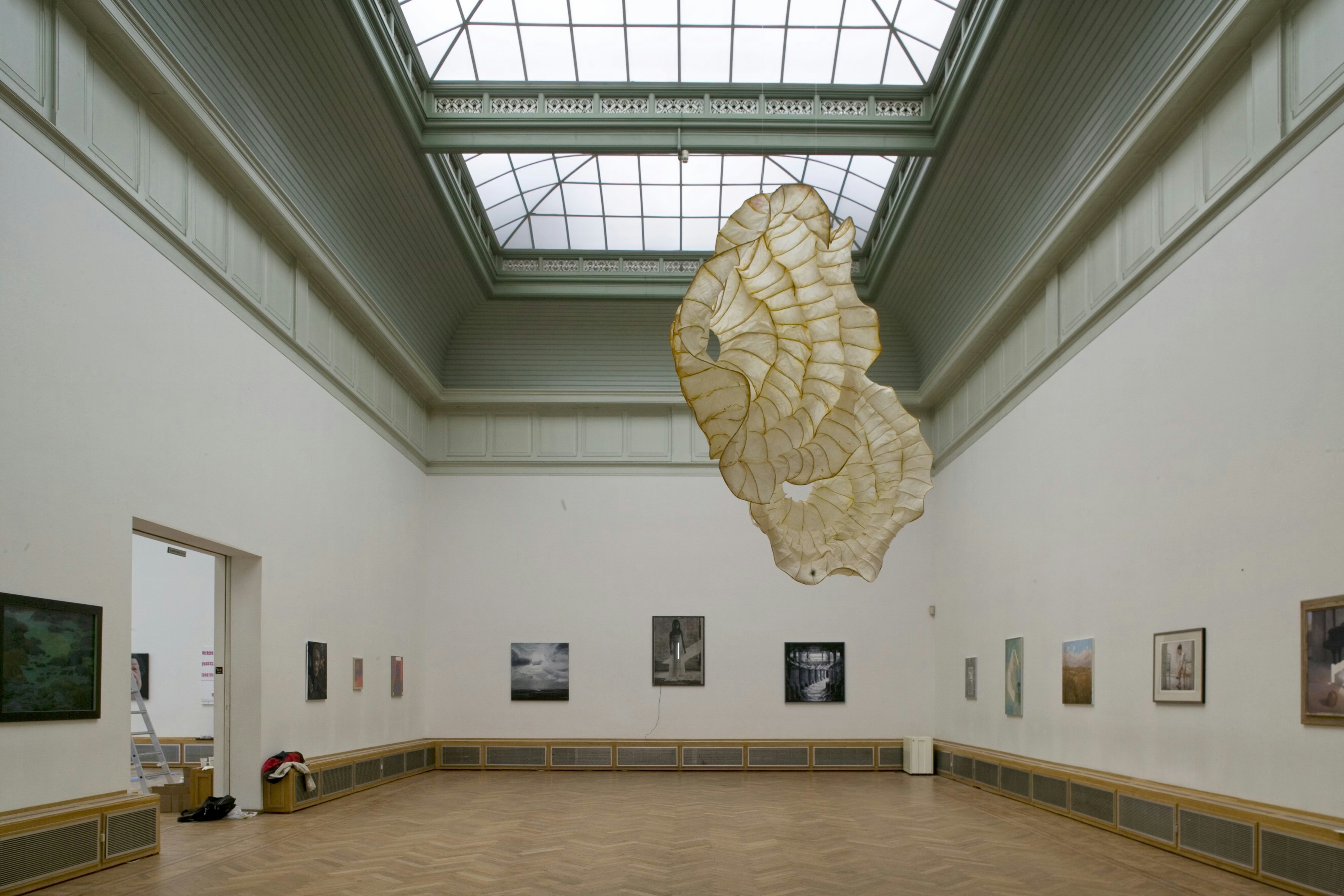
Since 1901, Pulchri has occupied a stately 18th-century townhouse at Lange Voorhout 15, on one of the most beautiful streets in The Hague - a tree-lined ceremonial promenade where carriages once carried diplomats between embassies. The villa, with its tall windows and quiet galleries, is open to the public for exhibitions. The society's painters, sculptors, and photographers still gather here for art considerations, still vet new members by committee, still host shows in rooms where Mesdag and Israels once argued over the right way to render a wave. There was a dark passage in 1943, when the wartime executive complied with a Nazi order to join the Reich Chamber of Culture. The postwar dismissal of chairman Willy Sluiter and a long, slow rebuilding of reputation followed; in 1996 Queen Beatrix restored the royal patronage. But the continuity is what astonishes. A 179-year-old artists' cooperative, still meeting, still arguing about what counts as beautiful, in the same building, on the same street, in the same city.
Visiting the Society
Pulchri's galleries at Lange Voorhout 15 are open to visitors most days, with rotating exhibitions of work by current members and occasional historical shows drawing on the society's archives. The address sits a five-minute walk from the Binnenhof and the Mauritshuis, in a stretch of The Hague that contains an absurd density of cultural institutions: Escher in Het Paleis is at number 74, the Literature Museum is in the Royal Library complex two blocks over, the Panorama Mesdag is a fifteen-minute walk west. To stand in the Pulchri exhibition rooms and then walk to the Panorama is to follow a single afternoon's distance from the table where the Hague School was discussed to the immersive seascape one of its members spent two years painting. The city kept these things close to each other on purpose.
From the Air
Pulchri Studio sits at 52.082N, 4.312E, on the Lange Voorhout in central The Hague, just inland from the Scheveningen dunes the founding members loved to paint. The Hague is 50 km southwest of Amsterdam Schiphol (EHAM) and 18 km north of Rotterdam The Hague Airport (EHRD). The city's flat topography and dense parkland make the green corridor of the Haagse Bos and the wide beach at Scheveningen the easiest landmarks from cruising altitude.