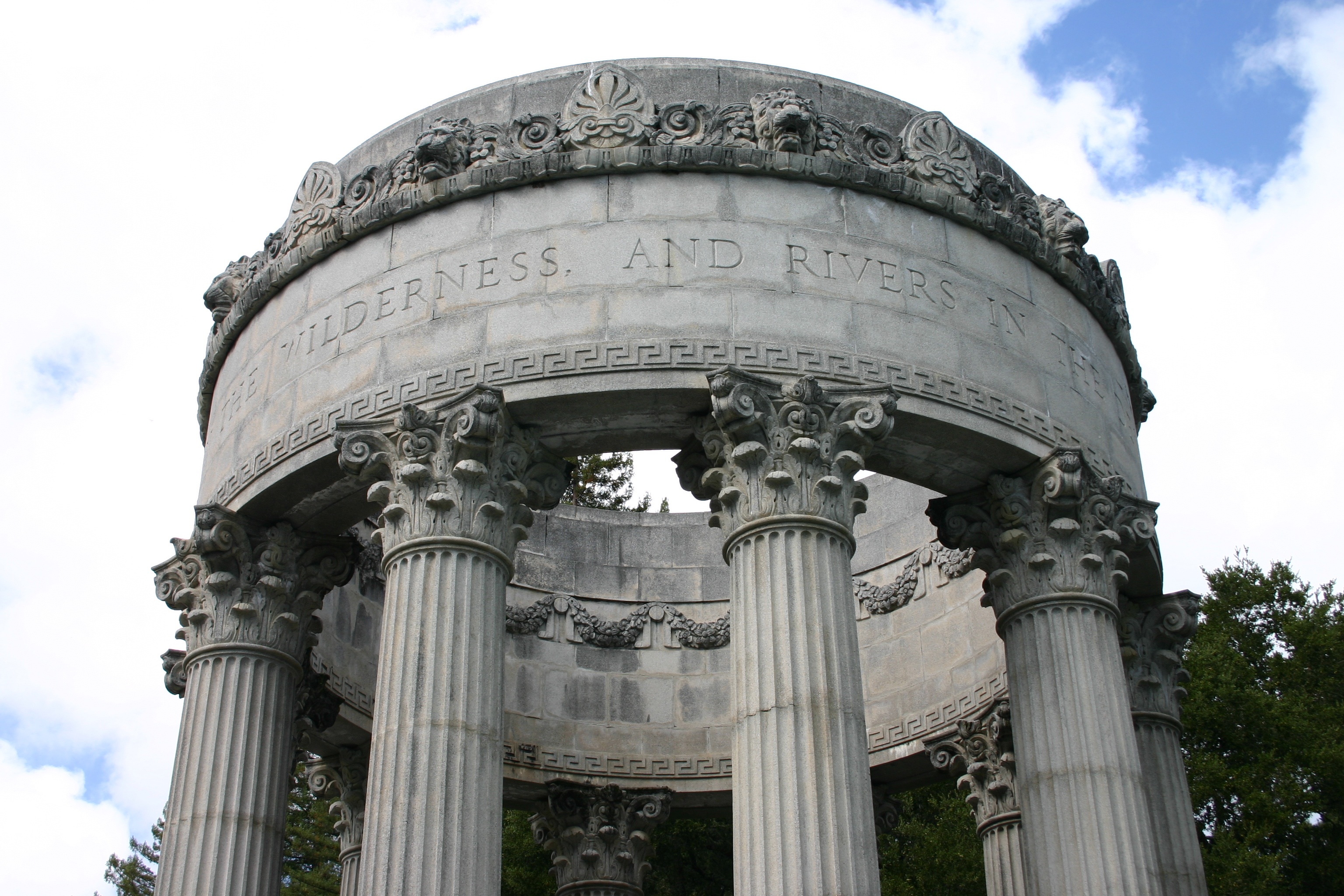
Pulgas Water Temple
"I give waters in the wilderness and rivers in the desert, to give drink to my people." The words from Isaiah 43:20 are carved into the masonry ring that crowns the Pulgas Water Temple, a circle of fluted Corinthian columns reflected in a cypress-lined pool in Redwood City, California. The temple stands at the terminus of the Hetch Hetchy Aqueduct, built to celebrate one of the most ambitious water projects in American history. Its name, though, comes from something far less grand: fleas.
Water from the Sierra
The San Francisco Water Department erected the Pulgas Water Temple to commemorate the 1934 completion of the Hetch Hetchy Aqueduct, which carries snowmelt from the Sierra Nevada mountains across 167 miles of California to the San Francisco Peninsula. Originally, water flowed through a vault directly under the temple itself, making the structure a literal monument standing atop its own subject. Modern water treatment requirements eventually forced the flow to be diverted to a nearby plant, but the temple remains. The permanent structure was completed in 1938, designed by architect William Merchant with carvings by Albert Bernasconi. It replaced an original temple made largely of plywood, a temporary marker for a permanent engineering achievement.
The Ranch of the Fleas
The temple's name derives from Rancho de las Pulgas, an early Spanish land grant. Pulgas is the Spanish word for fleas. The grant earned its unflattering name from the main village of the Lamchin, the Ohlone tribe living in the San Carlos area before the Spanish arrived. The village was called Cachanigtac, a name that appears to contain a word for vermin. Spanish missionaries translated it as Las Pulgas. That a neoclassical monument inscribed with biblical verse should carry a name rooted in the Ohlone word for pest is one of those accidental ironies that California specializes in.
Where Portola Turned Around
The temple grounds also host California Historical Landmark No. 92, which commemorates a pivotal moment in European exploration of California. Somewhere in this immediate area, on November 11, 1769, the Spanish Portola expedition made camp. Members of the expedition were the first Europeans to explore inland California and the first to see San Francisco Bay. The day before, while camped at San Francisquito Creek, expedition leaders had made the difficult decision to turn around and begin the return journey to San Diego. To do so, they first had to retrace their steps north to where they had crossed Sweeney Ridge from the coast. The temple, then, marks both an arrival and a departure: the end of the Hetch Hetchy Aqueduct and the turning point of the Portola expedition.
A Monument Overlooked
The Pulgas Water Temple sits along Canada Road in a quiet stretch of the San Francisco Peninsula, easy to miss even for locals. A San Francisco Chronicle writer once called it the Bay Area's most overlooked monument. Its columns rise above a reflecting pool bordered by Italian cypress, creating a scene that feels more Mediterranean than Californian. The water that once poured through the vault below has been rerouted, but the temple's purpose endures. It stands as a reminder that the cities of the San Francisco Bay Area exist in their present form because engineers figured out how to move a river across a mountain range and deliver it, reliably, to millions of people through a pipe that ends beneath a ring of Greek columns.
From the Air
Located at 37.48°N, 122.32°W along Canada Road in Redwood City, near Crystal Springs Reservoir. San Carlos Airport (KSQL) is approximately 4 miles east. The temple sits in a narrow valley corridor between the Santa Cruz Mountains and the reservoir, which is a prominent visual landmark from the air. The white columns of the temple may be visible from low altitude.