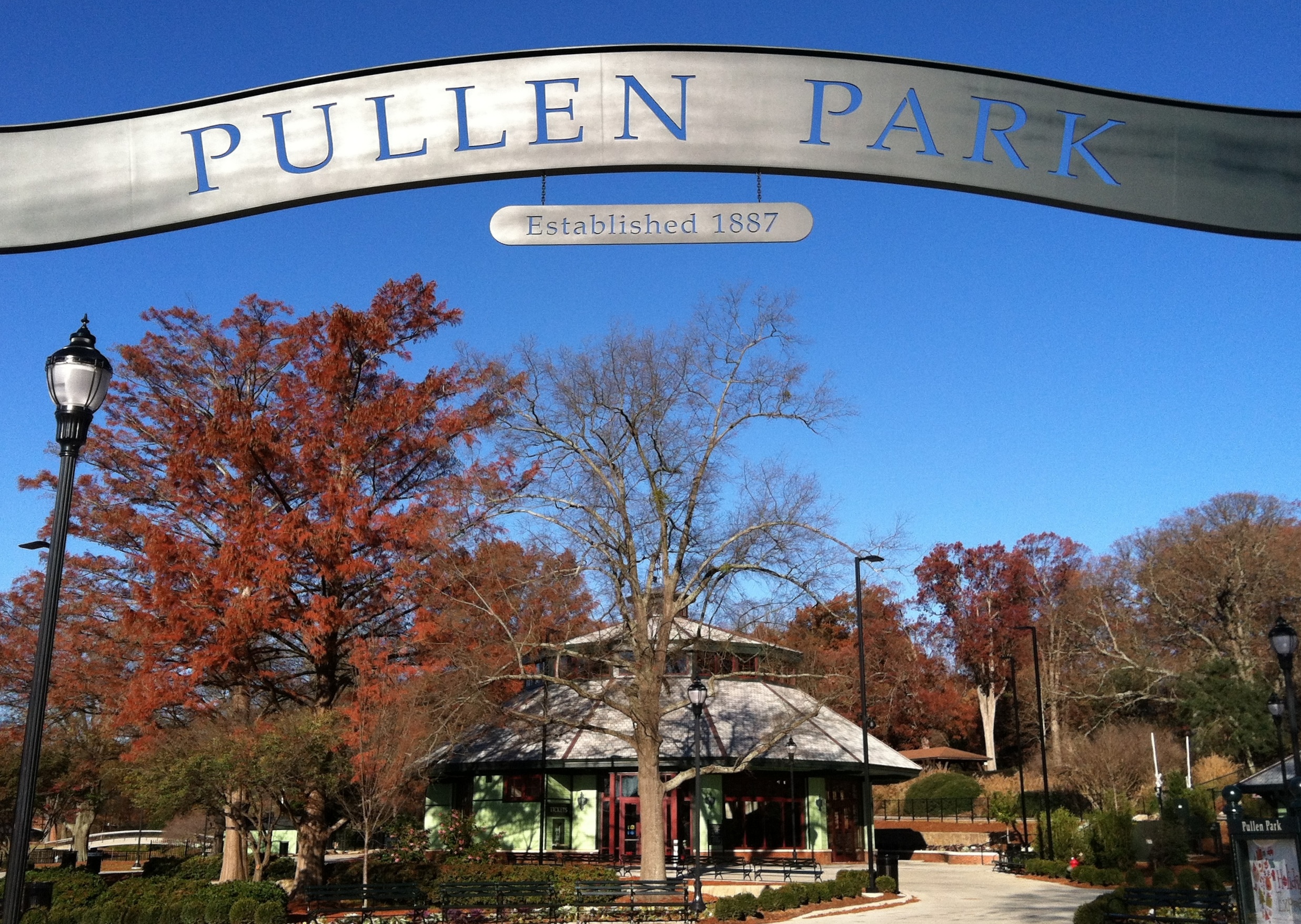
Pullen Park
The city paid $1,425 for a carousel -- one-tenth of its original price -- and Raleigh residents were furious. It was 1921, and the city board had voted to buy a Dentzel carousel from the failing Bloomsbury Park across town to replace Pullen Park's aging steam-powered merry-go-round. The public anger evaporated the moment the new carousel began spinning. More than a century later, 52 hand-carved basswood animals -- giraffes, ponies, ostriches -- still circle beneath gilded mirrors while a 1924 Wurlitzer 125 organ fills the air, and Pullen Park holds its place as the 14th oldest amusement park in the world.
A Shy Philanthropist's Gift
Richard Stanhope Pullen was born on September 18, 1822, on a small family farm in Wake County. He shied from the press his entire life, and little is known about his early years. What is known is that as a young man he went to work for his uncle, Richard Smith, in Raleigh, and eventually inherited a substantial fortune. Pullen poured that wealth into developing the city -- his land and monetary donations helped establish city roads, Peace College, UNC Greensboro, NC State University, and Edenton Street United Methodist Church. The park that bears his name became his most personal project. He remained actively involved in planning and funding improvements until his death in 1895. Despite his generosity, no monument or plaque appeared on park grounds until 1992, because the city feared that a memorial might violate the deed's clause requiring the land be used strictly for recreational purposes.
Carved in Basswood
The carousel is the soul of Pullen Park. Master carver Salvatore Cernigliaro created it for the Dentzel Carousel Company of Germantown, Pennsylvania -- the first American carousel company. Each of the 52 animals was hand-carved from basswood, joined by two chariots, 18 large gilded mirrors, and 18 canvas panels. Of the thousands of carousels manufactured in the United States, only about 200 antique examples survive. Fewer than 25 are Dentzels, and just 14 remain in operation. Pullen Park's carousel originally spun at Bloomsbury Park, an amusement park founded by Carolina Power & Light near what is now Five Points. When Bloomsbury fell into financial trouble, the city seized its chance. The carousel was added to the National Register of Historic Places in 1976. A major restoration between 1977 and 1982 uncovered the original factory paint and restored each animal to its exact Munsell Color System specification, preserving the first coat beneath a protective layer of shellac.
Trains, Statues, and a Red Caboose
A miniature train has circled the park since 1950, its whistle a familiar sound for generations of Raleigh children. The C.P. Huntington Train is a narrow-gauge, one-third-scale replica of a locomotive built in 1863 at the Danforth-Cook Locomotive works in Paterson, New Jersey. The original engine traveled by ship around Cape Horn to San Francisco, where Central Pacific Railroad christened it C.P. Huntington #3 on April 9, 1864. A tunnel and second train were added in 1971. Near the tracks sits a real Norfolk Southern Railway bay window red caboose in Southern Railway livery, open for children to explore. In 2003, TV Land permanently loaned a bronze statue of Andy and Opie Taylor from The Andy Griffith Show -- a move that sparked a territorial dispute with Mount Airy, North Carolina, the real-life inspiration for fictional Mayberry. Mount Airy eventually got its own statue outside the Andy Griffith Museum.
A Park for Everyone -- Almost
Pullen Park's history is not without complication. During the Jim Crow era, African Americans were prohibited from using some facilities, including the swimming pool, though the park's main areas remained open to everyone. That painful chapter sits alongside the park's broader identity as a place of community gathering. Today the park encompasses an Aquatic Center with an Olympic-sized pool completed in 1992, an Arts Center offering classes in pottery, jewelry-making, painting, printmaking, weaving, and glass arts, and the internationally acclaimed Theatre in the Park, which has staged Ira David Wood III's musical adaptation of A Christmas Carol every year since 1974. Lake Howell offers paddle boats, and the surrounding grounds hold tennis courts, ball fields, picnic shelters, and playgrounds. The park closed for nearly two years beginning in December 2009 for a sweeping renovation that added a climate-controlled carousel house, a geothermal energy system beneath the dredged lake, and a new welcome center.
Still Spinning
Pullen Park sits adjacent to NC State University's main campus, tucked between Western Boulevard and Hillsborough Street. It is a park defined by continuity -- the same carousel turning since 1921, the same miniature train circling since 1950, the same Theatre in the Park staging shows since 1947. Richard Stanhope Pullen's most recognizable monument is not in the park at all but an obelisk on the family plot in Raleigh's Oakwood Cemetery. The man who gave Raleigh its first public park never wanted a statue. Pullen Hall at NC State bears his name, but the truest tribute is the park itself: the Wurlitzer organ still plays, children still ride the basswood giraffes, and the train still disappears into its tunnel before emerging on the other side.
From the Air
Located at 35.780N, 78.664W, immediately west of downtown Raleigh and adjacent to NC State University's main campus. The park occupies a green space between Western Boulevard (south) and Hillsborough Street (north). Lake Howell is visible from altitude as a small body of water within the park. The miniature train loop and carousel house are identifiable at lower altitudes. Nearest airport is Raleigh-Durham International (KRDU), approximately 10 nm northwest. The NC State University campus buildings and bell tower provide visual references to the east. Recommend 1,500-2,500 ft AGL to appreciate the park's layout within the surrounding urban grid.