Puning Temple (Hebei)
The wooden figure stands 22.28 meters high and weighs 110 tons. It has a thousand arms and a thousand eyes, carved from five different kinds of wood -- pine, cypress, elm, fir, and linden -- and assembled inside a hall that was built specifically to contain it. This is the statue of Avalokitesvara at the Puning Temple in Chengde, the world's tallest wooden sculpture of the Bodhisattva of Compassion. The temple that houses it was commissioned by the Qianlong Emperor in 1755, not merely as an act of religious devotion but as a calculated gesture of political theater following a military conquest.
Victory Monument Disguised as a Temple
The Puning Temple -- the Temple of Universal Peace -- was built to commemorate the Qianlong Emperor's victory over the Dzungar people of northwestern China. The Dzungars, a confederation of Oirat Mongol tribes based in what is now Xinjiang, had resisted Qing expansion for decades. When the Qianlong Emperor dispatched his army to the Ili region, the Qing forces attacked Kulja and captured the ruling Dzungar khan. To mark the conquest, Qianlong personally inscribed a commemorative tablet -- the Puning Sibei -- that still stands in the temple's stele pavilion. But the temple was more than a victory monument. Because the Dzungars were followers of Tibetan Buddhism, the Qianlong Emperor ordered the temple built in imitation of the Samye Monastery in Tibet, the sacred site where Buddhism was first established in the Tibetan world. The message was deliberate: the Qing emperor could build your holy places as easily as he could conquer your lands.
Where China Meets Tibet
The Puning Temple's architecture is a deliberate hybrid. The front section follows traditional Chinese temple design -- axially symmetrical, proceeding through gates and courtyards in the familiar progression of Han Buddhist architecture. But the rear section shifts dramatically into Tibetan style, with terraced structures, flat roofs, and whitewashed walls that recall the monasteries of the Tibetan plateau. This fusion was not accidental. The Qing dynasty governed a vast multiethnic empire, and Chengde served as a stage where that diversity was performed. The historian Waley-Cohen has called Chengde "a crucial location for the exhibition of Manchu power and the representation of Qing imperial knowledge." The Puning Temple, along with the nearby Putuo Zongcheng Temple modeled after the Potala Palace in Lhasa, demonstrated the emperor's mastery of the architectural and religious traditions of his subject peoples.
A Thousand Arms, Five Kinds of Wood
The colossal statue of Avalokitesvara dominates the temple's main hall, rising through multiple stories of the building's interior. A thousand arms extend from the figure's frame in varying sizes, each hand bearing an eye that symbolizes the Bodhisattva's compassionate gaze upon all sentient beings. The craftsmanship required to assemble a 110-ton wooden sculpture from five different tree species represents one of the peak achievements of Qing-era woodworking. The choice of Avalokitesvara was significant: in Tibetan Buddhism, the Bodhisattva of Compassion is considered the patron deity of Tibet, and Tibetan tradition holds that the Dalai Lama is an incarnation of Avalokitesvara. By housing the world's largest wooden image of this figure, the Qianlong Emperor was simultaneously honoring Tibetan religious tradition and asserting Qing authority over it.
One of the Eight, and Still Standing
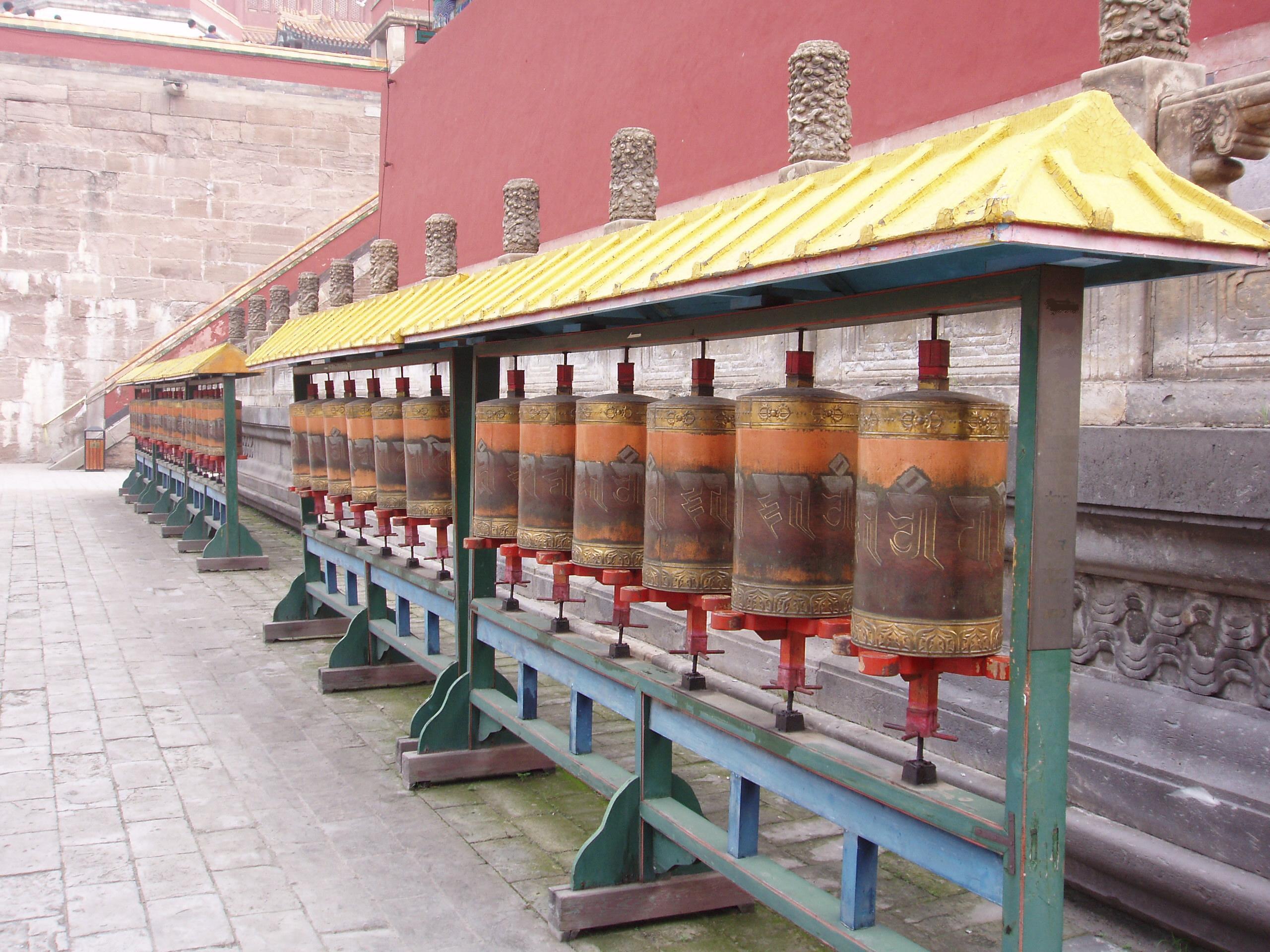
Puning Temple is one of the Eight Outer Temples of Chengde, a ring of religious complexes built outside the walls of the Mountain Resort during the eighteenth century. Each temple represented a different architectural and religious tradition from across the Qing empire. Together with the Mountain Resort itself, the Eight Outer Temples were designated a UNESCO World Heritage Site in 1994. The Puning Temple remains an active site of Buddhist worship and a major tourist attraction. Prayer wheels -- modern additions -- spin in the courtyards, and incense drifts through halls that have witnessed 270 years of devotion. The complex of temple halls, pavilions, drum towers, and bell towers surrounds the central hall like a frame around its monumental centerpiece. Walking through the Chinese-style courtyards into the Tibetan-style rear section, visitors experience the architectural shift that the Qianlong Emperor engineered -- a journey between two building traditions that mirrors the cultural reach of the empire he governed from these mountains.
From the Air
Located at 41.01N, 117.95E in Chengde, Hebei Province. The temple complex is visible from altitude near the Mountain Resort. The nearest airport is Chengde Puning Airport, approximately 20 km northeast. Beijing Capital International (ZBAA/PEK) is the nearest major international airport, about 225 km southwest. Terrain is mountainous. Best viewed from 3,000-6,000 feet AGL.