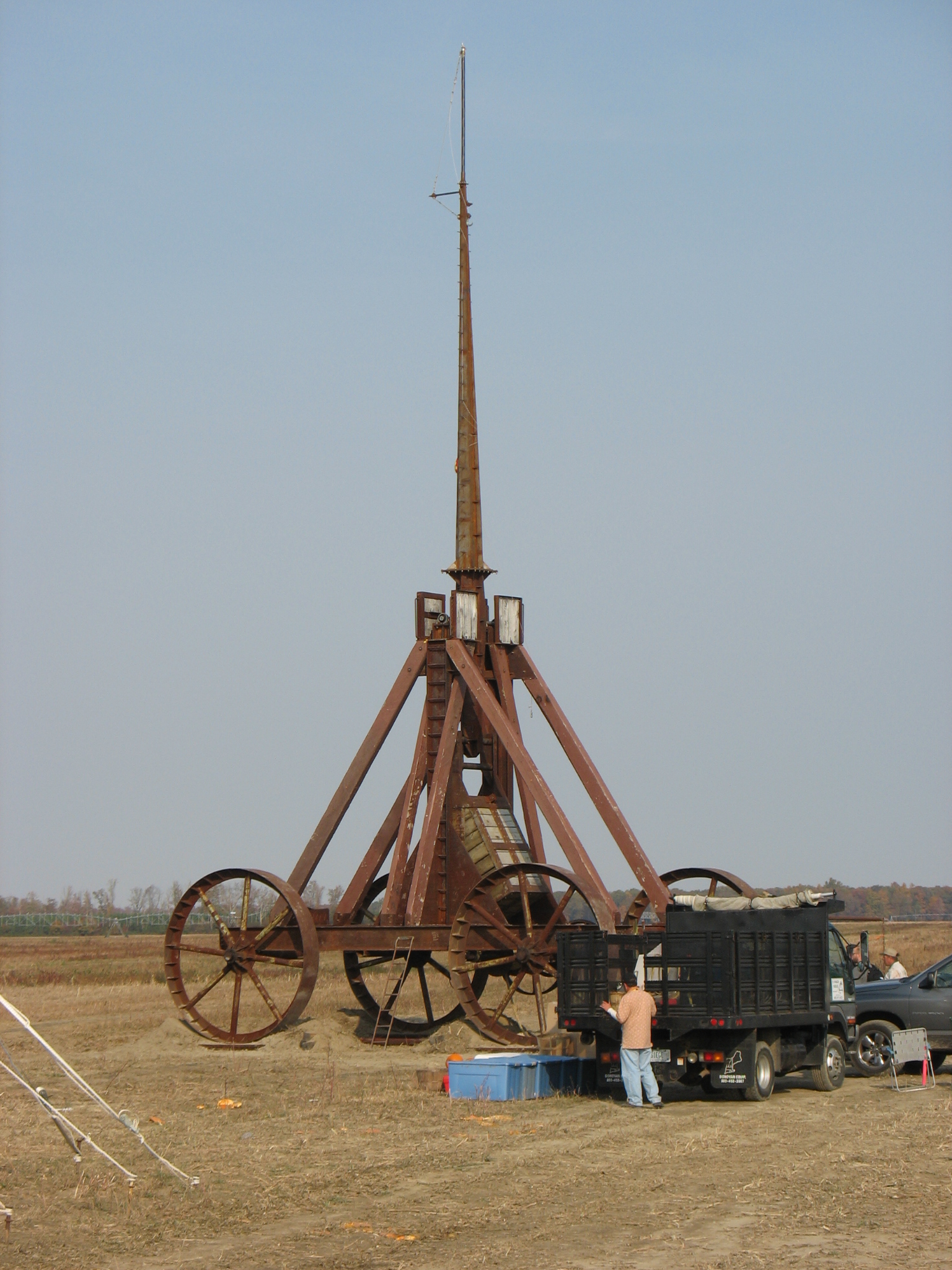
Punkin Chunkin
In 1986, somewhere in Sussex County, Delaware, a few friends with more ingenuity than sense built a contraption and launched a pumpkin 178 feet. They called it Punkin Chunkin, because in Delaware you do not throw a pumpkin, you chunk it. That first toss barely cleared a football field. By 2013, pneumatic air cannons were hurling ten-pound gourds nearly a mile across flat Delaware farmland, and the World Championship Punkin Chunkin had become a Thanksgiving television tradition watched by millions. The sport of competitive pumpkin launching sounds absurd because it is absurd, and that is precisely the point.
The Arms Race in Orange
What began with backyard slingshots evolved into a serious engineering competition. Teams compete across divisions including air cannons, catapults, trebuchets, centrifugals, and human-powered machines. The pneumatic cannons dominate the distance records, using compressed air to accelerate pumpkins through barrels at tremendous velocity. A cannon called Big 10 Inch holds the Guinness world record, set on September 9, 2010, in Moab, Utah, where the thin, dry desert air offered less resistance. The WCPCA championship record belongs to the American Chunker, captained by Brian Labrie, which fired a pumpkin 4,694.68 feet on November 1, 2013, in Bridgeville, Delaware. The choice of pumpkin matters as much as the machine. Casper, Lumina, and La Estrella varieties are preferred for their thick rinds. Any pumpkin that bursts mid-flight is called a "pie" and the shot is disqualified.
A Festival Finds Its Field
The World Championship Punkin Chunkin originated in Lewes, Delaware, and grew rapidly. By 2007, it had relocated to Bridgeville near the intersection of Seashore Highway and Chaplains Chapel Road, where about 75 teams competed, more than 20,000 spectators showed up, and the event grossed over $800,000. More than 70 percent of that revenue went to community organizations. The three-day festival featured far more than flying pumpkins: amusement rides, live concerts, a chili cook-off, a pumpkin cooking contest, fireworks, and the Miss Punkin Chunkin pageant. Teams got three shots over three consecutive days, with only the longest counting. Spotters on ATVs found the impact points, and professional surveyors calculated distances using GPS coordinates. Impact sites were marked with color-coded spray paint across the fields.
Lawsuits, Cancellations, and Comebacks
Success brought complications. After the 2013 championship, the landowner evicted the event following a 2011 lawsuit. Organizers tried to move to Dover International Speedway in 2014, but the straightaway was not long enough for machines that could fire a pumpkin nearly a mile. Insurance companies refused coverage, and the 2015 contest was expected to be shuttered permanently. The event managed a comeback at Bridgeville in 2016, but during that year's taping for the Science Channel, an air cannon malfunctioned and flying metal seriously injured a production staffer. Science Channel pulled its coverage, and the resulting lawsuit canceled the 2017 championship. In 2019, organizers relocated to the former Chanute Air Force Base in Rantoul, Illinois, citing better liability protections and Illinois's status as the country's top pumpkin-growing state. The event ran, but was substantially downsized.
Prime-Time Pumpkins
Television discovered Punkin Chunkin in 2002 when the Discovery Channel aired a special hosted by Bryan Callen. After a six-year hiatus, the Science Channel picked it up in 2008. The show became a Thanksgiving staple, airing on tape delay after turkey dinners across America. MythBusters hosts Jamie Hyneman and Adam Savage hosted in 2010, and the show's Build Team members Tory Belleci, Kari Byron, and Grant Imahara took over from 2011 to 2013. The broadcasts brought national visibility to what had been a quirky regional tradition, pushing teams to build bigger and more sophisticated machines each year. The progression of winning distances tells the story: from the Melson-Thompson team's 178 feet in 1986 to American Chunker's 4,694 feet in 2013, an increase of more than 2,500 percent in just 27 years.
The Chunk Lives On
Even as the World Championship has struggled with legal and logistical troubles, the spirit of punkin chunkin has spread far beyond Delaware. Independent competitions run annually in Lake County, California; Clayton and Ellicottville, New York; Brasstown, North Carolina; and Bald Eagle State Park in Pennsylvania. A European Championship has been held in Bikschote, Belgium, every year since 2004. A variant called the pumpkin shoot emphasizes accuracy over distance, with competitors aiming at specific targets. The Great Pumpkin Shoot in Olean, New York, has run most years since 2010. What started as a few Delaware locals finding creative uses for leftover Halloween pumpkins has become an international celebration of ingenuity, physics, and the enduring human desire to see how far you can launch a gourd.
From the Air
The original World Championship Punkin Chunkin site is near Bridgeville, Delaware, at approximately 38.72N, 75.54W, along the flat agricultural landscape of Sussex County. From the air, the area is characterized by open farmland ideal for long-distance projectile competitions. Nearest airports include Georgetown-Sussex County Airport (KGED) and Dover Air Force Base (KDOV) to the north. Best viewed at 1,500-2,500 feet AGL, where the scale of the flat Delaware farmland that made mile-long pumpkin shots possible becomes apparent. The 2019 event relocated to the former Chanute Air Force Base in Rantoul, Illinois.