Punxsutawney: Where a Rodent Controls the Weather
Every February 2nd, tens of thousands of people gather on a frozen hillside in rural Pennsylvania to watch a groundhog emerge from a fake burrow and supposedly predict the weather. They've been doing this since 1887. The tradition makes no meteorological sense - Phil's predictions are accurate about 40% of the time, worse than random chance - but sense isn't the point. Punxsutawney Phil has become an American institution, a midwinter spectacle that blends German immigrant folklore, small-town boosterism, and the human need for any sign that spring will eventually return. The 1993 film 'Groundhog Day' made the ritual famous worldwide. The groundhog seems unbothered by the attention.
The Origins
German immigrants brought Candlemas traditions to Pennsylvania, including the belief that a sunny February 2nd meant six more weeks of winter. In Germany, the prognosticating animal was usually a hedgehog or badger; Pennsylvania had neither, but groundhogs were abundant. Local newspaper editor Clymer Freas promoted the first official Punxsutawney Groundhog Day in 1887, declaring a local groundhog the official forecaster. The Punxsutawney Groundhog Club formed to manage the tradition. What began as a novel promotion for a small town became, over 130 years, a genuine American tradition - irrational, charming, and surprisingly durable.
The Ritual
The ceremony follows established forms. Before dawn on February 2nd, crowds gather at Gobbler's Knob, a cleared area outside town. Members of the Inner Circle - men in top hats and tuxedos who constitute the tradition's priesthood - coax Phil from his heated burrow. The groundhog is presented to the crowd. If Phil sees his shadow (sunny morning), six more weeks of winter; no shadow (cloudy), early spring. The President of the Inner Circle pretends to consult Phil, who communicates in 'Groundhogese,' and announces the prediction. The crowd cheers regardless of outcome. By sunrise, it's over.
The Immortal Phil
According to official mythology, there has been only one Punxsutawney Phil, kept alive since 1887 by regular sips of 'groundhog punch.' In reality, groundhogs live 6-8 years; there have been many Phils. The Inner Circle maintains the fiction with straight faces. Phil lives year-round at the Punxsutawney Memorial Library in a climate-controlled burrow, emerging for public appearances and the annual prediction. He has a wife, Phyllis. He has made predictions for over 130 consecutive years. The record shows roughly 100 predictions of more winter, 20 of early spring. His accuracy is dismal, but meteorology was never really the point.
The Movie Effect
Harold Ramis's 1993 film 'Groundhog Day,' starring Bill Murray, transformed the tradition from regional curiosity to international phenomenon. The movie used the holiday as a premise for time-loop philosophical comedy, not really engaging with Phil's predictions. But it put Punxsutawney on the global map. Attendance at Gobbler's Knob swelled from hundreds to tens of thousands. The town embraced the attention, adding Phil-related attractions and events. The film became a cultural touchstone; 'groundhog day' entered the language as metaphor for repetitive tedium. A small town's quirky tradition became Americana.
Visiting Punxsutawney
Punxsutawney is located in Jefferson County, Pennsylvania, approximately 80 miles northeast of Pittsburgh via US-119. For Groundhog Day itself (February 2nd), arrive very early - crowds gather before dawn at Gobbler's Knob, 2 miles from town. Shuttle buses transport visitors. Weather is typically frigid; dress accordingly. Outside the holiday, Phil can be visited at the Punxsutawney Memorial Library. The town features groundhog statues, Phil-themed shops, and the Punxsutawney Weather Discovery Center. Lodging is limited and books early for February; surrounding areas offer more options. The experience is best understood as folk festival rather than scientific inquiry.
From the Air
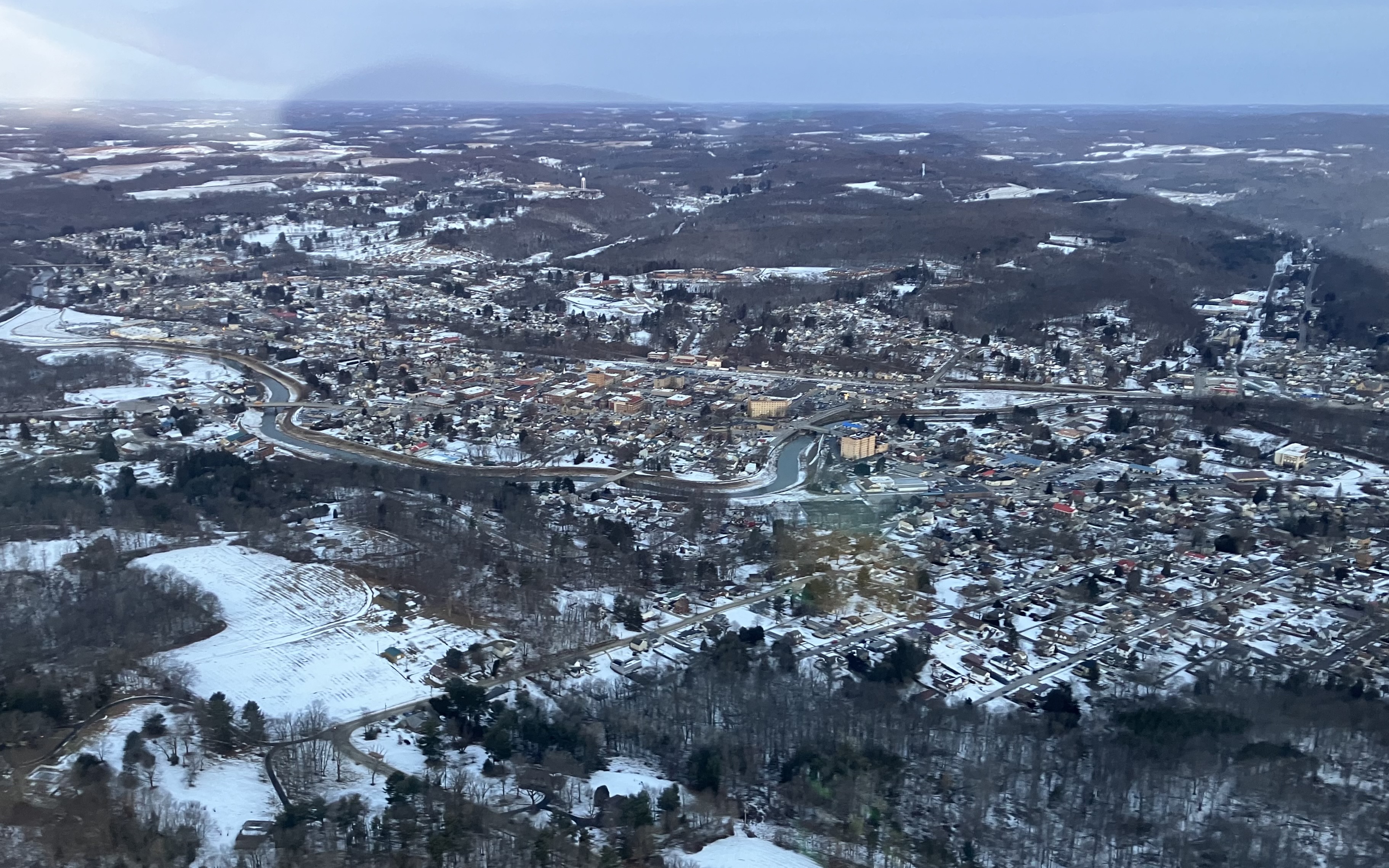
Located at 40.94°N, 78.97°W in the Allegheny Plateau of western Pennsylvania. From altitude, Punxsutawney appears as a small town in forested hill country, surrounded by the folded ridges characteristic of this region. Gobbler's Knob, the ceremony site, is a cleared area northeast of town. The terrain is rural, agricultural in valleys, forested on slopes. Pittsburgh is visible to the southwest on clear days. Nothing about the landscape suggests the worldwide fame this place achieves every February 2nd - it looks like what it is: a small Pennsylvania town, distinguished only by having successfully marketed a groundhog.