The Pilgrimage That Drowned
Every 210 days, the tide determined the terms of worship. When the water was low, pilgrims walked - hundreds of them filing through the mangrove forest that separated the main island of Bali from tiny Serangan, carrying ancient heirlooms and sacred temple objects above their heads, their feet sinking into the mud flats. When the tide was high, they loaded into jukung, the traditional outrigger canoes painted in colors bright enough to be seen across open water, and paddled to the island's northwestern shore. Either way, the journey was the point. Getting to Pura Dalem Sakenan required effort, exposure to the elements, a crossing that marked the boundary between ordinary life and sacred space. Then, in 1996, developers reclaimed the sea between Bali and Serangan, filled it with earth, and built a bridge. The jukung pilgrimage simply stopped. A tradition that had survived a thousand years did not survive the convenience of a paved road.
The Priest Who Shaped an Island's Faith
The temple traces its founding to the 10th century and to Mpu Kuturan, a high priest who arrived in Bali around 1001 AD, decades before the fall of the Majapahit Kingdom on neighboring Java. Mpu Kuturan was not simply a visitor. He is credited with systematizing Balinese Hinduism itself - organizing the island's scattered spiritual practices into the temple system that still structures religious life today. That he chose this small island off Bali's southern coast for one of his temples suggests Serangan held significance even before his arrival. The temple he established became dedicated to Rambut Sedhana, a deity associated with prosperity, and grew into a pilgrimage site whose gravitational pull extended across the surrounding region. The original construction used limestone and coral quarried from the coastal reefs - materials drawn directly from the sea that surrounded the sacred ground.
Walls That Remember
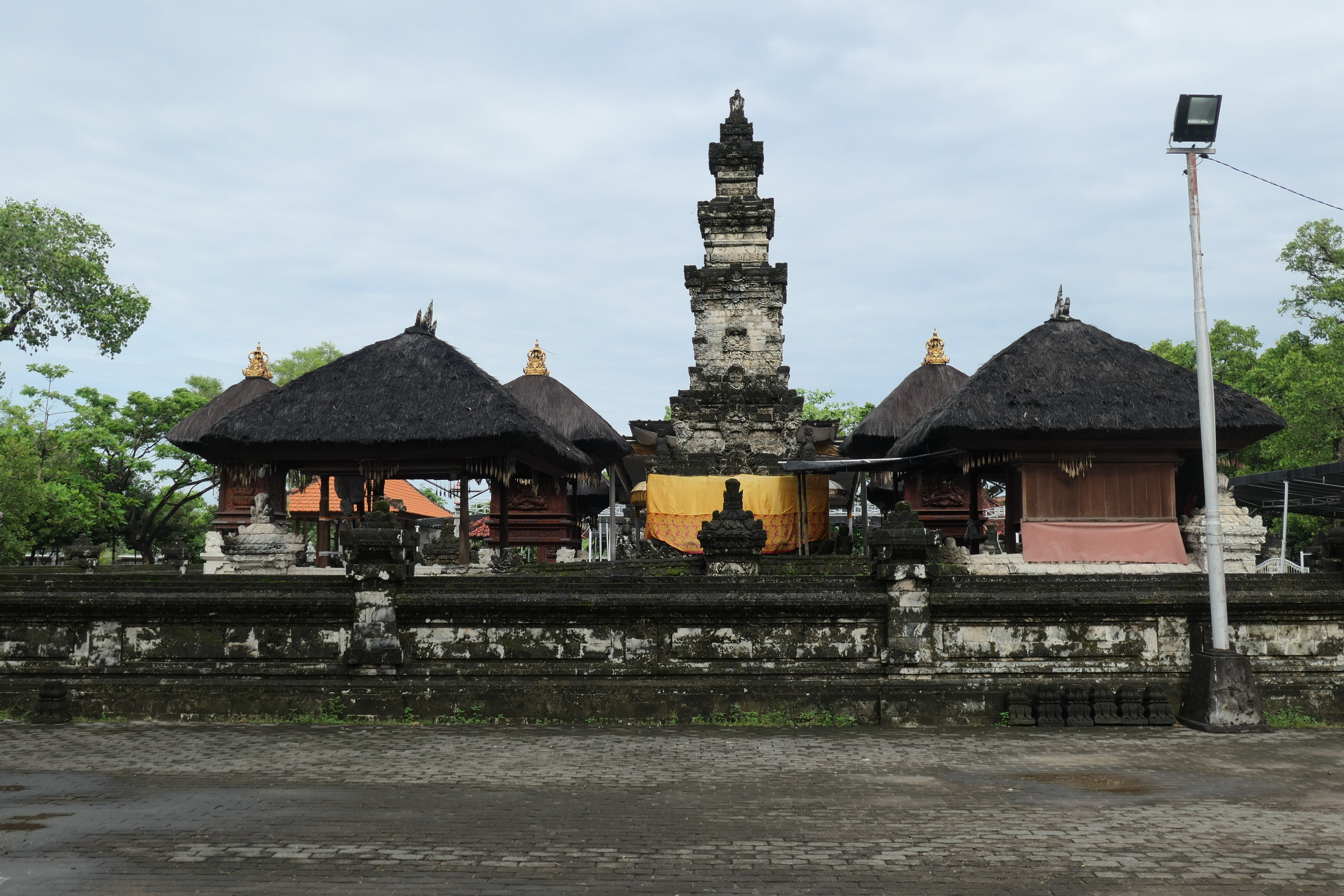
The temple compound follows the standard Balinese arrangement of nested sanctity. A candi bentar - the distinctive split gate that appears throughout Balinese architecture - marks the entrance to the middle sanctum, the jaba tengah. Beyond it, a paduraksa gate leads into the jero, the innermost and most sacred precinct. Here, multiple pelinggih shrines rise in thatched tiers, each dedicated to a local deity, with the tallest honoring Jro Dukuh Sakti. While renovations have updated much of the complex - surrounding villagers expanded the western section in 1982 - the antique perimeter walls remain untouched. These walls, built from the same coral and limestone as the original temple, are the oldest surviving element of the compound. They have outlasted earthquakes, colonial occupation, Indonesian independence, and the tourism boom that transformed the rest of the island. Walk along them and you are touching something Mpu Kuturan's contemporaries would recognize.
A Festival Measured in Balinese Time
The Piodalan festival celebrates the temple's anniversary, but it does not fall on the same date each year by Western reckoning. The Balinese pawukon calendar runs on a 210-day cycle, and the Piodalan is held on every Kliwon Kuningan Saturday - the final day of the Galungan celebrations, a period when ancestral spirits are believed to visit the living. The timing matters because it means the festival's relationship to the Gregorian calendar constantly shifts, drifting through seasons, sometimes falling in the dry months and sometimes in the wet. For the pilgrims, this meant the crossing to Serangan was never the same twice. Some years they walked through ankle-deep water under equatorial sun. Other years they fought monsoon swells in their jukung. The variability was not a flaw in the system. It was a feature - each pilgrimage uniquely demanding, each arrival uniquely earned.
Three Temples, One Journey
The pilgrimage to Serangan was never just about Pura Dalem Sakenan. Upon arriving on the island, worshippers first proceeded to Pura Susunan Wadon, located about half a kilometer to the east. From there, they moved to Pura Susunan Agung. Only after visiting both did they complete the circuit at Pura Dalem Sakenan itself. This three-temple sequence transformed a visit into a narrative - a story with chapters, each temple adding a layer of devotion before the climactic arrival at the main shrine. The progression also meant pilgrims spent hours on the island, moving between compounds, praying, presenting offerings, inhabiting the sacred geography rather than simply checking in and leaving. It was, in the truest sense, a journey rather than a destination.
What the Bridge Took
The Serangan Sakenan bridge, completed after the 1996 reclamation, did not destroy Pura Dalem Sakenan. The temple still stands. The Piodalan still occurs every 210 days. Pilgrims still come. But the crossing - the thing that made the pilgrimage a pilgrimage rather than a commute - is gone. Motorcycles and cars now drive directly to the island on a road built over what used to be open water and mangrove forest. The jukung, those painted outrigger boats that once ferried the faithful in a flotilla of color and prayer, sit beached or repurposed for tourist excursions. It is a familiar story in Bali and across the developing world: infrastructure that solves a practical problem while dissolving a cultural one. The pilgrims no longer need to negotiate with the tide. They no longer need to carry sacred objects above the waterline. They no longer arrive wet, exhausted, and transformed by the crossing. They arrive the same way they left - seated, dry, unchanged. Whether something essential was lost in that exchange depends on what you believe a pilgrimage is for.
From the Air
Located at 8.73°S, 115.23°E on the northwestern shore of Serangan Island, approximately 10 km south of Denpasar, Bali. Ngurah Rai International Airport (WADD) lies roughly 7 km to the west. From altitude, Serangan Island is clearly visible as a small landmass just off Bali's southern coast, connected to the mainland by the Serangan Sakenan bridge and surrounding reclaimed land. The temple compound sits near the island's northwestern tip. At lower altitudes (2,000-5,000 feet), the contrast between the island's developed areas and the remaining mangrove fringes is evident. The broader context of Bali's southern coast - Sanur Beach to the north, Benoa Harbor to the west, and the reef-fringed waters between - provides orientation. Tropical climate with wet season December-March.