The Temple That Carved Its Conquerors into Stone
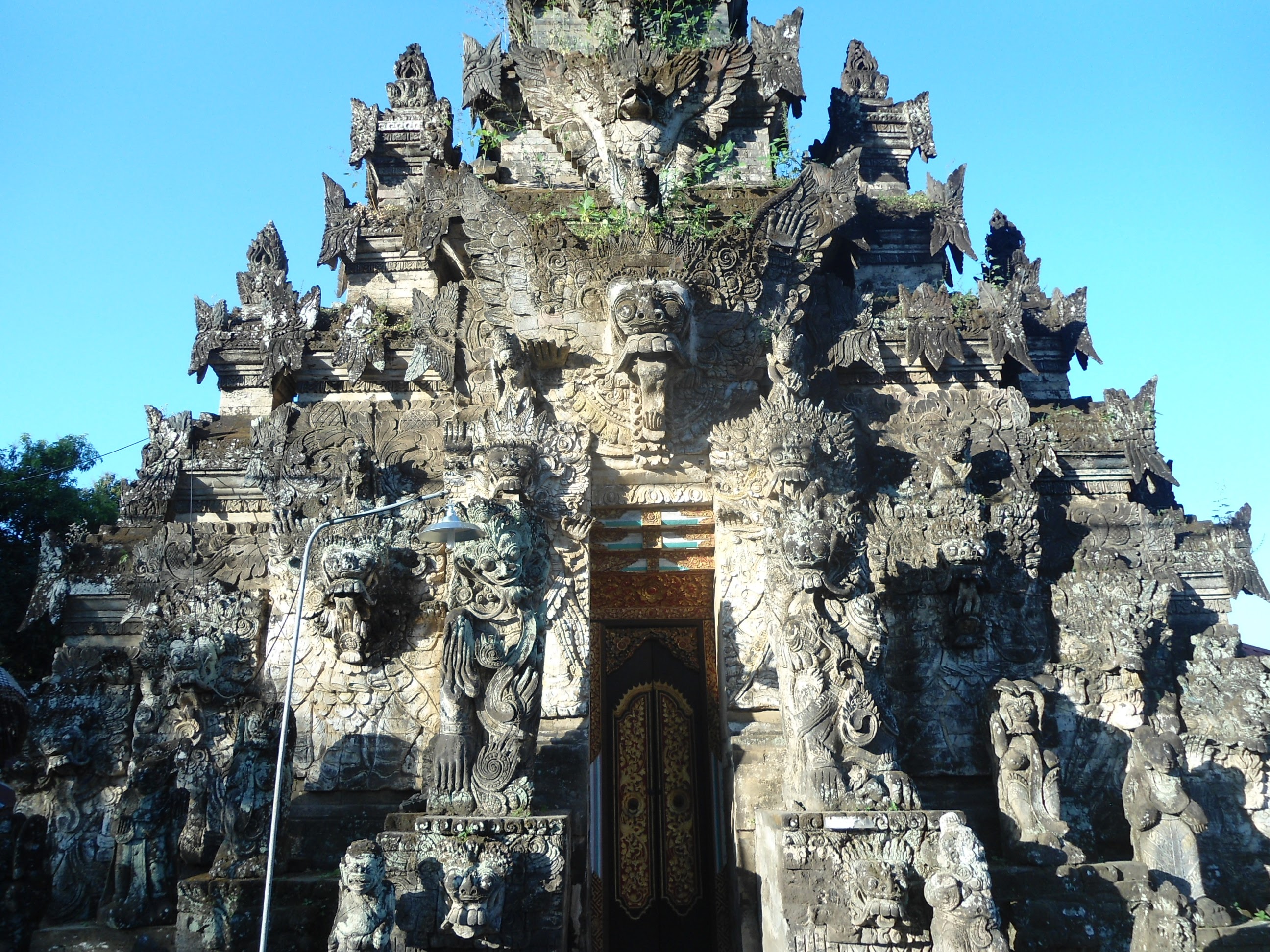
Somewhere on the perimeter wall of Pura Dalem Segara Madhu, an airplane falls into the sea. Nearby, a ship is attacked by a sea monster. An early automobile rolls across stone that was first consecrated eight centuries before the internal combustion engine existed. These are not modern additions or playful restorations. They are carvings from the early 20th century, made by Balinese artisans who had watched the Dutch arrive with machines the island had never seen and decided to absorb them - not as objects of worship or fear, but as motifs in a temple dedicated to Shiva, the god of death and destruction. Pura Dalem Segara Madhu sits in the village of Jagaraga, about 11 kilometers east of Singaraja in northern Bali. It is a temple that was destroyed by colonial violence, rebuilt by the people who survived it, and decorated with images of the world that had tried to erase them.
Eight Centuries and a Ruin
The temple's origins reach back to approximately the 12th century, according to the chronicle of Raja Sri Aji Jayaraga. For seven hundred years it stood in a village that would become infamous for one of the most traumatic events in Balinese history. In 1849, the Dutch military attacked the kingdom of Bali, and Jagaraga was where resistance met its end. The villagers witnessed puputan - the Balinese practice of ritual mass suicide in the face of certain defeat, a final assertion of sovereignty when sovereignty had become impossible. The Dutch destroyed the entire palace and temple complex. What stands today is not the 12th-century original but a reconstruction begun in 1865, sixteen years after the destruction. The rebuilt temple combined two sacred functions: Pura Prajapati, dedicated to Durga, and Pura Dalem, dedicated to Shiva. The architects merged them because the deities, in Balinese Hindu theology, belong to the same divine family. Destruction and creation, death and the power that governs it - the temple holds both.
Flowers, Nagas, and Falling Planes
Northern Balinese temples are carved more ornately than their southern counterparts, and Pura Dalem Segara Madhu is among the most intensely decorated on the island. Its walls crawl with foliage, flowers, nagas - the serpentine figures that bridge the human and divine worlds - and human forms rendered in deep relief. This density of carving is characteristic of the north, where temples like Pura Beji Sangsit share the same aesthetic of overwhelming surface detail. But what sets Jagaraga's temple apart is what the carvers chose to include alongside the traditional imagery. Western technology appears on the walls as if it had always belonged there - an airplane nosediving into ocean waves, a steamship grappling with a mythical sea creature, a car from an era when cars were still novelties in most of Europe. These carvings are not parody or protest. They are incorporation. The Balinese artisans treated Dutch machines the way they treated everything else that entered their world: they carved it into the temple and made it part of the story.
The Colonial Wound and the Ethical Turn
The Dutch entered Bali through the north, and the conflicts that followed scarred the region for decades. Between 1846 and 1849, the colonial government launched a series of military campaigns to impose its authority on Balinese kingdoms that had governed themselves for centuries. The final campaigns in the early 20th century were devastating - approximately a thousand Balinese civilians died, and an entire kingdom was erased. The disproportionate violence shocked observers in Europe, where the Netherlands had cultivated an image as a benevolent colonial power. Criticism mounted, compounded by Dutch policies in Java, Sumatra, and the eastern islands, and the colonial government announced what it called an "Ethical Policy" - a pivot from exploitation toward preservation. The Dutch began studying Balinese culture with scholarly seriousness, protecting traditions they had recently tried to subjugate. They envisioned Bali as a "living museum" of classical Hindu-Javanese civilization. In 1914, they opened the island to tourism. The temple carvings at Jagaraga predate this pivot, but they anticipated its logic: the encounter with the West was already being recorded in stone, processed through Balinese artistic tradition, long before any European decided Bali was worth preserving.
Three Sanctums and the Demon Queen
Pura Dalem Segara Madhu follows the traditional Balinese temple layout of three concentric zones, each more sacred than the last. The outer sanctum is essentially the village street itself - an openness that reflects the Balinese belief that the sacred is not walled off from daily life but continuous with it. A gate carved in the ornate northern style, topped by the monstrous face of Bhoma - a protective figure meant to ward off evil spirits - leads into the middle sanctum. Here stand the practical pavilions of temple life: the food pavilion where offerings are prepared, and the gong pavilion where the gamelan orchestra performs during ceremonies. Beyond lies the innermost sanctum, the most sacred ground, where shrines to the deities stand. As a dalem temple - a temple of death - the decorative program leans toward the fearsome. Statues of Batari Durga, the wrathful goddess, and carvings of Rangda, the demon queen of Balinese mythology, populate the space. These are not figures meant to frighten worshippers but to acknowledge what death is: powerful, monstrous, and part of the divine order.
From the Air
Located at 8.11S, 115.16E in northern Bali, approximately 11km east of Singaraja along the north coast. The village of Jagaraga sits slightly inland from the Bali Sea coast in the Buleleng Regency. From the air, Singaraja - the old colonial capital - is the dominant settlement on the north coast, and the temple lies in the agricultural hinterland to its east. The nearest major airport is Ngurah Rai International (WADD/DPS), roughly 85km to the south across Bali's central volcanic spine. Mount Agung (3,142m) rises prominently to the east-southeast. The north coast is drier than southern Bali, with generally excellent visibility. Approach from the north over the Bali Sea for views of the coastal plain and the foothills rising toward the central mountains. The contrast between the developed south coast and the quieter, more traditional north is visible even from altitude.