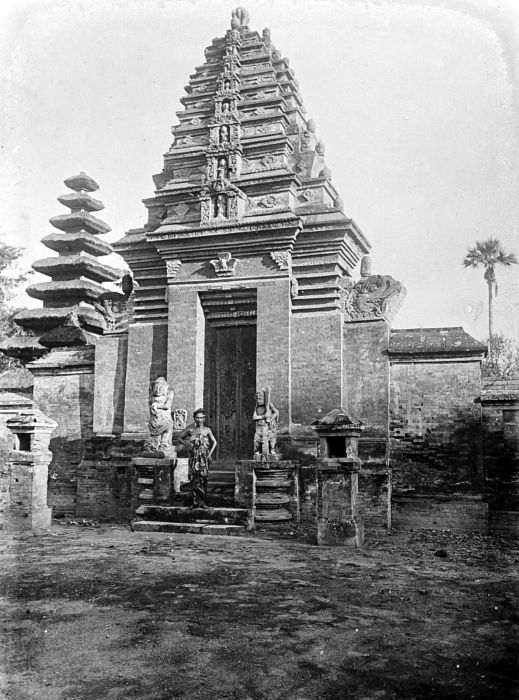
Pura Dasar Buana Gelgel
Five holy teachers crossed the sea from Java to reshape Bali's spiritual life. One of them, Mpu Ghana, chose celibacy and solitude. Around the year 1000 AD, he established a place of meditation in the village of Gelgel, a quiet settlement three kilometers from what would become the royal seat of Semarapura. He never married, never fathered children, and never sought political power. Yet the place where he sat and prayed would eventually become one of the most important temples on the island, a royal sanctuary for kings and a sacred anchor for an entire civilization's sense of itself.
The Celibate Who Built a Legacy
Mpu Ghana arrived in Bali during the reign of King Udayana Warmadewa and his consort Gunapraya Dharmapatni, who ruled from 988 to 1011 AD. He was a follower of the Ganapatya sect, devoted to Ganesha, and he committed himself to the Sukkla Brahmacari, a vow of lifelong celibacy. He was one of the Panca Tirta, the five holy teachers of Balinese Hinduism, alongside Mpu Gnijaya, Mpu Semeru, Mpu Kuturan, and Mpu Bradah. Each of these brahmins left a spiritual imprint on the island, founding traditions and lineages that endure to this day. Mpu Ghana's contribution was his parahyangan, a place of meditation that would outlast him by centuries. He asked for nothing but a quiet place to pray. The island gave him immortality.
From Ashram to Royal Pura
Two hundred and sixty-seven years after Mpu Ghana's death, another Brahmin from the Majapahit Kingdom arrived at the site of the old ashram. Mpu Dwijaksara built a formal pura there in 1267 AD as an act of homage to his predecessor. The temple might have remained a modest spiritual monument, but Bali's political geography intervened. When Sri Soma Kepakisan was crowned king of the Gelgel Kingdom in 1380 AD, he elevated the pura to royal status and christened it Pura Dasar Buana Gelgel. New shrines went up to honor the Tri-Residents: the Satrya Dalem, the Pasek, and the Pande. A century later, in 1489 AD, the great wandering priest Dang Hyang Nirartha arrived and built the Padma Tiga shrine in the inner sanctum to honor the Brahmins. Each generation added its own layer, transforming a hermit's meditation spot into one of the island's most architecturally rich temple complexes.
Three Courtyards, Twenty Shrines
Pura Dasar Buana follows the classic Balinese temple plan: three courtyards arranged along a north-south axis, each more sacred than the last. You enter through a candi bentar split gate on Jalan Waturenggong into the outer sanctum, the jaba pisan, where large banyan trees shade a grassy courtyard. A bale gong pavilion houses the gamelan instruments used during ceremonies. The middle sanctum holds the working spaces of the temple, including pavilions where offerings are prepared, and a bale kulkul tower whose slit-drum announces the time for prayer. But the inner sanctum is where the temple's history becomes visible in stone. More than twenty shrines and buildings fill this courtyard. The tallest is the Meru Tumpang Solas, an eleven-tiered meru tower dedicated to the descendants of Satrya Dalem. Two three-tiered meru towers honor the Pasek and Pande lineages. The Padma Tiga shrine, built by Dang Hyang Nirartha, completes the quartet known as the Catur Warga, four shrines representing the four social groups of Balinese Hindu society.
Living Ceremonies
Twice each year, on the day known as soma pon Kuningan, Pura Dasar Buana celebrates its piodalan, the temple's anniversary festival called Pemacekan Agung. The celebration draws worshippers from across the regency and beyond, filling the courtyards with offerings, incense, and the sound of gamelan. A separate annual festival, the Padudusan, takes place during the full moon of the fourth month in the Balinese calendar, the purnama kapat. These are not museum rituals performed for tourists. They are living ceremonies rooted in a continuous tradition stretching back to the brahmins who first carried Hindu teaching across the strait from Java. The temple that began as one man's quiet place of prayer still pulses with communal devotion, connecting twenty-first-century Bali to the spiritual ambitions of a celibate priest who arrived on these shores more than a thousand years ago.
From the Air
Pura Dasar Buana Gelgel sits at 8.555S, 115.408E in the village of Gelgel, about 3 km south of Semarapura (Klungkung). From the air, the temple complex is identifiable by its multi-tiered meru towers and large banyan trees within the walled courtyards. The nearest airport is Ngurah Rai International (WADD/DPS) approximately 40 km to the southwest. Approach from the east along the coast for views of the Klungkung Regency's terraced landscape, with Mount Agung rising to the northeast.