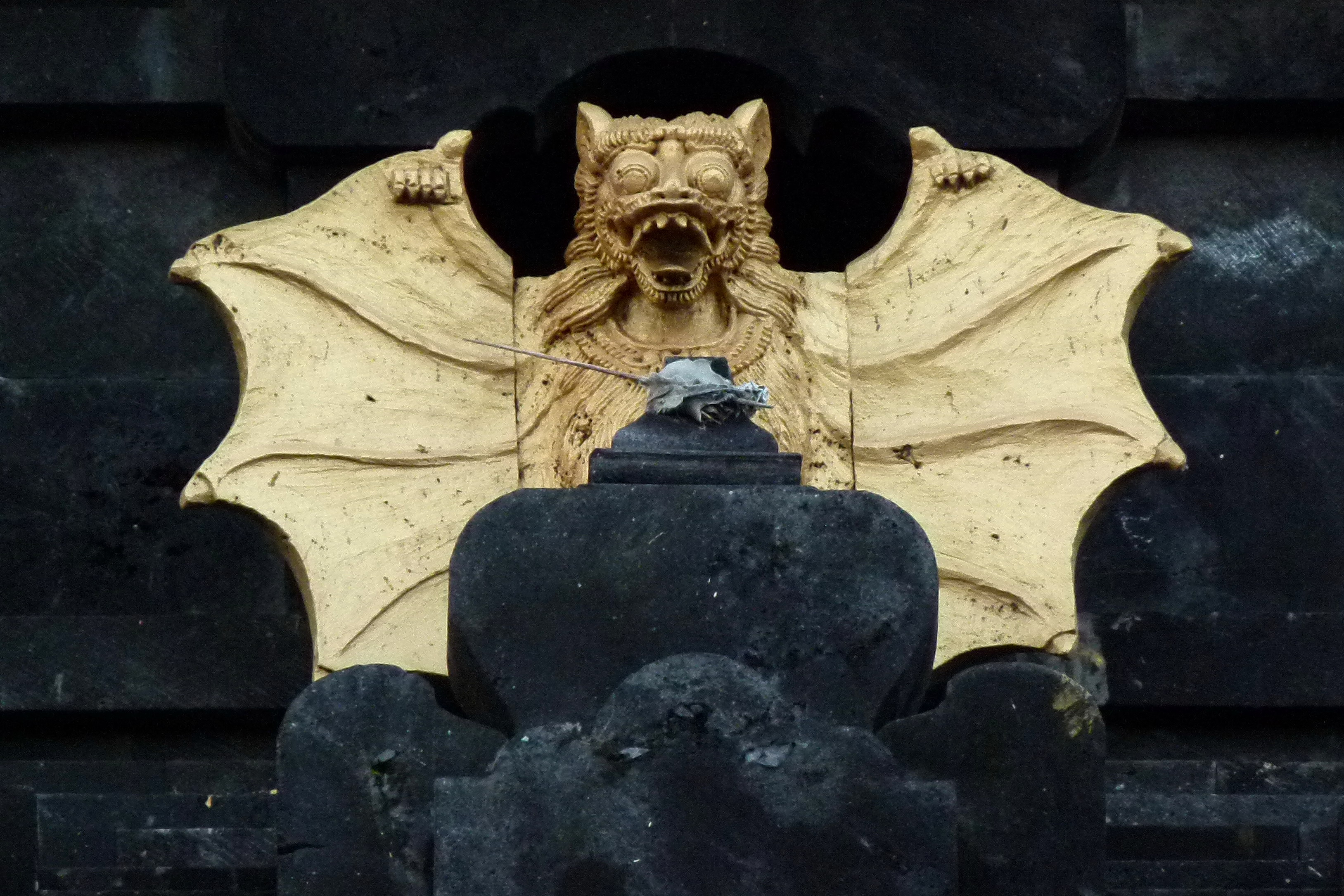
Pura Goa Lawah
The bats come out at dusk. Thousands of them pour from the mouth of a cave on Bali's eastern coast, spiraling upward past stone shrines and carved gates into the tropical air. They have done this every evening for at least a thousand years, since a Javanese priest named Mpu Kuturan chose this cave as a place of meditation in the eleventh century. The temple he founded around it, Pura Goa Lawah, the Bat Cave Temple, is not merely a curiosity built around an animal colony. It is one of the Sad Kahyangan Jagad, the six sanctuaries believed to be the spiritual pivot points of the entire island, holding Bali in cosmic balance.
Six Points of Spiritual Balance
Balinese Hinduism holds that six great sanctuaries anchor the island's spiritual equilibrium. The precise list varies by region, as different communities claim different temples for the honor, but the number is always six. Pura Goa Lawah consistently appears among them. The concept is geographic as much as theological: these temples are positioned at cardinal and intermediate points around the island, and their combined presence is believed to stabilize the spiritual forces that govern Bali. Losing any one of them would, in the Balinese understanding, unbalance the whole. This is not metaphor. It is lived conviction, expressed through centuries of continuous worship, offerings, and architectural investment. The cave and its bats are incidental to the temple's spiritual function, but they are inseparable from its identity.
A Priest's Meditation Cave
Mpu Kuturan was one of the pioneering Hindu priests who shaped Balinese religious practice in the eleventh century. He chose the cave at Pesinggahan, in what is now Klungkung Regency, as a meditation center. What drew him to this particular spot is unrecorded, but the cave's location on a hilly coastal outcrop, where the land meets the sea and the darkness of the underground opens to the sky, carries obvious symbolic resonance in Hindu cosmology. The temple complex grew around his meditation site over the following centuries. In the early twentieth century, the shrines and gates were decorated with porcelain ceramic plates, a practice common among Bali's older temples, including Pura Kehen in nearby Bangli. Most of that porcelain ornamentation has since been removed or replaced, but the tradition speaks to the temple's long history of aesthetic evolution, each era leaving its mark on the stone.
Through the Three Courtyards
The temple compound rises on a hilly outcrop near the beach of Goa Lawah. Like most Balinese temples, it is divided into three progressively sacred zones. A candi bentar split gate marks the entrance, with a bale kulkul drum tower standing to the west. The outer courtyard holds three pavilions, including the bale gong where gamelan instruments are stored for ceremonial performances. The middle courtyard lies to the west. But it is the innermost sanctum that reveals the temple's unique character. Three paduraksa portals open into the jero, where three meru towers rise, one dedicated to Shiva. Beyond these towers, smaller shrines are tucked directly into the cave mouth, nestled among the roosting bats. The cave entrance is framed by candi bentar gates, as if the natural opening were itself a doorway into the sacred.
The Dragon Beneath
Among the temple's most striking features is a bale pavilion flanked by carved representations of Naga Basuki, a primordial dragon from Hindu-Balinese mythology. Naga Basuki is not decorative. In Balinese belief, this serpent deity maintains the balance of the cosmos, coiled beneath the world to keep it steady. The dragon's presence at Goa Lawah reinforces the temple's identity as one of the island's stabilizing spiritual points. The bats, the cave, the dragon, the six-sanctuary system: these are not separate ideas but facets of a single cosmological vision in which the natural world and the sacred world are the same thing. When worshippers make offerings at the cave mouth while nectar bats hang in clusters overhead, they are participating in a relationship between humans, animals, and gods that has been maintained here since the eleventh century. The bats are not an inconvenience to be tolerated. They are part of the temple.
From the Air
Pura Goa Lawah is located at 8.552S, 115.469E on the eastern coast of Bali, in the village of Pesinggahan, Klungkung Regency. The temple sits on a hilly outcrop directly along the coastal road (Jalan Raya Goa Lawah). From the air, look for the temple compound adjacent to Goa Lawah beach on the north side of the road. Ngurah Rai International Airport (WADD/DPS) is approximately 50 km to the southwest. Approaching from the sea gives the best perspective of the temple's coastal setting, with Mount Agung dominating the horizon to the northeast.