The Palace Built Without a Single Nail
Not a single nail holds the Grand Hall together. The Pendopo Ageng of the Pura Mangkunegaran -- 3,500 square meters of open-air pavilion capable of hosting ten thousand people -- relies entirely on joinery, its square wooden pillars cut from trees in the Kethu Forest of Wonogiri and fitted by hand. That a building this vast can stand for centuries without metal fasteners says something about Javanese craftsmanship. That it was built at all says something about Javanese politics: the palace exists because a rebel prince, a colonial trading company, and two rival courts agreed, in March 1757, that peace was worth a duchy.
A Duchy Carved From Conflict
The Treaty of Salatiga ended a war by creating a kingdom. Signed in March 1757 by Mangkunegara I, Sultan Hamengkubuwana I of Yogyakarta, Susuhunan Pakubuwana III of Surakarta, and representatives of the Dutch East India Company (VOC), the treaty recognized a new political entity: the Duchy of Mangkunegaran, with Mangkunegara I as its first ruler. The man had earned his throne through rebellion -- years of armed resistance against both the Surakarta court and its Dutch backers -- and the treaty was less a reward than an acknowledgment that he could not be subdued. His first act as duke was to build. The Pura Mangkunegaran rose in 1757, modeled on the traditional Javanese kraton but inflected with the ambitions of a newly sovereign house. Every Javanese palace follows a prescribed spatial grammar: courtyard, then hall, then vestibule, then inner house, then private quarters. Mangkunegara I followed the grammar and then made his pendopo the largest anyone had seen.
Rooms That Tell a Story
Walking deeper into the Pura Mangkunegaran is like peeling back layers of Javanese court life. Beyond the Grand Hall lies the Pringgitan, a 1,000-square-meter open veranda where shadow puppet performances -- wayang kulit -- have been staged for audiences since the palace's founding. The dalang, or puppeteer, would work behind a lit screen while gamelan musicians played nearby, casting stories from the Ramayana and Mahabharata across the veranda's walls. Behind the Pringgitan stands the Dalem Ageng, the main house, a pyramid-roofed structure of roughly 1,000 square meters. Tradition designated it as the bridal chamber of the duke and duchess, but today it serves as a museum. Inside, glass cases display royal attire, medals, Javanese coins, jewelry, and the petanen -- a small shrine to Dewi Sri, the rice goddess -- that once anchored the spiritual life of the household. Portraits of successive dukes line the walls, their dress evolving from Javanese court costume to European-influenced uniforms as the centuries progressed.
Where Europe Met Java
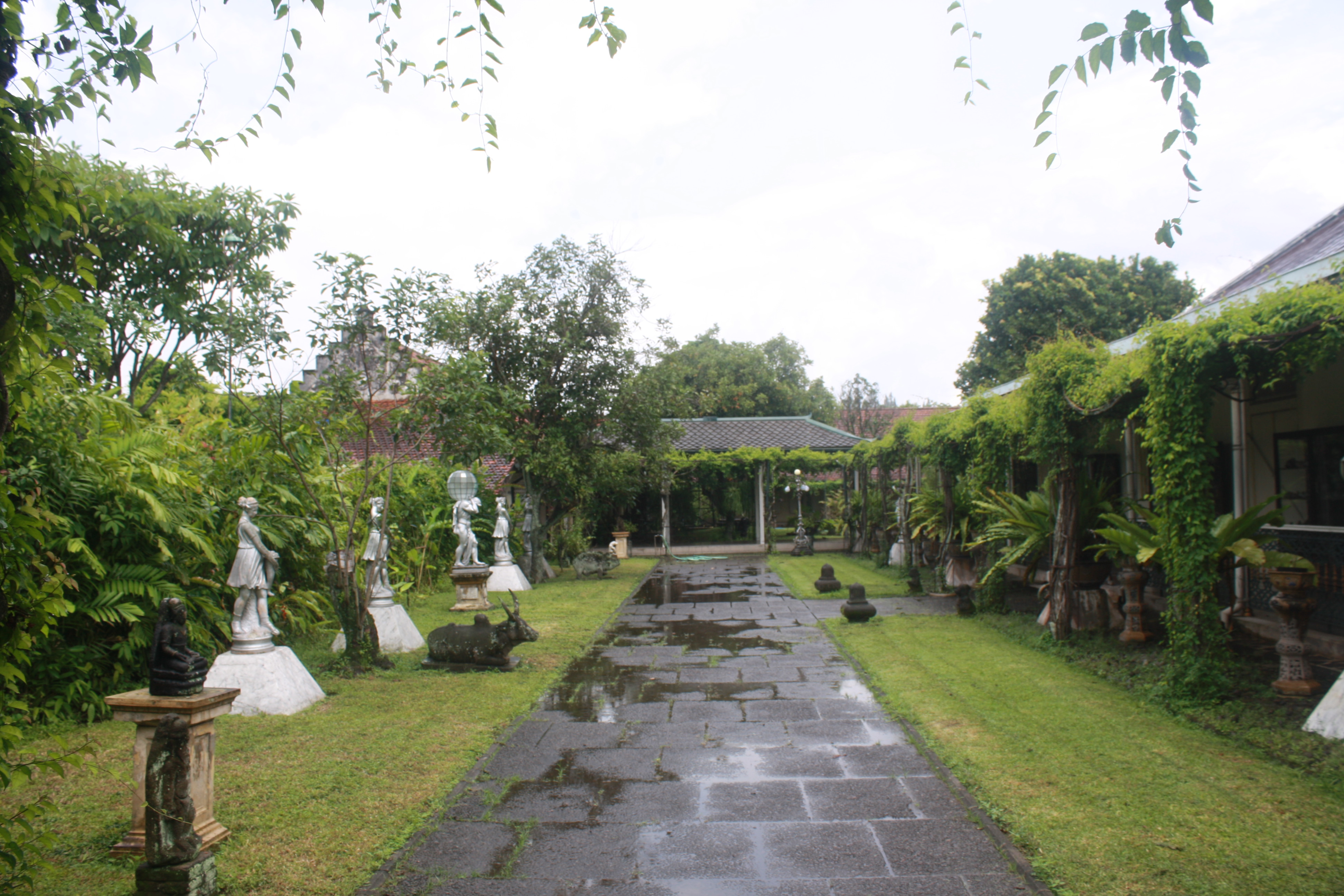
The Dutch colonial presence left its fingerprints throughout the palace, though never its soul. The Keputren -- the traditional harem, once home to royal consorts and princesses -- now serves as the private residence of the current duke and his family. Its garden mixes Javanese plantings with European-style fountains, classical statues, and ornamental shrubs, a hybrid landscape that mirrors the cultural negotiation the Mangkunegaran dynasty navigated for two and a half centuries. The Pracimoyasa, an octagonal reception room facing the garden, is furnished with European chairs and gold-framed mirrors, yet sits within a spatial arrangement that is fundamentally Javanese. Even the palace's exterior tells this story: the coat of arms features European-style cherubs flanking a Javanese crest, with a dhwarapala -- a traditional guardian figure -- standing watch nearby. The blending was not accidental. The dukes of Mangkunegaran maintained their legitimacy by mastering both worlds, attending Dutch colonial functions while preserving the rituals, gamelan performances, and court ceremonies that anchored their authority in Javanese tradition.
The Library Upstairs
On the second floor of the Palace Affairs Office, accessible from the left side of the courtyard, sits a library that few visitors reach. Its shelves hold leather-bound manuscripts in Javanese script, historical photographs, plantation records, and archive files documenting the economic life of the Duchy of Mangkunegaran -- which at its peak controlled significant agricultural lands across Central Java, including the Kethu Forest whose timber built the Grand Hall. The courtyard below, the pamedan, still serves its original military purpose on occasion. The Mangkunegaran Legion -- the duchy's own armed force, unusual among Javanese principalities -- once drilled infantry and cavalry troops on this ground. The legion's fortress-like headquarters still stands on the eastern edge of the courtyard, a reminder that the Mangkunegaran was never merely ceremonial. It was a state within a state, with its own army, its own lands, and its own palace built to prove it.
Still Standing, Still Occupied
Unlike many Javanese royal complexes that have become purely touristic, the Pura Mangkunegaran remains a living palace. The current duke and his family reside in the Keputren, maintaining a continuity of occupation that stretches back to 1757. The Grand Hall hosts cultural events. The museum draws visitors who come for the artifacts and stay for the architecture -- the ceiling alone, painted with Javanese cosmological motifs, rewards extended study. Surakarta itself, often called Solo, has long been overshadowed by Yogyakarta in the tourist imagination, yet it arguably preserves Javanese court culture more intimately. The Pura Mangkunegaran, smaller than the Kraton Surakarta just a kilometer away, compensates with accessibility and detail. Where the larger palace overwhelms, this one invites. Its rooms are scaled to human movement, its gardens to contemplation, its Grand Hall to the sound of gamelan -- which, in a building held together without nails, resonates through the wood itself.
From the Air
The Pura Mangkunegaran is located at 7.57S, 110.82E in central Surakarta (Solo), Central Java. The palace complex is visible from lower altitudes as a large compound in the dense urban center. The nearest major airport is Adisumarmo International Airport (ICAO: WARQ), approximately 10 km northwest of the city center. The flat terrain of the Solo basin is bounded by volcanic peaks: Mount Merapi (2,968m) and Mount Merbabu to the west-northwest, Mount Lawu (3,265m) to the east. The Bengawan Solo River threads through the city's southern edge.