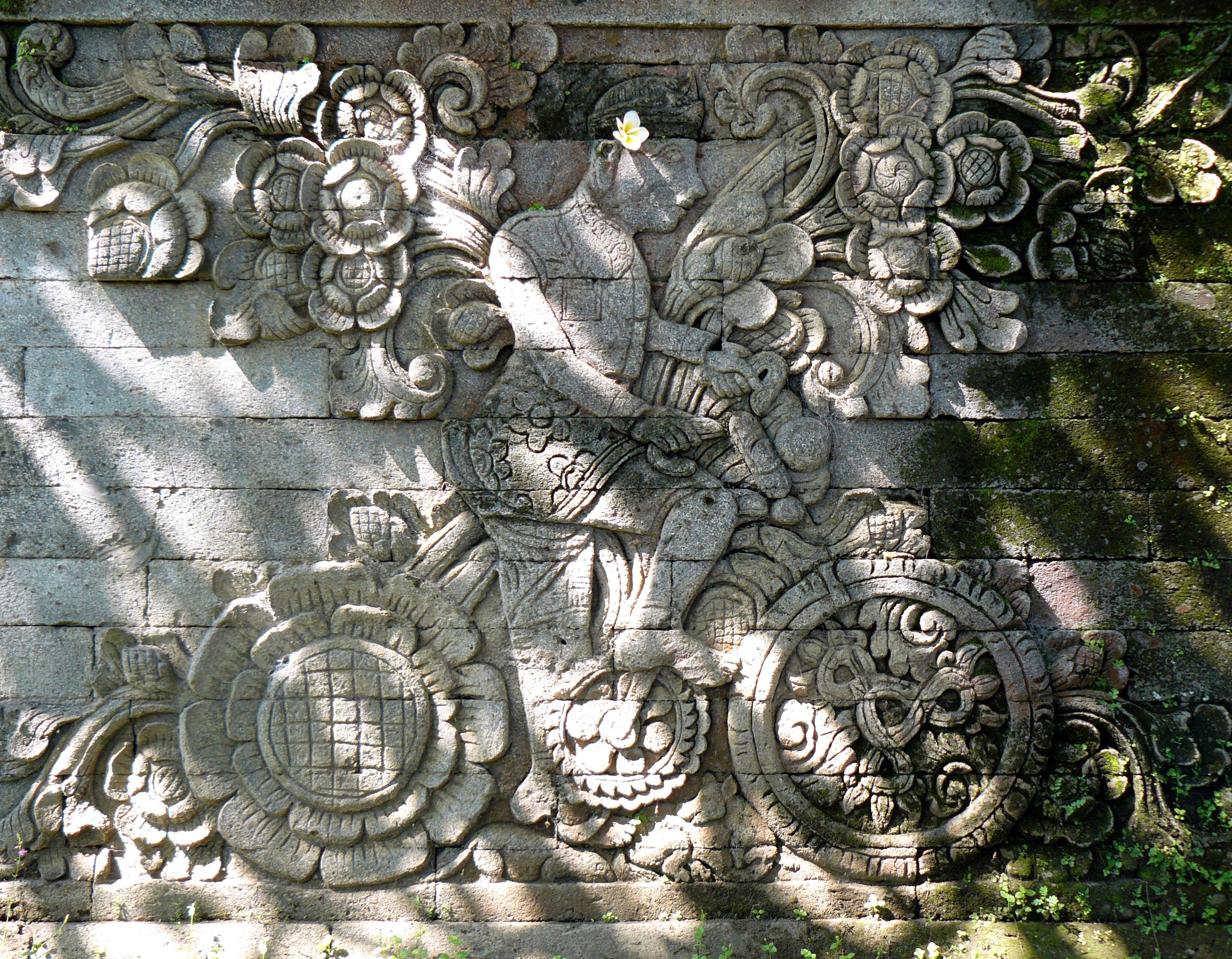
The Temple with a Bicycle
Somewhere on the wall of the main shrine at Pura Meduwe Karang, a man rides a bicycle. The relief depicts Dutch artist W. O. J. Nieuwenkamp, who pedaled across Bali in 1904, and it is one of the most reproduced images in Balinese art history. But the bicycle is not the strangest thing carved into this temple. A few panels away, the goddess Durga sits as the demon-queen Rangda with her knees spread open, a dog at her feet, her right foot crushing a bull's head. Sacred and profane, foreign and indigenous, the epic and the everyday all occupy the same carved surfaces here. Pura Meduwe Karang is a temple that has never seen a contradiction it could not absorb into stone.
Refugees Who Built a Monument
Pura Meduwe Karang was constructed in 1890 by people who had arrived in Kubutambahan from Bulian, a Balinese village that no longer exists. The name translates to 'temple of the lord ground possessor,' and the scale of what these displaced villagers built suggests they were claiming more than land. They were establishing permanence. The temple sprawls across multiple terraces connected by staircases and split gateways, its sheer size making it one of the principal temples of Bali. At the entrance, 36 stone figures from the Ramayana stand in formation across three levels: thirteen in the lowest row, ten in the middle, thirteen in the highest. The central figure is Kumbhakarna, the giant brother of Ravana, surrounded by the monkey troops of Sugriwa. Twin staircases flank this stone army and lead to the entrance terrace, where the first of several candi bentar split gateways marks the threshold into sacred space.
Gateway After Gateway
The temple is organized into three sanctums of increasing holiness, each separated by a candi bentar. The outer sanctum functions primarily as a gathering place, its courtyard hosting community celebrations and gamelan performances during religious festivals. A four-tiered split gateway leads to the middle sanctum, which contains a pair of symmetrical pavilions. Another candi bentar opens into the inner sanctum, the jero, the most sacred zone. But even within the jero, another split gateway must be passed to reach the highest point, where the towering Betara Luhur Ing Angkasa shrine stands. This is not merely architectural progression. Each threshold represents a spiritual transition, a shedding of the mundane. The main shrine is flanked by two smaller shrines: one dedicated to Ratu Ayu Sari, a manifestation of the earth mother Ibu Prtiwi, and another to Ratu Ngurah Sari, protector of the earth's produce. The temple's name, 'lord ground possessor,' finds its meaning here, in the connection between sacred architecture and agricultural fertility.
Where Empires Left Their Marks
Northern Bali was the island's gateway to the outside world in the early 20th century, and the temples of the region absorbed that contact into their iconography. The bicycle relief depicting Nieuwenkamp is the most famous example, but it is not the only one. At Pura Dalem in nearby Jagaraga, a relief shows a car driven by bearded foreigners being held up by a gangster armed with a revolver. These are not acts of cultural submission. Balinese sculptors incorporated foreign imagery into temple decoration the way the tradition had always incorporated new influences, by making the foreign serve the sacred. The bicycle becomes part of the temple's visual vocabulary, no less legitimate than the Ramayana figures at the entrance. The Nieuwenkamp relief is not in its original condition. The 1917 Bali earthquake badly damaged it, and the restoration process added more floral decorations to the original bas-relief. What visitors see today is a collaboration across time: Nieuwenkamp's ride in 1904, a sculptor's hand shortly after, an earthquake's destruction in 1917, and a restorer's interpretation of what had been lost.
The Goddess with the Dog
Less discussed but equally striking is the bas-relief of Durga in her manifestation as Mahisasuramardini, the destroyer of the malevolent bull-demon Mahisha. The carving depicts Durga as Rangda, the demon-queen of Balinese mythology, in an explicitly sexual posture. A dog licks at her exposed body while her right hand rests atop a person's head and her right foot crushes a bull. The relief is startling by any standard, but it belongs to a theological tradition in which divine power encompasses destruction, sexuality, and protection simultaneously. Rangda is feared and revered in equal measure in Balinese Hinduism. She is not evil in any simple sense. She is the necessary counterpart to order, the force that must exist for balance to hold. Placing her image on the wall of the main shrine, beside the Betara Luhur Ing Angkasa, is not transgression. It is completeness.
Flowers Carved in the Tropical Style
Pura Meduwe Karang exemplifies the flowery decorative style that distinguishes northern Balinese temples from their southern counterparts. Every available surface erupts with carved vegetation, floral motifs, and ornamental detail that seems to compete with the tropical landscape surrounding it. The shrine walls feature subjects from Balinese legend rendered in a style that values density over restraint. This is architecture as textile, as embroidery in stone. The decorative exuberance reflects a regional aesthetic that emerged from northern Bali's relative isolation from the royal courts of the south, and from its greater exposure to maritime trade and foreign influence. The result is a visual language that is recognizably Balinese but unmistakably northern, a local dialect of sacred architecture spoken most fluently in the temples along the coast between Singaraja and Kubutambahan.
From the Air
Pura Meduwe Karang sits at 8.08S, 115.18E in the village of Kubutambahan, roughly 12 km east of Singaraja along Bali's northern coast. From altitude, the temple complex is identifiable by its large terraced footprint set back from the coastal road. The northern coast of Bali presents a markedly different landscape than the tourist-developed south: drier, less densely built, with agricultural land climbing toward the volcanic highlands. Ngurah Rai International Airport (WADD) is approximately 85 km to the south. The Bali Sea stretches north toward Java, and on clear days the volcanic peaks of Lombok are visible to the east.