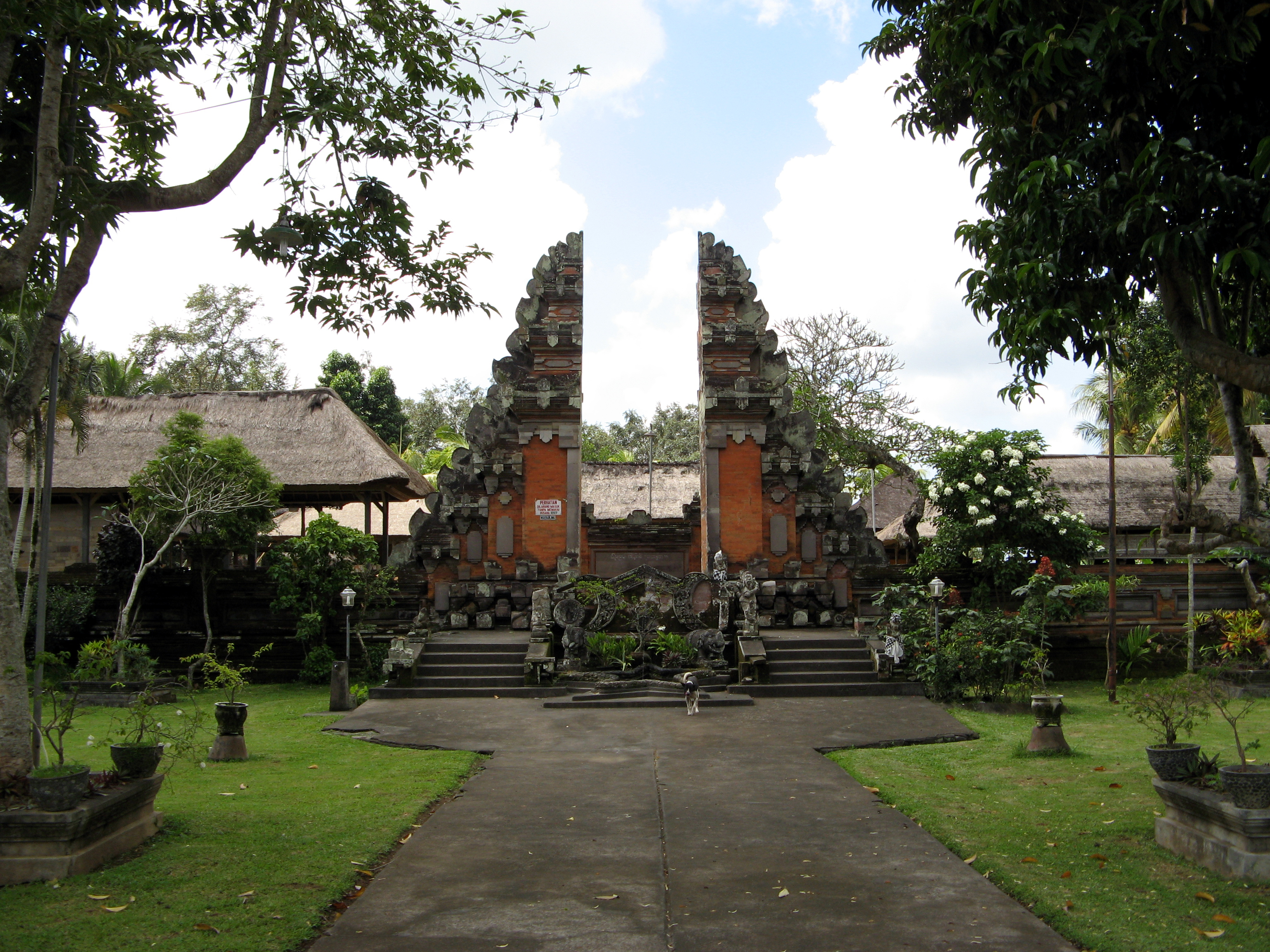
Pura Penataran Sasih: The Temple of the Fallen Moon
According to Balinese legend, the Moon of Pejeng was once a wheel on the chariot that pulled the real moon across the night sky. When it fell to earth, it lodged in a tree and glowed so fiercely that a band of thieves, unable to work in its light, tried to extinguish it. One climbed the tree and urinated on the glowing disc. The moon exploded, crashed to the ground as a bronze drum, and cracked across its base from the impact. The crack is still visible. The drum is still here, mounted high in a pavilion at Pura Penataran Sasih in the village of Pejeng, where it has been venerated for centuries. At nearly two meters tall and cast from a single pour of molten bronze around 300 BC, it is the largest single-cast bronze kettle drum ever found anywhere in the world.
Where Bali's History Begins
Pejeng sits in the valley between the Petanu and Pakerisan Rivers, a stretch of land sometimes called Bali's Holy Land. Archaeological research suggests it is the oldest continuously inhabited area on the island, with artifacts reaching back to the Paleolithic era. The Pejeng Kingdom ruled from here before falling to Javanese invaders from the Majapahit Empire in 1343, the last independent Balinese kingdom to do so. Pura Penataran Sasih served as the kingdom's state temple, founded in 1266 AD according to a chronogram carved at its entrance. The temple's name reflects its most sacred possession: penataran means offerings, and sasih means moon. Every stone in this compound carries the weight of a civilization that predates the temples tourists visit on Bali's southern coast by centuries.
A Drum Older Than the Temple
The Moon of Pejeng predates its temple by more than fifteen hundred years. Standing 186.5 centimeters tall with a tympanum 160 centimeters across, the drum belongs to the Dong Son bronze-casting tradition that spread across Southeast Asia during the first millennium BC. Its surface is decorated with geometric patterns and stylized faces, their meaning debated by archaeologists but clearly ceremonial. The drum's existence in Bali points to intensive inter-island trade networks linking the archipelago long before written records began. Today it sits mounted on a high wooden frame inside a dedicated pavilion, deliberately placed beyond easy reach of visitors. Locals consider it highly sacred. It is still used in ceremonies to invoke rain and peace, its deep resonance likened to a thunderclap. The crack from its legendary fall runs across the base, a physical feature that sustains the myth.
Stone and Sculpture
Beyond the Moon, the temple compound rewards slow exploration. A split gate marks the entrance, its two halves symbolizing the division between the material and spiritual worlds. Inside the main courtyard, a towering stone Seat of Ganesh rises from the center, its scale suggesting the devotion of the artisans who carved it. Scattered throughout the grounds are Hindu sculptures dating from the 10th to 12th centuries, brought here from other parts of the island over the centuries as Pejeng consolidated its role as a cultural repository. Six hundred meters south, the Gedong Arca Museum holds additional archaeological relics, including a collection of carved Balinese sarcophagi that once held the remains of the region's elite. Together, the temple and museum form an open-air archive of Balinese civilization stretching back two millennia.
Between Rivers, Between Worlds
The valley that cradles Pejeng is where complex irrigated rice culture first evolved on the island. The subak system of cooperative water management, later recognized by UNESCO as a cultural landscape, has roots in this terrain. Rice terraces step down the hillsides toward the rivers, fed by the same water channels that have sustained agriculture here since at least the 9th century. Pura Penataran Sasih sits within this living landscape, not apart from it. Farmers still work the paddies within sight of the temple walls. Ceremonies still mark the agricultural calendar. The Moon of Pejeng still presides over a community that measures time not only in years but in planting seasons, harvests, and the rhythms of water flowing downhill through channels carved by ancestors whose names no one remembers but whose engineering endures.
From the Air
Pura Penataran Sasih (8.514S, 115.293E) sits in the Pejeng valley, about 5 km east of Ubud in central Bali. The nearest major airport is Ngurah Rai International Airport (WADD/DPS) in Denpasar, approximately 30 km to the south-southwest, with one runway 09/27 (3,000m). The temple is in a river valley between the Petanu and Pakerisan rivers, visible as green terraced hillsides from moderate altitude. Mount Agung (3,142m) dominates the eastern horizon. Tropical climate with wet season November-March.