Pura Taman Saraswati: The Sculptor Who Fled a King
I Gusti Nyoman Lempad was already old when he designed Pura Taman Saraswati. He was already old, in fact, when he arrived in Ubud decades earlier, fleeing the royal court of Blahbatuh after a disagreement so serious it provoked the wrath of the king. Lempad had been married when Krakatoa erupted in 1883, which places his birth around 1862. By the time the Prince of Ubud, Cokorda Gede Agung Sukawati, commissioned him to build a temple dedicated to Saraswati, the Hindu goddess of learning, literature, and art, Lempad was approaching ninety. He completed it in a single year, 1951 to 1952. He would live another twenty-six years after that, dying in 1978 at roughly 116 years of age. The temple he left behind in the center of Ubud, its entrance marked by a lotus pond that has become one of Bali's most recognized images, is the work of a man who spent a very long life shaping stone and wood into sacred form.
An Architect in Exile
Lempad was born into an artistic family and grew up learning sculpture under his father's guidance. When political tensions forced him from the court of Blahbatuh, the Sukawati royal family of Ubud took him in. It was a fortunate match. The royals needed an undagi, a Balinese architect specializing in ritual structures like cremation towers, wooden sarcophagi, and temple gates. Lempad needed patrons. Over the following decades he built palaces, temples, and pavilions across Ubud and its neighboring villages, establishing himself as the most important architectural sculptor of his generation. He was also a founding member of Pita Maha, the artists' association that helped launch modern Balinese painting in the 1930s. In his later years he produced hundreds of linear ink drawings depicting mythological scenes, work now held in museums across the island. Pura Taman Saraswati was one of his final architectural commissions, and he poured a lifetime of accumulated skill into it.
The Lotus Pond and What Lies Beyond
Visitors encounter the lotus pond before they encounter the temple. Pink and white blooms float on still water, their broad leaves creating a living carpet that extends from the street to the temple's outer wall. Frangipani trees line the edges, dropping fragrant flowers onto the water's surface. A straight bridge crosses the pond, its path flanked by volcanic tuff sculptures of Hindu mythological figures, many carved by Lempad himself. The effect is designed to transition the visitor from the noise of Ubud's commercial streets into the quiet required by sacred space. At the far end of the bridge, three red-bricked kori agung gates mark the entrance to the inner compound. The central gate is the largest, flanked by tall plumeria trees whose branches arch overhead. The lotus is not decorative accident. Saraswati is traditionally depicted seated on a lotus flower, and the pond places worshippers within the goddess's own symbolic landscape.
Walls Against Evil, Thrones for the Divine
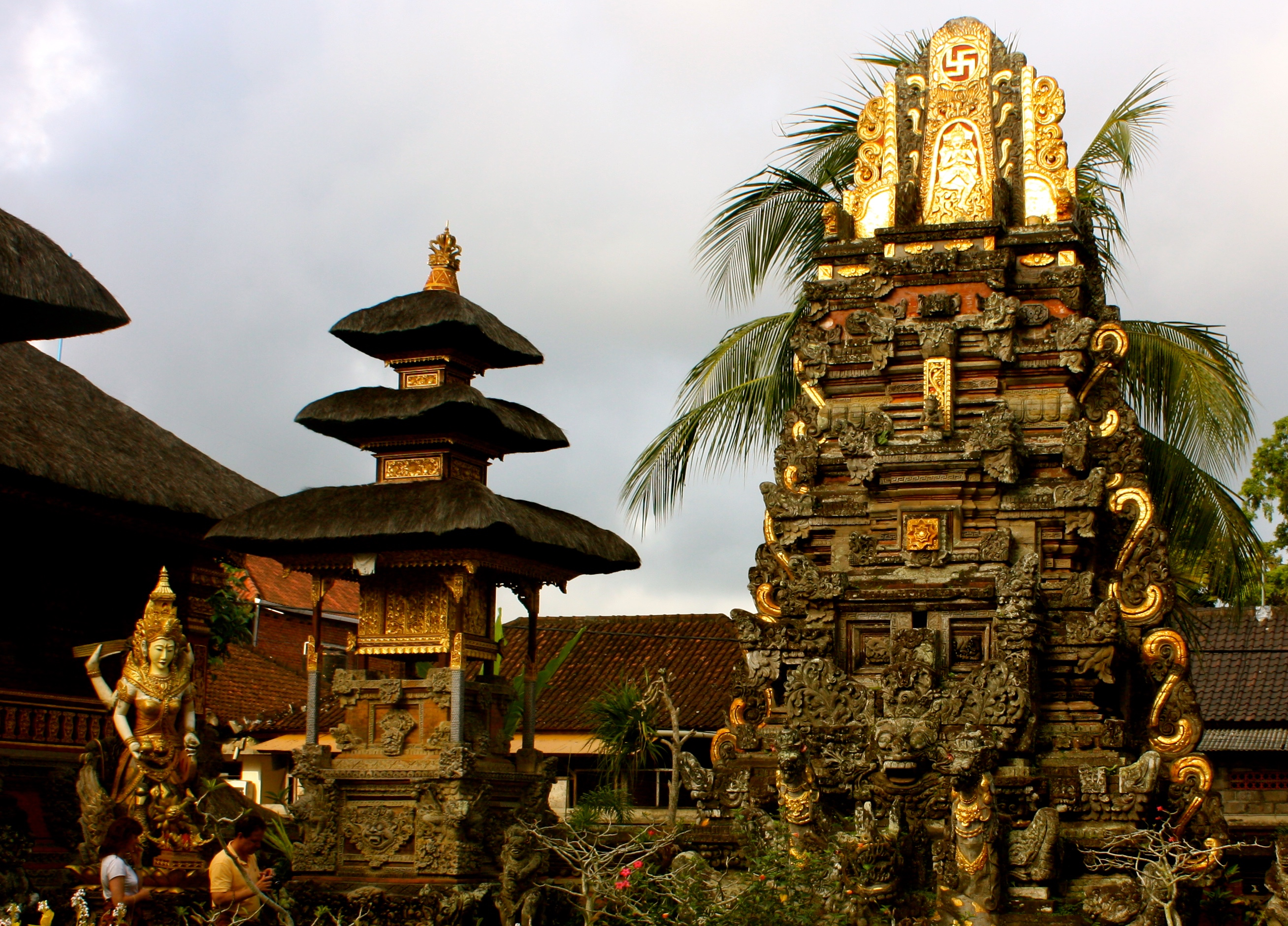
Inside the gates, the temple reveals its architectural logic. The straight path from the entrance is deliberately blocked by an aling-aling, a wall designed to confuse evil spirits, which Balinese tradition holds can only travel in straight lines. This particular aling-aling doubles as the back of a three-meter-tall statue of Jero Gede Mecaling, a fearsome rakshasa figure. The temple's holiest feature, a padmasana shrine, occupies the northeast corner, the most sacred direction in Balinese cosmology. Its base is carved with a cosmic turtle and coiling nagas representing the underworld. At its peak sits a golden empty throne bearing the image of Acintya, the supreme deity in the Balinese Hindu pantheon, a god so transcendent that the throne remains perpetually unoccupied. Nearby, a pavilion holds three empty thrones for the Trimurti: Brahma, Vishnu, and Shiva.
Where Dance Meets Devotion
Every evening, as the tropical light fades and bats begin circling above the frangipani, the temple's outer courtyard transforms into a performance space. Traditional Balinese dance troupes stage nightly shows against the backdrop of Lempad's stone carvings, the lotus pond glowing with reflected lantern light. The repertoire rotates: Legong with its precise, angular movements; the Barong drama depicting the eternal battle between good and evil; the Kecak fire dance, its rhythmic chanting rising from a circle of performers. Inside the compound, the bale barong pavilion houses the village's own barong figures, the lion-like Barong Ket and the boar-like Barong Pangkal, used in exorcism rituals that predate tourism by centuries. The temple holds both functions without apparent contradiction. Sacred space and performance venue, ancient ritual and nightly show, the devotional and the theatrical coexist here as comfortably as the lotus and the water that sustains it.
From the Air
Pura Taman Saraswati (8.506S, 115.261E) sits in central Ubud, Bali's cultural heartland, about 25 km north of Ngurah Rai International Airport (WADD/DPS) in Denpasar, which has one runway 09/27 (3,000m). The temple is in the dense commercial center of Ubud, identifiable from the air by the surrounding cluster of traditional Balinese rooflines amid green tree canopy. Mount Agung (3,142m) is visible to the northeast. Rice terraces surround the town on all sides. Tropical climate with wet season November-March, afternoon rain common even in dry season.