Palace of Paintings
In 1936, four men sat together in Ubud and decided to save Balinese art from itself. Tjokorda Gde Agung Sukawati, the prince of Ubud, joined forces with Dutch painter Rudolf Bonnet, German artist Walter Spies, and the legendary Balinese master I Gusti Nyoman Lempad to form the Pita Maha -- the "Great Spirit" -- a movement that would select, promote, and preserve the finest work emerging from the island's studios and workshops. Two decades later, in 1956, that effort crystallized into something permanent: Museum Puri Lukisan, the "Palace of Paintings," Bali's first and oldest art museum. It stands today on the main road of Ubud, its four pavilions set among lotus ponds and frangipani trees, housing a collection that traces the evolution of Balinese painting and sculpture from the 1930s to the present.
A Prince, a Painter, and the Great Spirit
The story of Puri Lukisan begins with an improbable friendship. Bonnet arrived in Bali in the early 1930s and settled in Ubud, where the royal court had long been a center of artistic patronage. He and Spies saw something extraordinary in Balinese art -- work rooted in Hindu mythology and ritual, executed with obsessive detail -- but they also saw it threatened by the tourist trade's hunger for cheap souvenirs. Together with Tjokorda Gde Agung Sukawati and Lempad, they founded the Pita Maha to establish quality standards and connect Balinese artists with galleries and exhibitions across the Dutch East Indies, the Netherlands, and the United States. The movement did not impose Western aesthetics on Balinese painters. Instead, it encouraged them to develop their own traditions while experimenting with new techniques -- perspective, shading, individual expression -- that would carry their work beyond temple walls and palace commissions.
Four Pavilions, Four Centuries of Vision
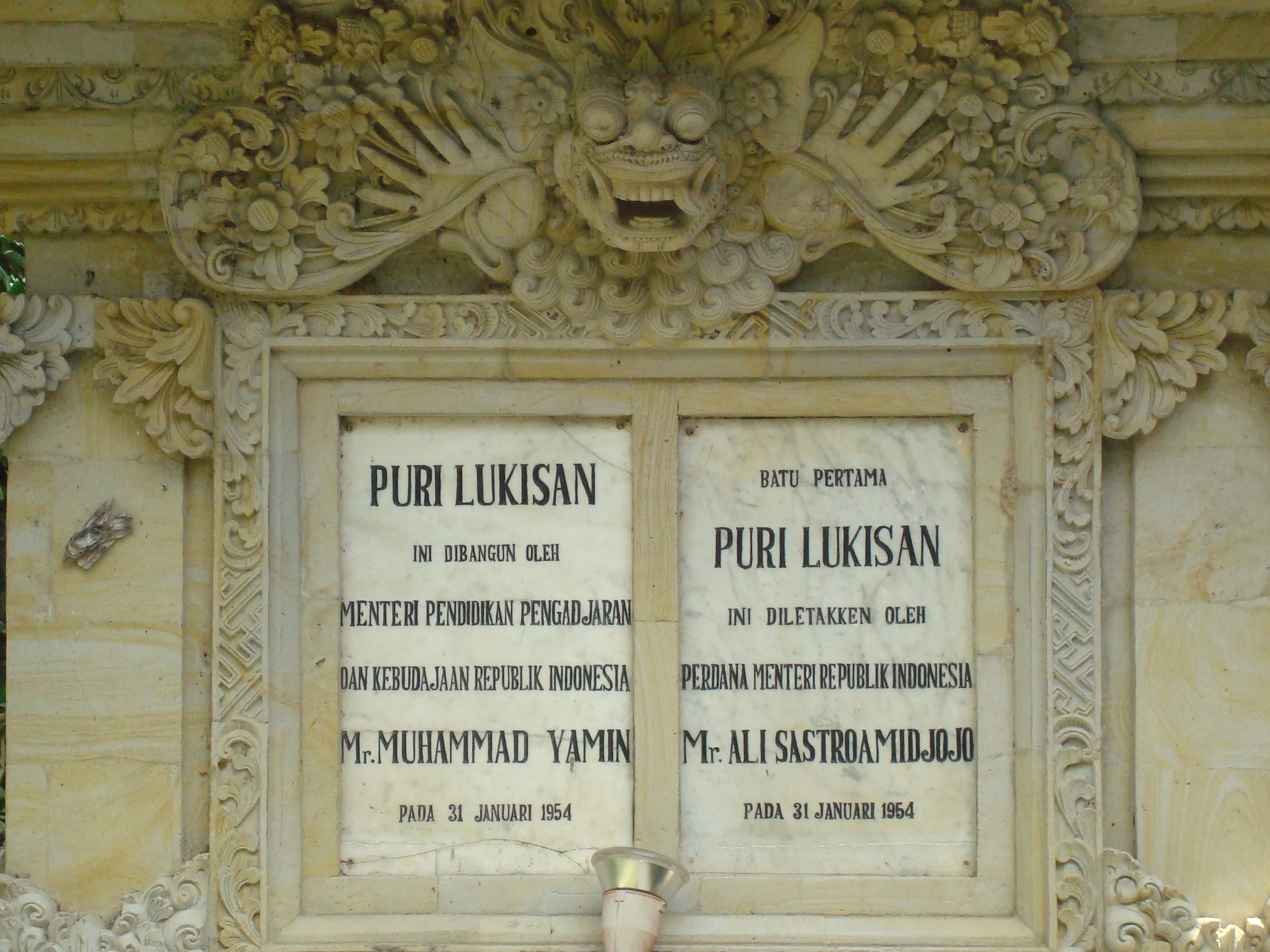
Bonnet designed the museum himself, in Balinese style and from local materials, after a foundation called Yayasan Ratna Warta was established in 1953 to make it real. The foundation stone was laid in January 1954, and the first pavilion opened two years later. Today the museum comprises four buildings arranged around garden courtyards. The Pitamaha Gallery in the north houses pre-war paintings from 1930 to 1945 alongside Lempad's ink drawings -- works of such precise, flowing line that scholars have compared them to Renaissance draftsmanship. The Ida Bagus Made Gallery to the west holds that artist's estate collection, a body of devotional work so personal his widow loaned a hundred paintings to the museum after his death, fulfilling his last wish. The Wayang Gallery to the east showcases the shadow-puppet painting tradition, while the Founders Gallery in the south preserves the museum's own history and rotates temporary exhibitions.
Masters Who Pulled Life from Wood and Ink
The collection reads as a portrait gallery of Balinese genius. Ida Bagus Nyana, a dancer as well as a sculptor, carved elongated wooden figures so fluid they seem pulled from taffy -- his Goddess Pertiwi, with spidery legs and a coiled serpent, is dreamlike and surrealistic. Ida Bagus Gelgel, raised in Kamasan far from Western influence, evolved beyond the conventions of wayang tradition so inventively that one of his paintings won a silver medal at the 1937 International Colonial Art Exhibition in Paris. Anak Agung Gde Sobrat, the aristocrat's son who learned shadow puppetry from his grandfather before studying under both Spies and Bonnet, painted a Balinese Market scene for the museum's opening that remains one of its masterpieces. And I Gusti Made Deblog, who began as an apprentice in a Chinese photographer's studio, created drawings of such refined detail that the chairman of the Ford Foundation personally presented his Birth of Hanuman to the museum.
Where Lempad Still Draws
Lempad deserves his own section because he transcends categories. Born around 1862, he lived to be approximately 116 years old, dying in 1978. He was a painter, sculptor, and architect who designed palaces and temples throughout the Ubud area, including portions of the museum itself. He painted the murals at the entrance of the north building. His drawing The Dream of Dharmawangsa, rendered in his unmistakable linear style, is among the museum's greatest treasures. Though he maintained close friendships with Bonnet and Spies, Lempad never compromised his identity as a Balinese artist. In 2014, the museum mounted a landmark exhibition of his masterworks, drawing loans from the American Museum of Natural History, the Library of Congress, the Tropen Museum in Amsterdam, and collections in Vienna and Stockholm -- proof that his spare, illuminating line had reached every corner of the world.
Living Tradition on a Lotus Pond
Walking through Puri Lukisan today, what strikes you is not the age of the collection but its continuity. The museum spans all of Bali's major artistic schools -- Sanur, Batuan, Ubud, Young Artist, and Keliki -- and the progression from sacred temple art to individual expression is visible room by room. Anthropologists Gregory Bateson and Margaret Mead collected some of these same artists' work during their field research in Bali from 1935 to 1937, and pieces from their collection have returned to Ubud for exhibitions here. The gardens between the pavilions are as carefully composed as the paintings within them, with stone carvings, reflecting pools, and shaded walkways that make the transition between indoor and outdoor feel like moving between frames in a scroll painting. It is a place where art was never separated from landscape, ritual, or daily life -- and where that integration persists.
From the Air
Located at 8.505°S, 115.260°E on the main road through Ubud in central Bali. The museum grounds are not individually visible from altitude, but Ubud sits in a lush river valley between terraced rice paddies that are clearly visible. Ngurah Rai International Airport (WADD) lies approximately 18 nm to the south. Approach from the south over the coastline and follow the green valley corridor north into the Ubud area.