Purple Bamboo Park
Early mornings in Purple Bamboo Park belong to the retirees. They arrive before the heat, claiming shaded benches near the lakes for tai chi, calligraphy practice with water brushes on the pavement, and the kind of animated card games that draw small crowds of spectators. By midday, the park fills with families, students, and tourists drawn to its bamboo groves, but the dawn hours reveal its truest purpose: this is where the neighborhood of Haidian comes to breathe. Covering 48 hectares of lakes, hills, bridges, and rustling bamboo, Zizhuyuan Park -- also called Black Bamboo Park -- is one of Beijing's seven largest green spaces and among its most intimate.
Water and Earth in Balance
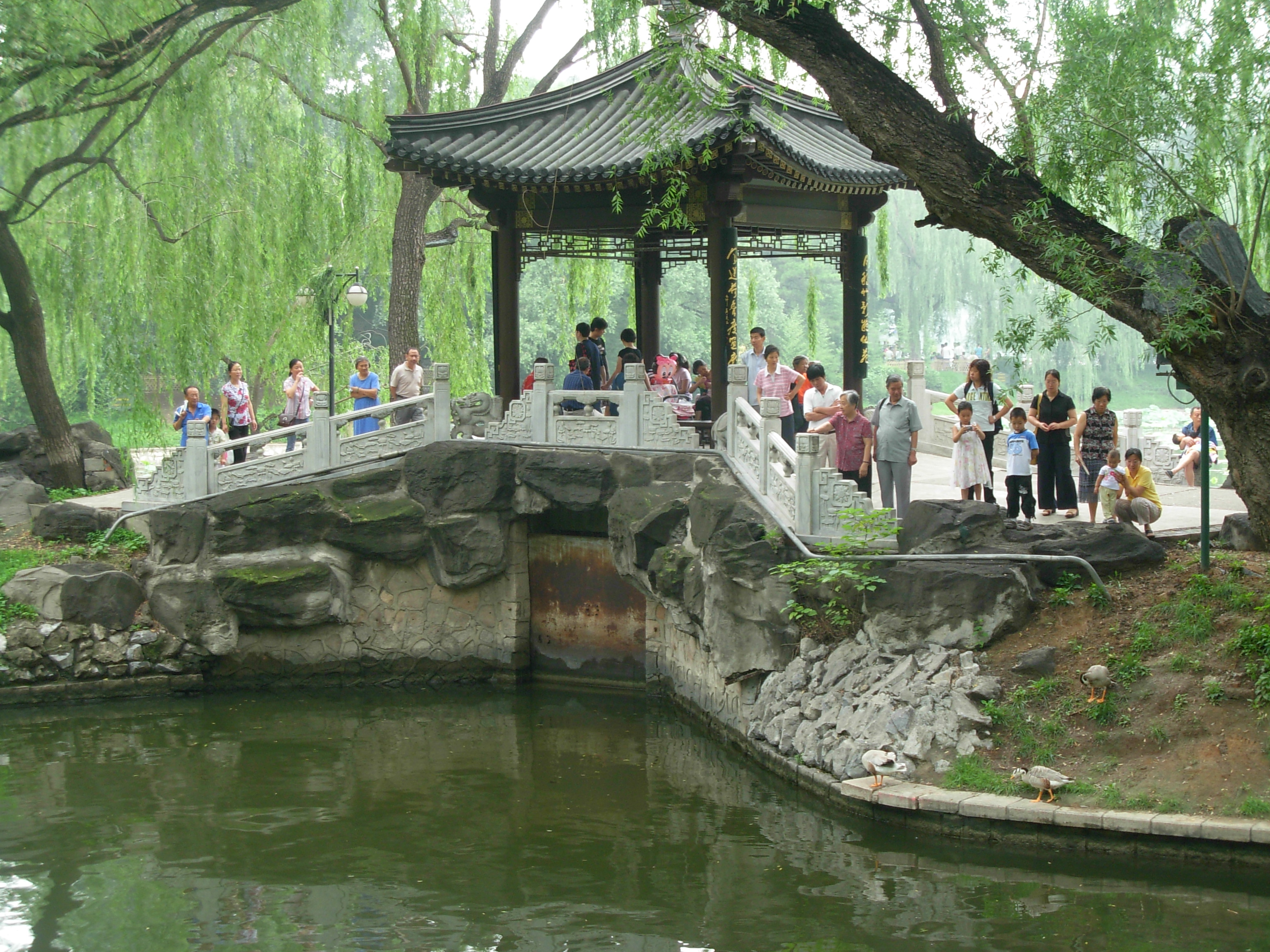
The park is built around three interconnected lakes, their surfaces reflecting willows and the arched silhouettes of five bridges that link islands, hills, and shoreline into a single flowing composition. The hills along the eastern shore are artificial, raised from earth dredged during the creation of the lakes -- a classic technique of Chinese garden design that turns excavation into sculpture. Natural hills line the western shore, and the contrast between the two banks gives the park a sense of depth that belies its urban setting. To the north, the Changhe River flows through, connecting the park to Beijing's historic canal system, which once carried imperial barges between the Forbidden City and the Summer Palace.
Fifty Shades of Green
Bamboo is the park's signature, and it takes its role seriously. Up to 50 species grow here, from towering timber bamboo with culms thick as a forearm to delicate ornamental varieties that sway in clusters along the walkways. The groves create a particular quality of light -- green-filtered and cool, rustling with a sound somewhere between wind chimes and rain. In the classical Chinese garden tradition, bamboo represents resilience and moral uprightness, bending without breaking. The park's designers used this symbolism deliberately, planting bamboo not just as decoration but as atmosphere, transforming what could be an ordinary urban park into something that feels ancient and contemplative even when surrounded by Beijing's northwest sprawl.
A Classical Garden in a Modern City
Purple Bamboo Park follows the principles of classical Chinese garden design, where the ideal landscape balances mountain and water -- shan and shui. The lakes serve as the water element, the hills as the mountain element, and the bridges, pavilions, and planted groves create the 'borrowed scenery' that makes a garden feel larger than its physical boundaries. Unlike Beijing's imperial gardens, which were built to demonstrate dynastic power, Zizhuyuan was designed for public use, and its scale feels approachable rather than overwhelming. It sits in the heart of Haidian District, Beijing's university quarter, flanked by some of the country's most prestigious institutions. For students and faculty from nearby Peking University, Tsinghua University, and Renmin University, the park functions as a shared backyard -- a place to read, argue, jog, or simply sit beside water and watch the bamboo move.
From the Air
Coordinates: 39.941N, 116.313E. Located in Haidian District, northwest Beijing, near the intersection of major ring roads. The park's three lakes are visible from the air as a cluster of water bodies amid dense urban development. The nearby Beijing Zoo and National Library provide additional visual reference points. Nearest major airport is Beijing Capital International (ZBAA/PEK), about 28 km northeast.