Pusading
One hundred and eight stone steps lead up from the temple valley floor to Pusading, the Bodhisattva Summit Temple. The number is not arbitrary. In Buddhist tradition, 108 represents the number of worldly worries that cloud the human mind, and the climb is meant to be a shedding -- one worry released with each step, so that by the time a pilgrim reaches the top, they arrive emptied and ready. The steps are worn smooth by fifteen centuries of feet making this same ascent.
Where Manjushri Preached
The name Pusading translates roughly as "Bodhisattva Summit," and the legend behind it is direct: the bodhisattva Manjushri -- Wenshu in Chinese -- is said to have revealed himself and preached at this very hilltop. The temple carries a second name, too: Spiritual Black Eagle Peak, a reference to Griddhraj Parvat (Vulture Peak) near Rajgir in the ancient Indian kingdom of Magadha, where the historical Buddha delivered some of his most important sutras. The comparison is deliberate. It positions this Shanxi hilltop as a Chinese echo of one of Buddhism's most sacred Indian sites, linking the two traditions across thousands of kilometers and centuries of transmission.
Empires and Emperors
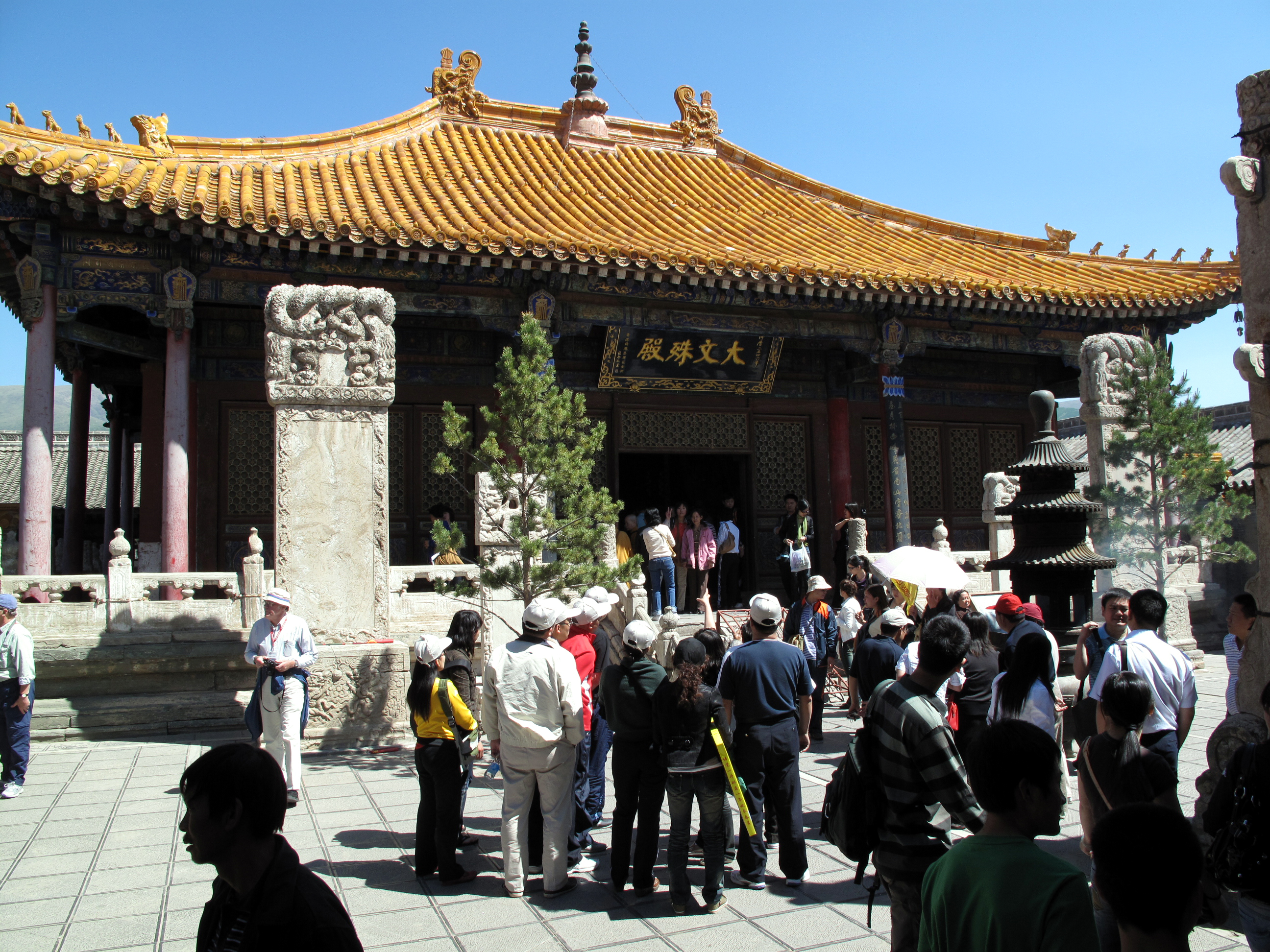
Pusading was first established during the reign of Emperor Xiaowen of the Northern Wei dynasty (467-499), when it was called the Great Temple of Wenshu. In 631, the Buddhist monk Fayun rebuilt the temple during the Tang dynasty and renamed it Zhenrong Temple. But the Qing dynasty left the deepest imperial mark. The Kangxi Emperor (1654-1722) personally inscribed a plaque with characters praising the "beautiful site of Lingjiu Peak" and hung it beneath the shanmen gate. A second imperial plaque, also in the Kangxi Emperor's hand, declaring the "beautiful site of Mount Wutai" hangs on a stone paifang before the Wenshu Hall. These are not casual dedications -- the Kangxi Emperor was one of the most powerful rulers in Chinese history, and his calligraphy on a temple plaque was an act of state-level endorsement.
The View from the Summit
The temple structure at Pusading is considered the finest of all Mount Wutai's monasteries, and its elevated position explains why. From the summit, the entire Taihuai Town temple valley spreads out below -- the Great White Pagoda of Tayuan Temple, the green-roofed halls of Xiantong Temple, the smaller compounds dotting the hillsides. The temple was designated a National Key Buddhist Temple in Han Chinese Area in 1983, a recognition that formalized what pilgrims had known for centuries. In 1948, the Communist military commander Chen Yi passed through Mount Wutai on his way to the revolutionary headquarters at Xibaipo and composed a poem praising the scenery -- even in wartime, the view from the summit demanded acknowledgment.
From the Air
Located at 39.01N, 113.59E at the summit of a hill overlooking the Taihuai Town temple valley on Mount Wutai, Shanxi Province, China. The temple's elevated position makes it one of the more visible compounds from the air. Elevation approximately 1,750 meters. The 108-step stone stairway leading up to the temple is visible as a light-colored linear feature on the hillside. Nearest airports: Wutai Mountain Airport (ZBWT) at roughly 50 km and Taiyuan Wusu International Airport (ZBYN) approximately 230 km southwest. Recommend 2,000-4,000 feet AGL for the best view of the temple in its hilltop setting.