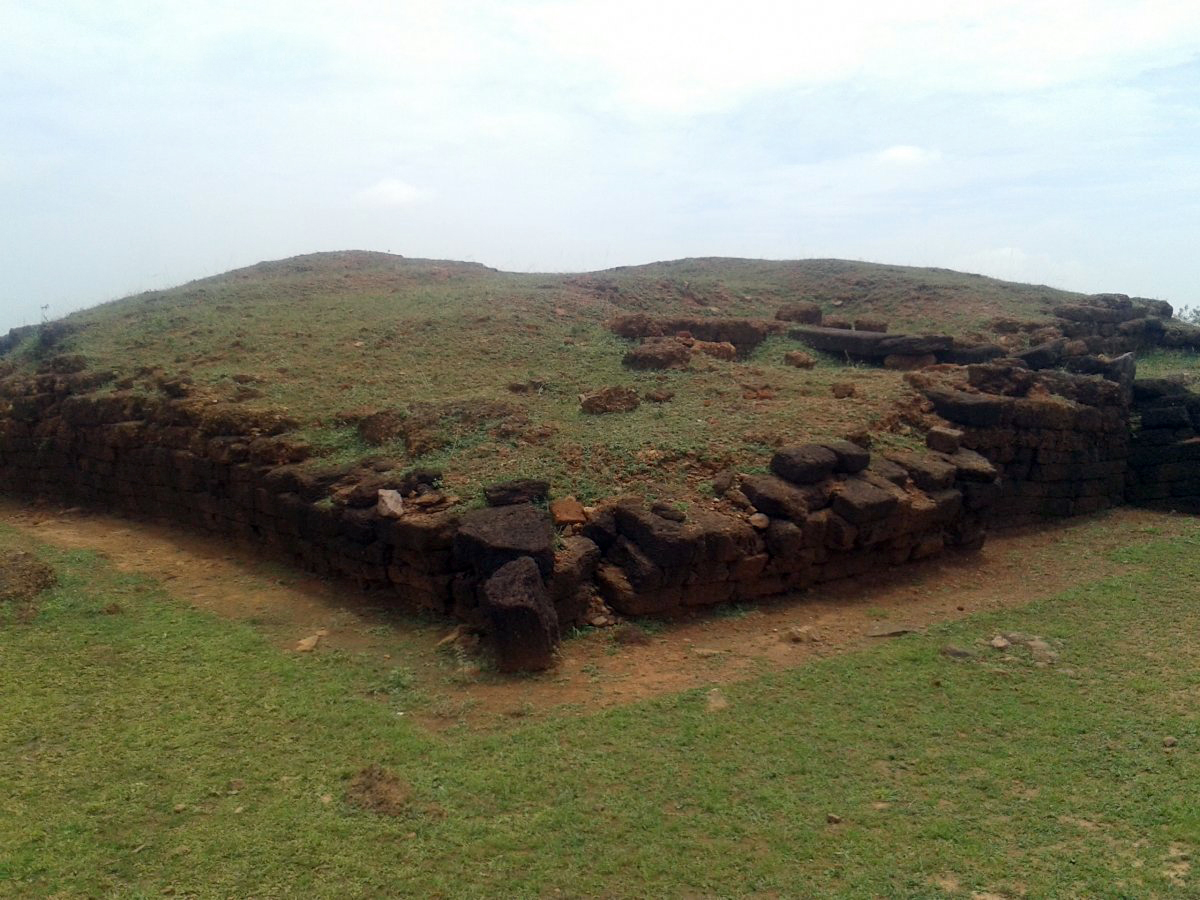
Pushpagiri Vihara
For decades, scholars argued over a name. The Chinese pilgrim Xuanzang, traveling through India in the 7th century, described a monastery called Pu-se-p'o-k'i-li in the land of Udra -- a place of learning so significant that he recorded it alongside Nalanda and Takshashila. Generations of archaeologists searched for this "Pushpagiri" across Odisha, proposing one site after another, until excavations on Langudi Hill in 1996 uncovered an inscription that settled the question. Carved into stone, the words pusha sabhar giriya -- "flower-filled hill" -- identified the monastery that had eluded identification for over a century.
The Flower-Filled Hill
Pushpagiri sits atop Langudi Hill in Jajpur district, Odisha, overlooking a landscape where the Brahmani and Kimiria rivers converge. The name itself is poetic: in Sanskrit, pushpa means flower and giri means hill. Between the 3rd and 11th centuries CE, this hilltop complex served as a mahavihara -- a great monastery and center of learning that drew monks and scholars from across the Buddhist world. A 3rd-century inscription from Nagarjunakonda in Andhra Pradesh records that a lay devotee named Bodhisiri sponsored the construction of a stone mandapa at "Puphagiri," the Pali form of the Sanskrit name. This means Pushpagiri's reputation was already established enough by the 3rd century to attract patronage from hundreds of kilometers away.
A Pilgrim's Account
Xuanzang visited Pushpagiri around 639 CE, during his seventeen-year journey across Asia collecting Buddhist texts. His description places the monastery in the southwest of the kingdom he called Wu-T-U, which scholars identify as Odra -- ancient Odisha. He recorded a sangharama, a monastic community, significant enough to warrant specific mention in his chronicles. The 9th-century monk Prajna followed a similar path centuries later, spending eighteen years at various monasteries including Nalanda before settling at an unnamed monastery in Odra -- which some scholars believe was Pushpagiri -- before eventually traveling on to China. These accounts place Pushpagiri in the same tier as Nalanda, Vikramashila, Odantapuri, Takshashila, and Vallabhi: the great universities of ancient India, places where Buddhist philosophy, logic, and medicine were studied and debated.
The Long Search
Finding Pushpagiri became one of Indian archaeology's enduring puzzles. In 1930, Ramaprasad Chanda of the Archaeological Survey of India suggested that either Udayagiri or Lalitgiri -- both monastic ruins in Jajpur district -- might be the historical site. K. C. Panigrahi proposed in 1961 that three nearby sites -- Udayagiri, Lalitgiri, and Ratnagiri -- formed a single complex that was collectively Pushpagiri. N. K. Sahu placed it entirely elsewhere, in the Phulbani-Ghumsur region. The Archaeological Survey began excavating Lalitgiri in 1985, discovering important artifacts but nothing that confirmed the identification. It was only when the Orissa Institute of Maritime and South East Asia Studies began exploring Langudi Hill in 1996 that the answer emerged from the ground itself.
What the Stones Revealed
Between 1996 and 2006, excavators uncovered 143 acres of archaeological remains on Langudi Hill. The finds were extraordinary: 34 rock-cut stupas of varying sizes on the northern slopes, sculptures of Dhyani Buddhas in multiple postures carved into the southern spur, and the critical Brahmi inscription naming the site. The archaeological record spans from the 1st century CE to the 9th century, suggesting continuous monastic activity for at least eight hundred years. Nearby Kaima Hill yielded a unique rock-cut elephant surrounded by four monolithic khondalite pillars dating to the Mauryan period in the 3rd century BCE -- evidence of Buddhist royal patronage from the time of Emperor Ashoka himself. The Mahastupa at Pushpagiri is counted among the ten illustrious stupas that Ashoka is said to have erected across India.
A Constellation of Sacred Sites
Pushpagiri does not stand alone. The surrounding landscape is dense with Buddhist heritage: Deuli Hill preserves five rock-cut chambers inside caves at the confluence of the Brahmani and Kimiria rivers; additional sites at Bajragiri, Sarapur, and Paikrapur extend the monastic network further. Together with the Lalitgiri-Ratnagiri-Udayagiri triangle to the south, these sites may constitute the largest historic Buddhist complex in India. The region tells a story of intellectual and spiritual activity sustained across centuries -- monks studying, debating, and carving devotion into stone on hilltop after hilltop, connected by river valleys that served as corridors of pilgrimage and trade.
From the Air
Pushpagiri Vihara is located at 20.72N, 86.19E atop Langudi Hill in Jajpur district, Odisha. From the air, the hill is identifiable between the Brahmani and Kimiria river confluence. The Lalitgiri-Ratnagiri-Udayagiri triangle of Buddhist sites is visible approximately 10-15 km to the south. Biju Patnaik International Airport (VEBS) in Bhubaneswar is about 90 km southwest. Accessible from National Highway 5 via Jaraka and Chandikhol. Best visibility October through February.