Putten Raid
They sang as they were marched away. The men and boys of Putten, herded into the village school on the morning of 2 October 1944, lifted their voices in the Reformed Psalter and sang Psalm 84 - the pilgrim's psalm about longing for the courts of God. Their wives, mothers and daughters could hear them from inside the Oude Kerk, where the women had been held since dusk the night before. By nightfall the men were gone. Of the 602 who left Putten that week, only 48 would ever come back.
A Bridge, a Car, a Shot in the Dark
The reprisal that ended Putten began with five minutes of confused gunfire on a country road. Near the Oldenallerbrug, the small bridge between Putten and Nijkerk, a Wehrmacht staff car was ambushed by Dutch resistance fighters on the night of 30 September 1944. They had hoped to capture a senior German officer. Instead the night collapsed into improvisation. A resistance fighter named Frans Slotboom was hit and died of his wounds the following day. Lieutenant Otto Sommer staggered to a farmhouse and raised the alarm before dying the next day. The two corporals fled into the fields. The remaining officer, Oberleutnant Eggart, was wounded so badly that the resistance left him by the roadside for the Germans to find. By dawn, both sides had their dead - and the men of Putten, who had no part in any of it, were already being counted by an enemy looking for someone to punish.
The Order from Christiansen
Reprisal at this scale required a signature, and the signature came from General Friedrich Christiansen, the German commander for the occupied Netherlands. By the morning of 1 October, Putten was ringed by Wehrmacht troops. The villagers were rounded up at gunpoint and separated - women and small children to the church, men and older boys to the school. Houses began to burn; more than a hundred would be torched before the week was out. Six men and one woman were shot dead in the streets. On 2 October, 661 men aged 18 to 50 were marched out toward Amersfoort concentration camp. Some sang the psalms they had learned in this same village all their lives. Behind them, their families watched from the church doors and tried to memorize their faces.
Neuengamme and the Long Silence
At Amersfoort the camp doctors released 59 men deemed too old or too sick to work. The remaining 602 were loaded onto a train bound for Neuengamme, on the edge of Hamburg. Thirteen jumped from the moving carriages and made it home. The rest were dispersed through the camp's satellite network - Ladelund, Bergen-Belsen, Meppen-Versen, Beendorf, Wobbelin, Malchow - and worked until they could not work anymore. Some were held in cages too small to stand upright in. Most died of starvation, of typhus, of beatings, of exhaustion that was indistinguishable from grief. In all, 552 of the men of Putten and one woman from the village would die in German captivity. Five more came home only to die of what had been done to them. The village had lost almost an entire generation of husbands, fathers and sons.
The Mourning Widow
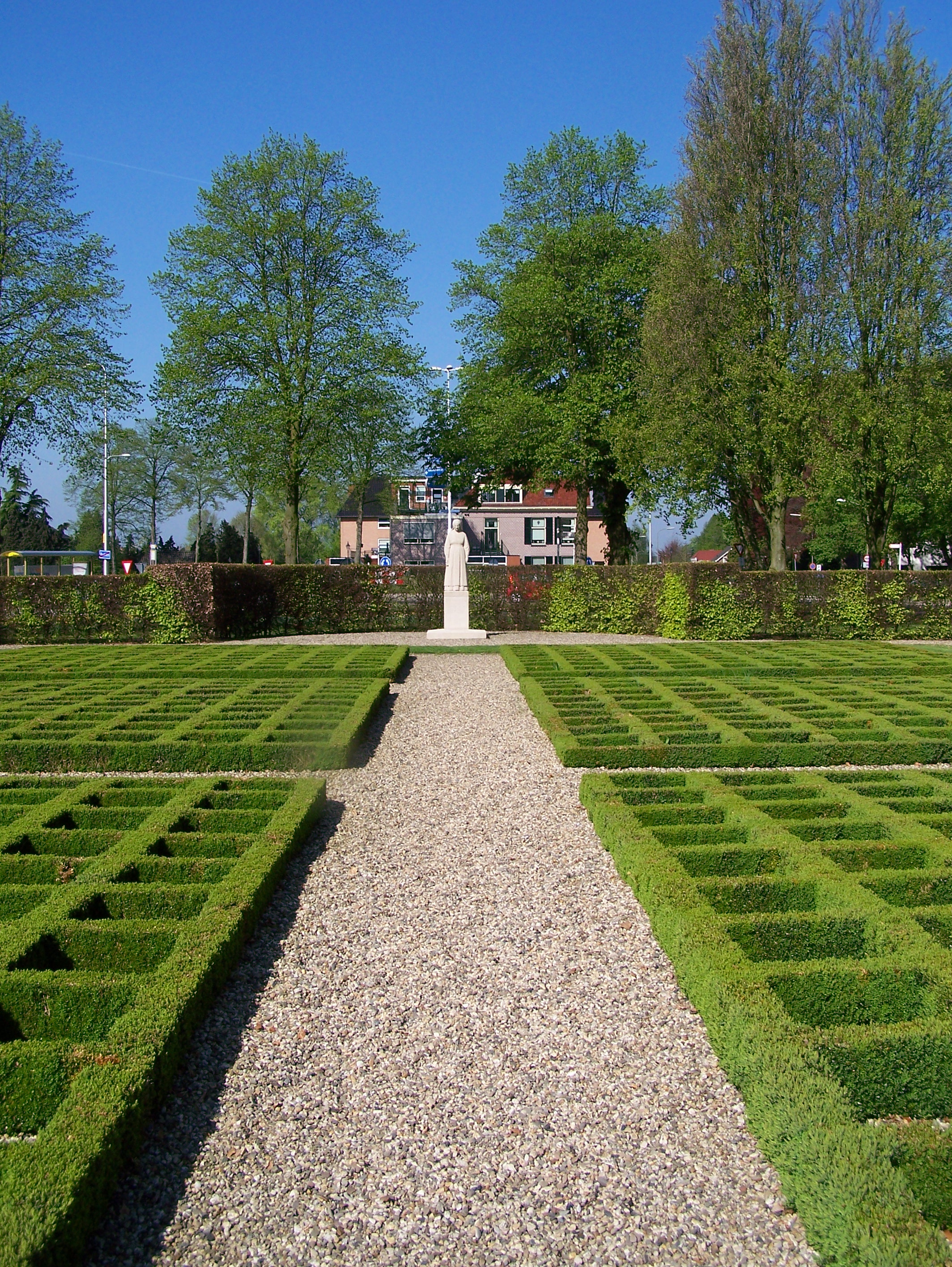
On 1 October 1949, five years to the day after the raid, Queen Juliana unveiled a memorial in Putten. At its heart stands a sandstone figure by the sculptor Mari Andriessen: a woman in the traditional dress of the Veluwe, a handkerchief pressed in her hand, her face turned toward the Oude Kerk from which her husband never returned. Officially she is the Treurende Weduwe, the Mourning Widow. The village calls her something gentler - het Vrouwtje van Putten, the Little Lady of Putten. The landscape architect Jan Bijhouwer laid out the memorial garden around her, and in time 660 small markers were set into the ground, one for each man taken. She has been watching that church for more than seventy years now, and she has never stopped.
Every Second of October
Each 2 October, the village gathers at the monument. There are no speeches. A small ensemble plays. A choir sings verses of Psalm 84, the same psalm the men of Putten sang on their way out of town. The last survivor of the raid died in 2013, so the wreaths are now carried by schoolchildren and grandchildren and great-grandchildren - by the descendants of those who came back and the descendants of those who didn't. The black silhouette of the widow at her church became, in the decades after the war, one of the most recognizable images of Dutch wartime grief: not a soldier, not a statesman, but a woman waiting for someone the train was never going to bring back.
From the Air
The memorial garden and the Oude Kerk lie in the village center at 52.25 degrees N, 5.53 degrees E, on the western edge of the Veluwe in Gelderland. From 6,000 to 10,000 feet on a clear day the village reads as a compact knot of red rooftops surrounded by farmland and forest, with the A28 motorway slipping past to the west. Nearest major airport is Amsterdam Schiphol (EHAM), about 60 km west; smaller traffic uses Lelystad (EHLE) just to the north, across the polder. The Oldenallerbrug, where the 1944 ambush took place, sits about 4 km south, on the lane to Nijkerk.